

Augur, one of the earliest decentralized prediction market protocols, is set to experience what it calls “cryptocurrency’s first algorithmic fork” following a community effort to test the dispute system built into the protocol.
According to an October 24th X post from Augur’s official account, Micah Zoltu, an Ethereum ecosystem developer and Augur contributor, has raised 200,000 REP, Augur’s governance token, to fund the Augur v2 fork through a crowdsourcing agreement.
A Zoltu blog post explaining the initiative published in June states that the REPs collected will be used to trigger a fork of the Ethereum-based prediction market platform. The post explains that this process mimics attacks on the protocol, costs approximately 200,000 REPs, and the end goal is to eliminate passive REP holders. Zoltu also notes that participants will lose their deposited REP in the process.
According to Defiant’s price tracking page, REP has surged more than 50% in the past week to hit multi-month highs amid news of the fork moving forward. However, the token is still down over 99% from its 2016 all-time high of over $340.
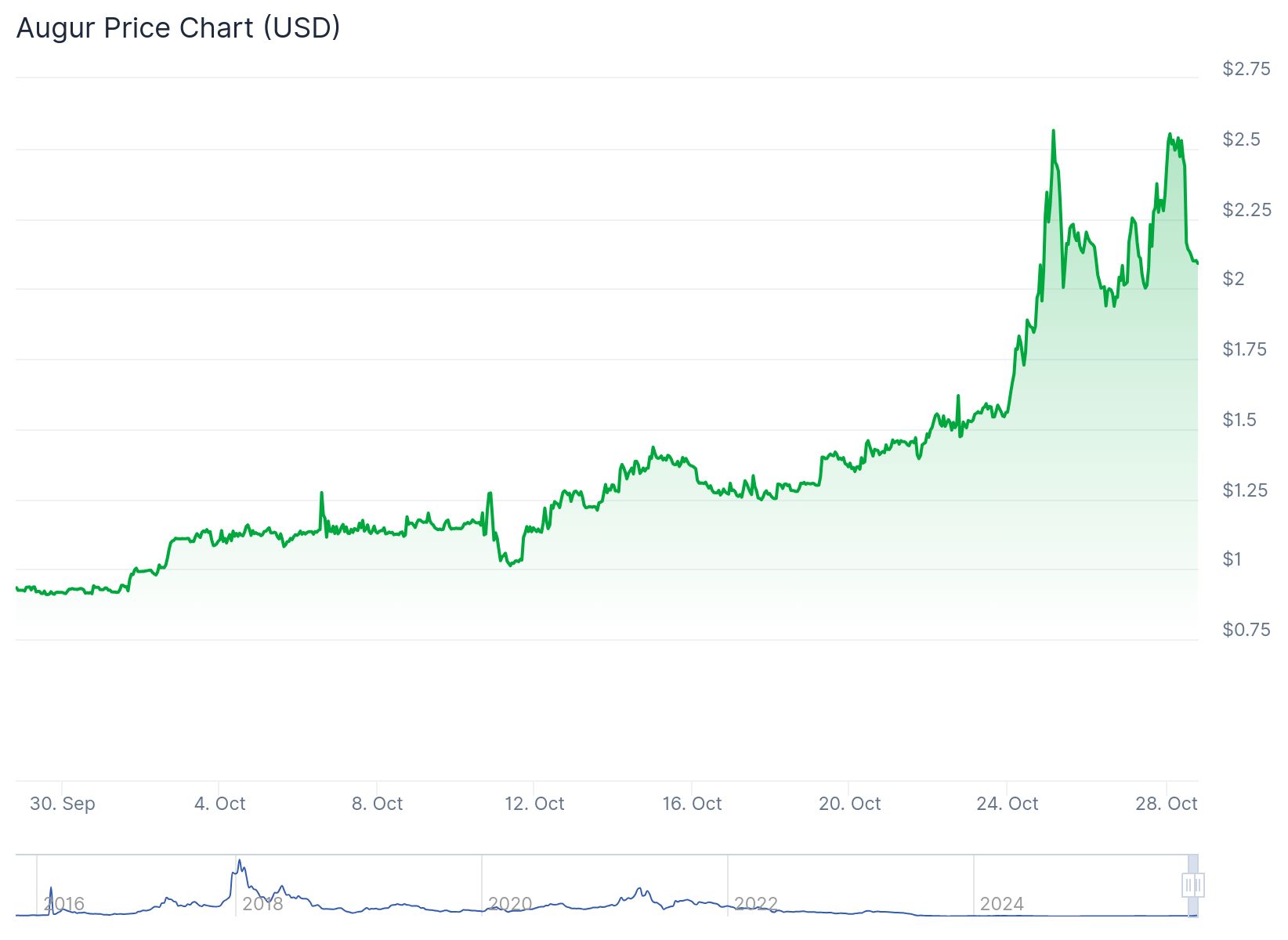
REP 1 month price chart. Source: CoinGecko
Once a fork is triggered, a 60-day transition period opens for holders to move their tokens to a version they believe reflects reality. If you fail to migrate within that period, your REP will remain in the “old universe” forever.
Migration timeline
Zoltu said in an interview with The Defiant that the fork process hasn’t started yet, so users “don’t need to take any action right now.”
“The old Augur UI doesn’t load properly anymore, so we’re currently starting to build a new minimal UI that will allow people to do what they need to participate in the fork,” Zoltu said, adding that this is “not a full-featured prediction market UI, but something that people can report and migrate to.”
Zoltu said the rollout “will tentatively begin next week, but it will take some time to ensure it is robust enough to handle people’s money.”
Once the code is written, audited, and deployed to mainnet, the team creates a market to begin the dispute process. This is expected to last between 12 and 20 weeks, followed by a two-month divergence period. “The important thing is that REP holders emerge during this two-month period,” Zoltu said.
REP is not intended for passive ownership
Zoltu said in a June post that the goal of the crowdfunding campaign was to “return the set of REP holders to the set of people who are actually paying attention.” They described this effort as a way to “filter out” inactive token holders and restore Augur’s fundamental principle that REP is an active token rather than a passive one.
The Lituus Foundation, which is overseeing the ongoing Augur development, said it supports the idea of testing the system’s financial security but will not participate in the fork itself.
“Augur is a permissionless system, and anyone can build on it, test it, and run experiments like this,” the foundation said in an Aug. 21 blog post.
Once the 2.5% REP dispute threshold is reached, Augur’s system automatically splits into two “universes”, each containing identical markets and contracts. This process does not create any new platforms or tokens.
Instead, existing REP holders will have to migrate their tokens to a version they believe to be true. In reality, the true universe is expected to remain active, but the other universe involved in the losing outcome will most likely not trade and its REP will become effectively worthless.
Commenting on the initiative, Auger said in a Friday
“New developments are underway”
When asked why now, Zoltu stressed that the timing was intentional. “Augur doesn’t require permissions, so anyone can do this at any time,” Zoltu told The Defiant, noting that “it’s generally not profitable to do so (by design), but no one has, which means we’ve never had a chance to see it in action in the real world.” The blockchain developer added:
“There are some new developments in the works, but there is no activity on Augur at the moment, so it seemed like a good idea to try it before those new developments come to fruition. The lack of an active market at the moment also means there is minimal disruption to actual users.”
Founded in 2014 by Joey Krug, Jack Peterson, and Jeremy Gardner, Augur is widely known as one of the first initial coin offerings (ICOs) on Ethereum, conducting a REP ICO in 2015 to fund its development. The platform went live in 2018 with a native REP token and an oracle system for reporting results.
As previously reported by The Defiant, it promised a permissionless market, but in practice it struggled to realize that vision as the initial UI and third-party node services were unreliable, blockchain synchronization issues caused delays, and high Ethereum gas fees further slowed activity.


