

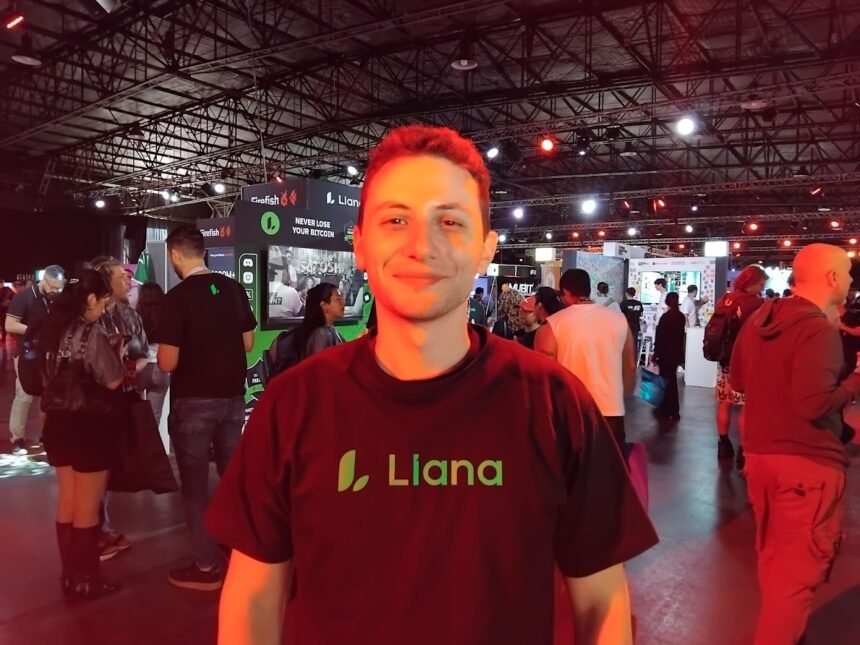
Hernan González is an anomaly within the Bitcoin (BTC) ecosystem and digital assets. The 27-year-old hails from his hometown of Rosario, Santa Fe (Argentina) and is just three subjects away from completing his degree in public accounting. But his passion extends beyond traditional accounting books to electronics, antennas, cords, and communications.
Active member of the NGO Bitcoin Argentina and former coordinator of Bitcoin Argentina speaker At LABITCONF, Gonzalez also defines himself as an amateur radio operator. This unusual combination of finance, engineering, and wireless communications came to life. Bitcoin Stratos, a research project that aims to take Bitcoin infrastructure to a literal new level.
In the framework of the recent LABITCONF conference in Buenos Aires, CriptoNoticias sat down with Hernan to understand how a mostly accountant ended up leading a team of electronic engineering students with a clear mission. Bitcoin proves it can live without the internet.
A bridge connecting two worlds
“I’ve always loved the numbers part and the technology part, and this project is basically a way to bring those two worlds together,” Gonzalez explained at the beginning of the interview, defining the hybrid spirit of his effort.
His approach to Bitcoin followed the same path as many: financial speculation. He came across Lipio in 2019 after attending a Rosario event that featured a large number of traditional investment products. “I decided to buy Bitcoin in March 2020, just as international markets were falling due to the coronavirus. Since then, I haven’t stopped learning,” he said.
But his curiosity soon shifted from prices to infrastructure. “Bitcoin is already nearly 17 years old, but we can see that this technology is still in its infancy. It seems like the world needs to spread Satoshi’s word more,” he reflected. That educational impulse led him to create Bitcoin Stratoslater added Marco Contini and Bautista Olivera as collaborators on the project, both electronic engineering students from Argentina.
Beyond TCP/IP: Bitcoin as a communication protocol
For most people, sending Bitcoin is a financial act that takes place on a mobile app. But in reality, each transaction is a data packet, a message that needs to go from one point to another. The near-exclusive reliance on the global Internet network (TCP/IP protocols) theoretically represents a point of failure. In scenarios of catastrophe or extreme censorship.
«Bitcoin Stratos is focused on education and research. “We are experimenting with sending messages using alternative and complementary transmission channels to the Internet using Bitcoin, the Lightning Network and Nostr,” the expert said.
Gonzalez delved into the technical nature of the network and recalled: Transaction validation doesn’t have to be tied only to fiber or mobile data.
Bitcoin is a communication protocol, but we always look at it from a financial perspective. Each transaction is a message that is distributed to different nodes around the world, verified, and then uploaded to a distributed ledger. This entire path can be carried out through various channels such as radio frequencies.
Hernán Gonzalez, Founder of Bitcoin Stratos
The basic purpose is emergency redundancy and security. “We would like to find alternatives to the Internet in the event of a disaster. Using other channels such as network meshallowing offline transactions to be signed and connected nodes to synchronize their information.
Bitcoin nodes in the stratosphere
The project name is not figurative. One of the central goals of González and his team is to We use Earth’s upper atmosphere as a laboratory to perform hardware tests under harsh conditions.
“One of the most iconic experiments of this project, which is where it gets its name, is sending Bitcoin nodes into the stratosphere,” the interviewee admitted. The logistics of accomplishing such a feat include: Adapting weather technology to load mining or validation hardware.
We want to send nodes via weather balloons and are conducting tests on the ground to achieve this. The stratosphere ranges from 10 to 50 kilometers in height. Latex balloons can usually reach a height of 20-35 kilometers. It’s two to three times the height of a commercial aircraft plane, and the images you can get from it are truly mesmerizing.
Hernán González, founder of Bitcoin Stratos.
When asked about the technical details, Gonzalez explained that it is a common scientific practice. « Approximately 2,000 weather balloons are launched every day around the world. The cargo is tied with a rope to a latex balloon inflated with helium. ” he instructed. “When these balloons rise with their weight on them, the low pressure overexpands them and they burst and fall. But the descent is done with a parachute, so the equipment can be returned to the ground and retrieved.”
Costs and the Ghost of Past Projects
Technical independence usually comes at a high cost. Hernán González revealed. Bitcoin Stratos is currently a “freelance” funded initiativeis made up of unique contributions and contributions from the community through platforms such as Geyser.
Although the cost of the basic materials needed for launch seems affordable (a rubber balloon costs about $100), the overall mission requires a larger budget. He estimated that the mission could cost about $2,000 to $3,000, taking into account the node’s helium, recovery equipment and electronics.
The project is being carefully pursued and aims to differentiate itself from previous efforts that fused mesh networks and Bitcoin with controversial results. González cited the example of Locha Mesh, a Venezuelan project that promised internet-free transactions through a device called Turpial.
«It was a project that integrated solutions for conducting transactions on mesh networks, but it was eventually discontinued. Apparently there was embezzlement of funds, which is what they were accused of, and the project disappeared. “Basically nothing happened,” he recalled ruefully.
Unlike that endeavor, Bitcoin Stratos is establishing itself and seeking grants from the academic and research community (grant) save time. “Launching balloons is a medium- to long-term idea. We think it will be possible within a year or two, but in the meantime we are testing the technology on land,” he predicted.
airspace regulations
Launching a Bitcoin node into near space is not as simple as climbing on a rooftop and releasing a balloon. Mr. Gonzalez, who is familiar with regulations, clarified: There are strict regulations.
In Argentina, “pico balloons” (small and long-lasting) usually do not require complicated permits, but heavy luggage is a different story. “You need a permit to launch a stratospheric cargo balloon using latex,” he warned.
This procedure involves local authorities and “authorization from the aviation authorities, EANA or ANAC, is required to issue air traffic notices and avoid problems with civil aviation.” Compliance with this legality A professional personality Gonzalez is trying to imprint on the initiative.
The debate over the use of Bitcoin: money or data?
The interview also addressed current tensions within the Bitcoin community regarding the use of block space. The rise of protocols that allow images and other data to be recorded over networks has sparked a debate about whether this constitutes “spam” or a natural evolution.
Gonzalez remains pragmatic. “As my particular desire, I point more to Satoshi’s vision, which is to use it as an economic value transfer through Bitcoin tokens,” he confessed.
Nevertheless, Recognize immutability and censorship resistance as inviolable properties of protocols:
“The fact that you want to limit something that is virtually unavoidable seems a little illogical to me. Anyone who wants to generate spam within the network can do so, and it’s always in effect. “I think we have to try to live with it.”
Hernán González, founder of Bitcoin Stratos.
Future Vision: Simplifying complexity
Looking ahead to the next five years, Bitcoin Stratos’ goals are not limited to the grandiose nature of launching into the stratosphere. The ultimate goal is ease of use. González recognizes that current radio frequency solutions are complex for the average user.
“We want to create a system that is very easy to use. “We aim to really understand all the complexities behind the technology,” he said.
Its five-year vision includes multiple releases, integration with the Nostr protocol and Lightning Network, but most of all: We have developed a friendly interface. “Often the big issue is user experience. “I’d like to see an off-the-shelf interface that makes deployment easier,” he concluded.
Bitcoin Stratos ProjectAlthough it is still in the early stages, It represents the spirit of “unauthorized” innovation that characterizes Bitcoin.. Gonzalez wrapped up the interview nicely with an analogy about human priorities. “While there are rovers orbiting Mars, there are people without food on their plates. What we believe to be obvious is often more important than we imagine. “Everything in the world still has work to do.”
For those who wish to closely follow or collaborate with this advanced experiment, the team has enabled a contact channel through social networks under the user @BitcoinStratos.
(Tag Translation) Argentina


