


Ethereum just completed its Fusaka upgrade, a hard fork designed to allow the network to be used at a larger scale and cheaper. While technical on paper, this change affects the core functionality of Ethereum: how data is stored, how transactions fit into blocks, and how rollups such as Arbitrum, Base, and Optimism interact with the main chain.
For everyone who holds ETH, this upgrade forms the basis for reduced fees, increased network efficiency, and increased long-term ecosystem resilience.
Larger network with more space
The biggest change has come in the way Ethereum processes data.
Every transaction, NFT mint, DeFi swap, or Layer 2 batch requires block space, and until now that space has been limited. Fusaka increases Ethereum’s capacity, allowing blocks to carry more information at once.
Did you miss an upgrade to your Fusaka network?
Thirteen Ethereum Improvement Proposals (EIPs) are currently live on mainnet.Fusaka after 35 seconds. pic.twitter.com/DlUh1ATA55
— Ethereum (@ethereum) December 4, 2025
While this will not make the chain instantly faster, it will relieve pressure during times of demand spikes, such as during market volatility or the launch of a popular token.
Simply put, Ethereum can absorb more activity without much effort.
Reduce rollup costs by expanding BLOB capacity
The majority of Ethereum traffic today comes from rollups. These networks batch thousands of user transactions and settle them as compressed data called “blobs” on Ethereum.
Before Fusaka, there were constraints on blob space. As demand soared, so did fees. Fusaka expands the room available for sending BLOBs and introduces a flexible system that allows you to increase or decrease capacity without a complete upgrade.
As rollups scale up to this new area, users should experience reduced transaction costs and smoother application activity.
The ultimate goal is simple. It’s about increasing transactions and reducing friction.
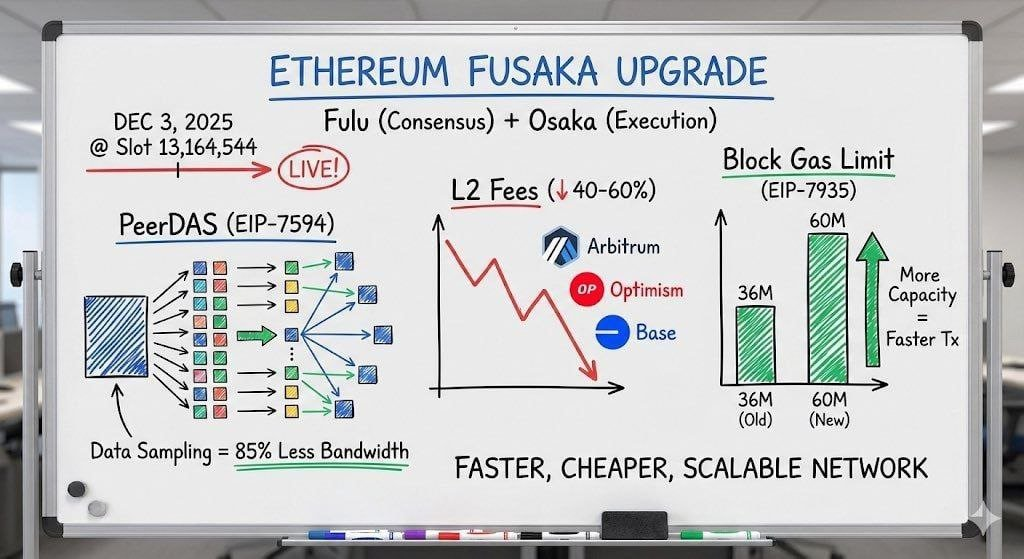
Ethereum Fusaka upgrade explanation. Source: X/Bull Theory
PeerDAS: An easy way to validate your data
Another big improvement is the way Ethereum nodes validate data. Previously, nodes had to download large portions of block data to ensure nothing was missing or hidden.
Fusaka introduces PeerDAS, a system that checks small, random pieces of data rather than the entire load.
This works similar to inspecting a warehouse by randomly opening a few boxes instead of checking every box.
Fusaka’s PeerDAS is important because it is literally sharding.
Ethereum is reaching consensus on blocks without requiring a single node to see more than a small portion of the data. And it is robust against 51% attacks. This is client-side probabilistic validation and is not… pic.twitter.com/OK81xBteER
— vitalik.eth (@VitalikButerin) December 3, 2025
This reduces bandwidth and storage requirements for validators and node operators, making it easier and cheaper for more people to run their infrastructure.
Expanding the validator base will increase decentralization and ultimately strengthen Ethereum’s security and resilience.
Larger block capacity improves throughput
In addition to expanding capacity, Fusaka also increases block gas limits. A higher limit means more work can fit within each block and more transactions and smart contract calls can be resolved without delay.
It doesn’t increase block speed, but it does increase throughput. There is more room for DeFi activity, NFT auctions, and high-frequency trading at peak times.
Improved wallet support and future UX improvements
Fusaka also includes improvements to Ethereum encryption and virtual machines. This upgrade adds support for P-256 signatures used in modern authentication systems, such as those behind passwordless logins on smartphones and biometric devices.
This paves the way for future wallets that function more like Apple Pay or Google Passkey, rather than seed phrase-based apps. Over time, this could make Ethereum easier to access for mainstream users.
Ethereum has about 10x the wallet UX.
Fusaka’s upgrade includes EIP-7951, which is support for the signature scheme that iPhones use to power features like Face ID.
That means you’ll soon be able to sign deals with your face.
A big win for getting ordinary people into the chain. pic.twitter.com/7Ad38m4Oxz
— Jarrod Watts (@jarrodwatts) November 27, 2025
What fusaka means to ETH holders
The impact on ETH holders will be gradual but meaningful. Layer 2 network charges should reduce as data capacity grows. The network should be less congested. Lower hardware requirements allow more validators to participate.
Most importantly, Ethereum has room to grow without sacrificing security or decentralization. As adoption increases, payment volume also increases. And the role of ETH as the asset that powers, secures, and settles everything will increase.
$ETH continues to consolidate near the $3,000 level.
There hasn’t been much price movement since it’s the weekend, but next week could be interesting.
QT ends on December 1st, Chairman Powell’s speech will take place on December 1st, and Fusaka upgrade will take place on December 3rd.
If Ethereum stayed on top… pic.twitter.com/pxgmrOHyah
— Ted (@TedPillows) November 30, 2025
Basic upgrades, not flashy upgrades
Fusaka won’t rewrite Ethereum’s economic structure or suddenly make ETH deflationary, but he will strengthen the foundations on which future demand will depend. Low roll-up fees encourage usage.
A more scalable base layer invites developers. A more accessible node environment encourages participation. These are structural upgrades that have little effect in one day, but will transform your network over time.
Ethereum has expanded highways, improved toll structures, and made it easier for new drivers to join. That is the true meaning of fusaka. It is a quiet change with long-term weight.
As Layer 2 networks expand and applications increase, the impact should shift from technical discussions to user experience, transaction costs, and ultimately the value of ETH itself.
The post What really changed with the Ethereum Fusaka upgrade appeared first on BeInCrypto.