


Demand for tokenized US equities is accelerating, making this asset class an important source of liquidity for global trading platforms.
According to a recent Bitget study, activity around tokenized stocks surged 450% during the most recent earnings season, suggesting a tectonic shift in market behavior.
Spot and futures markets registered month-on-month increases of 452% and 4,468%, respectively, indicating that both speculators and long-term investors are gravitating towards these instruments.
What’s driving the surge?
The strongest momentum was in the futures market, where traders focused on megacap technology stocks. Monthly futures trading volume for Meta, Microsoft, Apple, Tesla, and MicroStrategy grew at an unusual rate as traders leveraged tokenized contracts to speculate on earnings volatility and AI-related catalysts. Meta alone recorded a growth of 40,774%.
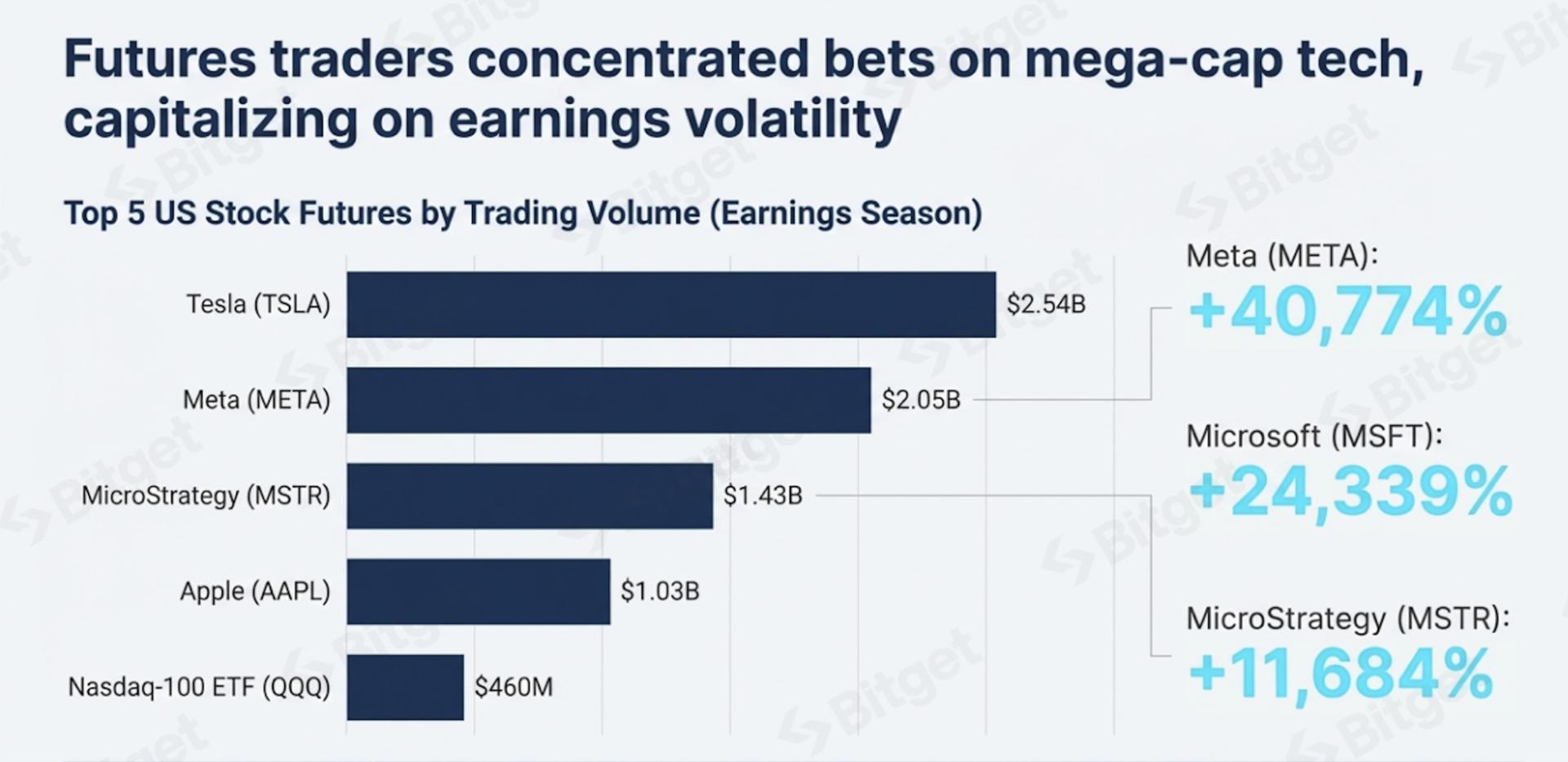
Stock trading volume at the end of the fiscal year. biget research
The spot market showed a different pattern and a more defensive posture. Investors combined exposure to major technology companies with large allocations to tokenized ETFs. The volume of QQQon and SPYon, key technology and tokenized versions of the S&P 500 ETFs, increased more than 30x.
Demand for the tokenized long-term government bond ETF TLton surged 69,573%, highlighting its role as both a hedge against earnings season uncertainty and a macro bet on the possibility of a US Federal Reserve rate cut.
(#Highlighted link#)
Why this matters to the platform
For trading platforms, this surge goes beyond the surge in one asset class. Tokenized stocks form a stable liquidity channel that attracts both high-frequency and long-term investors, supporting increased customer activity and new commercial opportunities.
The company’s 24/7 operations give it a competitive advantage over traditional stock markets, especially in Asia and Europe, where investor demand extends beyond U.S. trading hours.
Institutional market infrastructure is adapting. Nasdaq has indicated that tokenized equities are a strategic priority, and Switzerland is moving in the same direction. These developments indicate that traditional exchanges are preparing to support continued multi-jurisdictional trading of tokenized assets.
Barriers to scaling tokenized services continue to fall as regulatory pathways expand. The result is a market where tokenization moves from an experiment to a meaningful force shaping liquidity flows across trading ecosystems.


