


China’s yuan rose to a 14-month high against the dollar on Monday, adding further complexity to an already turbulent macro environment for risk assets including cryptocurrencies.
The world’s three largest central banks are currently moving in distinctly different directions. The Federal Reserve just decided to cut rates hawkishly, the Bank of Japan is poised to raise rates this week, and the People’s Bank of China is trying to weather the yuan’s strength amid a slowing domestic economy. For crypto markets caught in the crosscurrents of global liquidity flows, the stakes have rarely been this high.
Yuan soars as dollar weakens
The onshore yuan rose to 7.0498 yuan to the dollar as of 8:30 a.m. UTC, the highest level since October 2024. The yuan continued to rise throughout Monday’s Asian session, rising from 7.0508 yuan in early trading.
The move came despite weaker-than-expected guidance from the People’s Bank of China, which set the daily fixed price at $7.0656, lower than market expectations, in an apparent attempt to limit the yuan’s appreciation.
Analysts say the yuan’s strength is primarily due to a broader dollar weakness rather than domestic factors. Seasonal demand at the end of the year also had an impact, as Chinese exporters typically cash out a large portion of their foreign exchange receipts to meet various payment and administrative requirements.
The yuan is expected to remain at around 7.05 yuan until the end of the year, but the PBOC is unlikely to allow a sharp appreciation, meaning there is limited room for further appreciation. At the same time, exports remain a key driver of economic growth.
The possibility of a Bank of Japan rate hike looms amid heightened uncertainty due to the U.S. Federal Reserve’s hawkish interest rate cuts
The yuan’s move comes just days before the Bank of Japan’s policy meeting on Dec. 18 and 19, where officials are reportedly finalizing a 25 basis point rate hike, bringing the policy rate to 0.75%.
The possibility of interest rate hikes has reignited concerns about an unwinding of the yen carry trade. In early August, a similar move triggered a sharp selloff across global markets, with Bitcoin plummeting more than 15% in a single day as leveraged positions were liquidated.
Market participants are paying close attention to Bank of Japan Governor Kazuo Ueda’s comments after the meeting. A dovish tone on future rate hikes could help soften the impact on markets.
Last week, the Fed decided to cut interest rates for the third time in a row, lowering the federal funds rate to 3.50% to 3.75%. However, this decision was markedly hawkish, with the dot plot suggesting only one additional cut in 2026.
Fed Chairman Jerome Powell cited tariffs as a major factor in inflation concerns, but three members disagreed, the most since September 2019.
Impact on the virtual currency market
Differences in central bank policies present a complex picture for the crypto market. A weak dollar typically supports Bitcoin and other digital assets as an alternative store of value. However, potential liquidity contraction from the unwinding of yen carry trades could offset these gains.
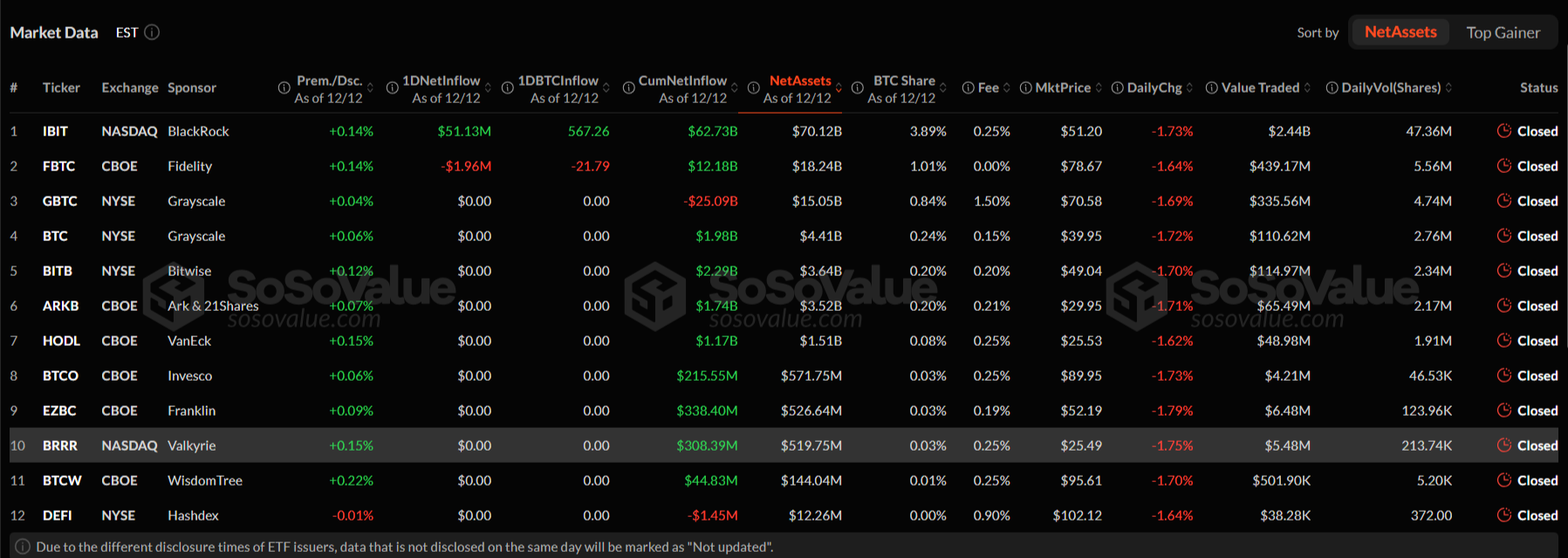
ETF inflows/outflows. Source: sosovalue
Recent ETF flow data suggests that buying momentum is limited. On Dec. 12, the Spot Bitcoin ETF recorded net inflows of just $49 million, with BlackRock’s IBIT accounting for nearly all of the $51 million purchases. The remaining 11 ETFs had zero or only slight outflows.
This marks a significant slowdown from November’s peak inflows of more than $500 million per day, raising questions about whether institutional demand can provide adequate support if the macro-driven sell-off intensifies.
With the Bank of Japan’s decision expected to be announced midweek, crypto traders should brace for increased volatility in the coming sessions as year-end liquidity conditions fade.
The article CryptoImpact appeared first on BeInCrypto: Fed-BOJ-PBOC split sends yuan to 14-month high.


