


The supply of Ethereum on exchanges has fallen to historic lows since 2016 due to increased pent-up demand from institutional investors and corporations. Changes in the supply ratio indicate changes in holder behavior toward long-term holdings, as opposed to short-term selling pressure from retailers.
According to on-chain data provided by CryptoQuant Analytics, the Exchange Supply Ratio (ESR), which measures the proportion of total ETH held by exchange platforms, has decreased to around 0.137 across all exchanges. This drop was the lowest level since 2016, when the Ethereum blockchain was in its early stages of development. Across Binance, the largest crypto exchange platform by trading volume and with the highest ETH supply, the ESR decreased to approximately 0.0325.
Shift in ETH supply indicates decreased intention for immediate liquidation
According to ESR numbers provided by CryptoQuant analyst Arab Chain continues to experience a net outflow of Ethereum tokens from exchanges to external or private wallets. Arab Chain’s analysis on CryptoQuant noted that these patterns often coincide with an accumulation phase after a period of volatility, as the market absorbs more liquidity with low selling pressure.
Ethereum exchange supply drops to lowest level since 2016
“This move reflects increased trader caution and reduced short-term selling pressure.” – via @ArabxChain pic.twitter.com/QdqLdtzYIo
— CryptoQuant.com (@cryptoquant_com) December 17, 2025
Across all exchanges, charts tracking the ESR indicator show a sustained decline from mid-2024 to late 2025, with a steady downward swing from around 0.165 to the current level of around 0.137. Meanwhile, ETH price has also fluctuated between $4,500 and its all-time high of $4,953.73 on August 24, 2025, to the current price of $2,830 based on CoinMarketCap. data.
Binance, the largest exchange by trading volume, has recorded a similar pattern starting from 0.038 in mid-2024 to the current range of 0.032-0.0325. Ethereum token prices tend to follow a similar pattern, with a positive correlation between ETH price and ESR.
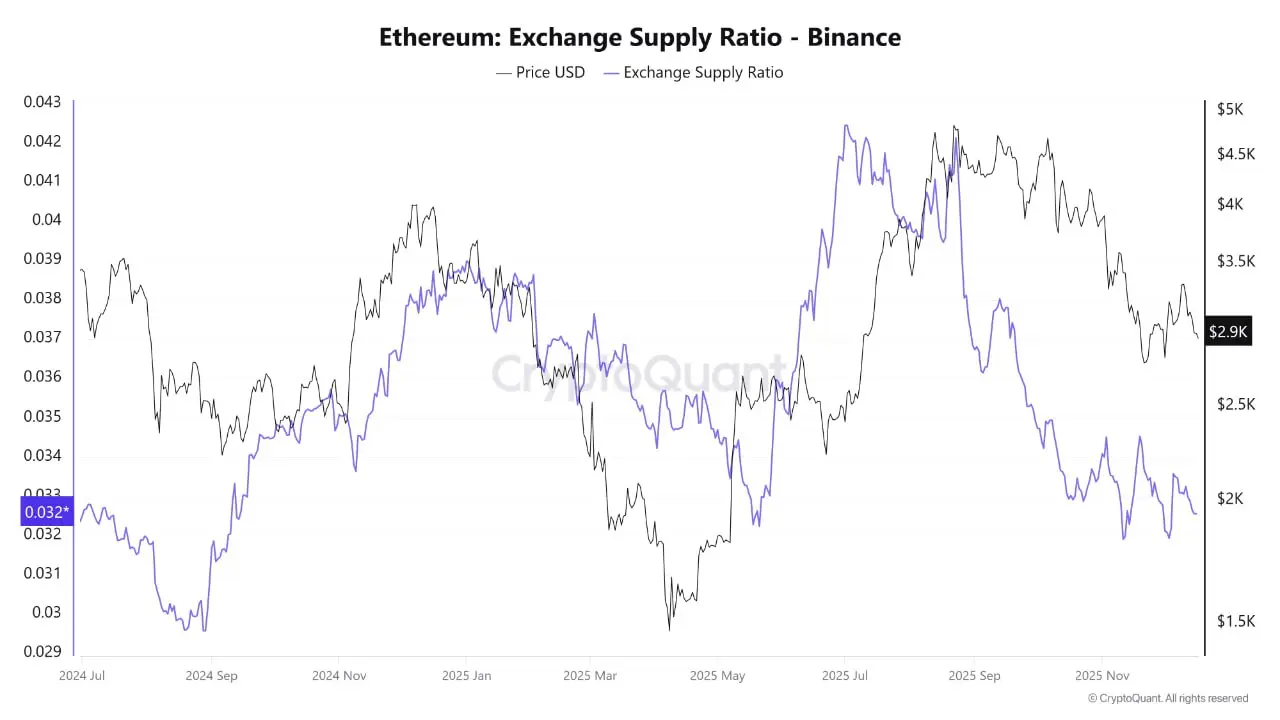
Source: CryptoQuant; Trend of ETH supply ratio on Binance exchange from mid-2024 to late 2025.
The Ethereum blockchain’s move to a proof-of-stake consensus mechanism has encouraged staking, allowing users to lock up their tokens and earn rewards. This consensus mechanism has currently collected approximately 36 million ETH bet You will need to transfer off the exchange to a dedicated wallet or protocol. The shift in consensus mechanisms contributed to the acceleration of supply decline across all exchanges.
Layer 2 ecosystems such as Base will increase the supply shift to DEXs.
Risks associated with exchange failures, such as the FTX exchange collapse in 2022, have prompted the adoption of self-custody to increase security and control. Additionally, layer 2 ecosystems such as Base, Arbitrum, and Optimism are also attracting liquidity, further reducing the supply held by exchanges. Ethereum’s Layer 2 ecosystem provides a scaling solution that facilitates cheaper and faster transactions, pulling the supply of ETH from centralized exchanges (CEXs) to decentralized exchanges (DEXs). DEXs such as PancakeSwap and Uniswap are all built on these protocols to facilitate direct P2P cryptocurrency trading.
According to on-chain data, approximately 67 publicly traded companies, government agencies, and institutions that hold ETH as part of their readiness strategies currently hold approximately 6.71 million ETH (worth approximately $19.02 billion). Additionally, an ETF focused on Ethereum possession Approximately 6.22 million ETH, valued at $17.63 billion. These values represent 5.55% and 5.14% of the total ETH supply, respectively.
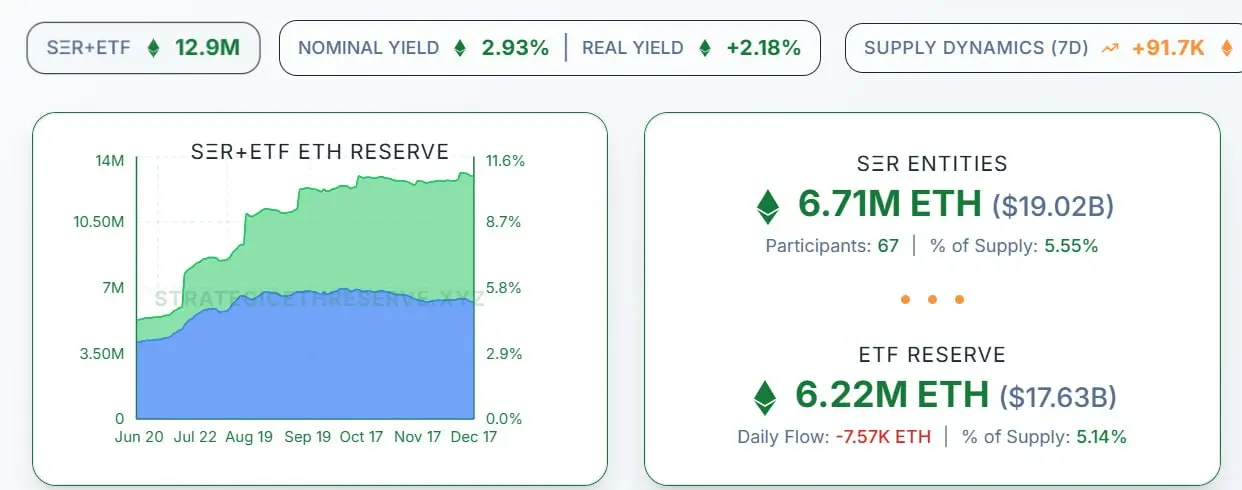
Source: Strategic Reserves. Supply of ETH across public treasuries and Ethereum ETFs.
Decreasing ETH supply across exchanges and increasing institutional demand have created an environment of low liquidity and high demand, leading to tight supply. According to Arab Chain analysis on CryptoQuant, increased selling pressure may have contributed to the decline in ETH price. However, ETH price could rise in the long run, especially if buying pressure from institutional investors continues.


