

Ripple, the blockchain payments and infrastructure company behind XRP, is once again the focus of IPO speculation.
Recent claims circulating among crypto watchers suggest the company may be engaged in late-stage discussions for a potential initial public offering in 2026.
These claims come despite clear statements from Ripple management that the company has no plans to go public anytime soon.
Ripple IPO rumors resurface
Copy link to section
Cryptocurrency researcher SMQKE recently shared findings that he points to as a documented sign that Ripple is considering going public.
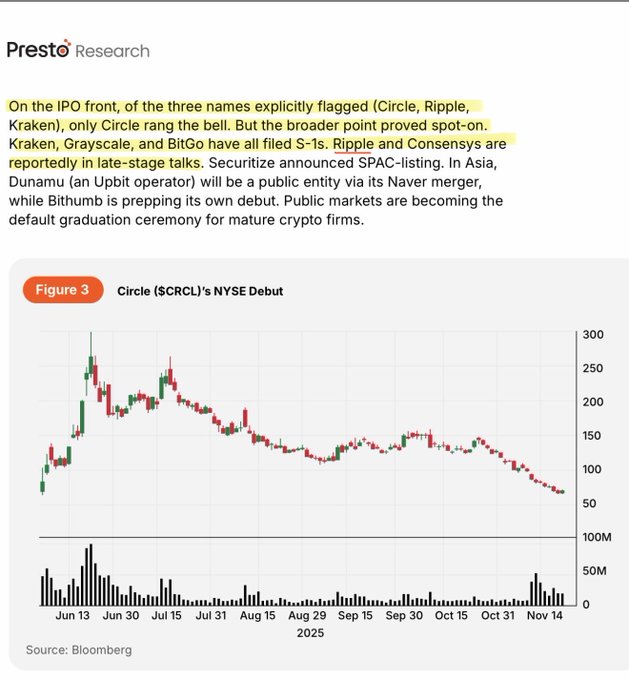
Images and excerpts from Presto Research are cited as evidence that Ripple is being grouped with other crypto companies preparing to enter the public market, including Kraken, ConsenSys, and BitGo.
‼ ️ Ripple is reported to be in final stage negotiations for IPO in 2026!! ️Documented. 📝👇
6:25 PM · December 21, 2025
The study identifies IPOs as a growing trend for mature crypto companies, making going public a natural progression for companies seeking broader validation and long-term growth.
Proponents of this narrative highlight the performance of companies like Circle, which recently went public on the New York Stock Exchange.
SMQKE references these developments to explain that crypto-related public offerings are no longer theoretical, suggesting that Ripple’s potential move could follow a similar path.
This claim has sparked interest within the crypto community, with some interpreting the potential IPO as a sign of regulators’ confidence rather than a market-driven decision.
Ripple CEO says there are “no plans” for an IPO
Copy link to section
Despite the speculation, Ripple President Monica Long has repeatedly stated that the company has “no plans or timelines” for an IPO.
Speaking at the Swell conference in New York in November, Long emphasized that Ripple is well-capitalized and does not need the public market to fund its growth.
CEO Brad Garlinghouse echoed this sentiment earlier, noting that the company does not need to raise capital through a public listing and that discussions about an IPO are likely to be a long-term consideration rather than an immediate strategy.
This cautious approach stands in contrast to other crypto companies that have entered the public market.
Companies such as Coinbase, Robinhood, and Circle have experienced mixed performance after going public, with market volatility and regulatory oversight impacting performance.
Ripple appears intent on avoiding these pitfalls, insulating itself from the pressure of quarterly earnings forecasts and the influence of equity investors unfamiliar with crypto token trends.
Ripple will grow strategically without going public
Copy link to section
Ripple’s decision to remain private is also consistent with its ongoing expansion efforts.
The company raised $500 million in recent months at a $40 billion valuation, not out of necessity but as a way to secure strategic partnerships.
Ripple has also made a series of acquisitions, including prime brokerage Hidden Road, stablecoin platform Rail, financial management software GTreasury, and crypto asset custody provider Palisade.
These moves are aimed at complementing its focus on payments and expanding into new market frontiers, although CEO Garlinghouse suggested acquisition activity could slow in 2026.
By remaining private, Ripple is able to control its significant XRP reserves and maintain governance flexibility.
A public market would place more scrutiny on token management, potentially creating tension between shareholders and the crypto community, a challenge Ripple is currently avoiding.
Additionally, regulatory uncertainty remains a concern. Although Ripple won a landmark lawsuit against the SEC in 2023, the broader law remains unresolved and a public offering will likely require increased disclosure.


