

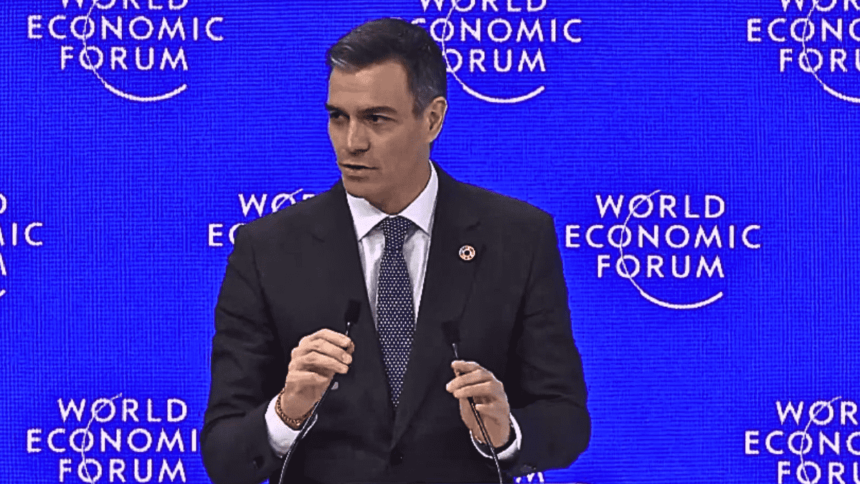
Spanish President Pedro Sánchez proposed abolishing anonymity on social networks at the World Economic Forum in Davos. Its approach aims to have a large platform link each account to a European digital identity wallet. The aim, Sanchez said, is to combat misinformation, hate speech and cyberbullying that are prevalent in these spaces.
The initiative, announced on January 21, 2026, aims to create a “pseudo-anonymity” that allows users to continue using a pseudonym. Your real identity will be linked in a traceable way. Sanchez said this would allow authorities to identify those responsible in the event of a crime without violating legitimate privacy. “In a democracy, citizens have a right to privacy, not anonymity or impunity,” Sanchez said.
The proposal is part of a three-part package of measures that Mr Sanchez will submit to the European Council in Brussels. The other two call for greater transparency of platforms’ algorithms and personal accountability for administrators in the event of non-compliance.
Sanchez argued: Social networks concentrate too much power in the hands of a fewthey polarize public debate and are a breeding ground for fake news and bots, accounting for about a third of profiles and almost half of internet traffic, according to their data. With more than 5 billion users worldwide, the influence of these platforms is undeniable, he said.
The European Union has already taken action on this issue with the Digital Services Act (DSA), which mandates content moderation and platform transparency. But Sanchez advocates stronger enforcement of the law.
Online privacy: a fundamental right
In this context, online privacy has emerged as a fundamental right, protected by regulations such as Articles 7 and 8 of the EU Charter of Fundamental Rights, which protect private life and the protection of personal data.
Although there is no absolute right to complete anonymity on the Internet, Recognizes the right to privacy and the use of pseudonyms in legitimate contextsleaving room for debate as to where to draw the line.
In the face of centralization and the prospect of forced linking of identities, alternatives that prioritize user privacy and control are emerging and growing. These decentralized platforms offer greater autonomy and a digital ecosystem that is more respectful of individual rights.
Among these alternatives is Mastodon, which operates on a federation of independent servers known as Fediverso. Its model moves away from ads and heavy data tracking, giving users granular control over content visibility and privacy.
As reported by CriptoNoticias In 2018, Mastodon was part of the destiny of At the time, the Bitcoiner Twitter community was affected by scam bots related to cryptocurrencies. Also, due to censorship measures against some users. Most recently, the decentralized social network was chosen by tweeters after tycoon Elon Musk took the helm of the social network Twitter (now X).
Additionally, there is Nostr, a distributed protocol that allows users to publish and receive messages without relying on a centralized server. Anonymity provides a normative space, guaranteeing privacy and freedom of expression against possible external interference.
These networks are an important complement to those who value privacy as an essential right in a complex digital ecosystem. Spain’s proposal, while motivated by legitimate concerns about security and disinformation, raises fundamental questions about how to address it. Balancing the need for accountability and protecting privacy and freedom in an age of global interconnectedness.
(Tag translation) Spain


