



Ethereum is struggling to sustain the $2,000 level as the overall crypto market enters a more vulnerable phase due to sustained selling pressure, declining momentum, and rising uncertainty. Despite several attempts to rebound in recent weeks, price movements remain subdued as liquidity conditions tighten and investor sentiment becomes increasingly cautious. The inability to cross this psychological threshold and secure sustained acceptance reinforces the perception that the market is still navigating a correction environment rather than moving into a clear recovery phase.
A recent CryptoQuant report provides additional context by highlighting a sharp increase in trading activity. According to the data, total Ethereum inflows into Binance in the past 30 days amounted to approximately $33.3 billion, the highest level since November last year. This surge comes as ETH is trading near $1,955 after a slow but sustained decline in recent weeks.
Historically, increased inflows to major exchanges tend to indicate an increasing supply of assets available for trading. Once a significant amount of Ethereum migrates to platforms like Binance, it could be used for spot sales, collateralizing derivatives, and rebalancing portfolios. This surge in inflows therefore indicates heightened market activity and the potential for increased short-term volatility.
Although the recent surge in Ethereum inflows to Binance may seem bearish at first glance, the report emphasizes that this development should not be automatically interpreted as a negative signal. Increased exchange inflows may reflect strategic repositioning rather than immediate sales intent. Investors may be preparing to trade aggressively, hedge their exposures, or adjust their portfolio allocations, especially during periods of heightened volatility when access to liquidity becomes more important.

Furthermore, periods of strong capital inflows may precede periods of price stabilization. If the additional supply coming into the exchange meets enough demand, the market could move into consolidation rather than a prolonged decline. This dynamic often depends not only on capital inflows but also on broader liquidity conditions, derivatives positioning, and macro sentiment.
That said, Ethereum is at a structurally sensitive stage, having recorded its highest inflow levels since November of last year. The market’s reaction to these developments is likely to provide clearer directional signals in the coming weeks. Downside risks could remain high if additional supply translates into sustained pressure on the seller side. Conversely, if demand effectively absorbs this liquidity, the current phase may represent a redistribution that precedes a more constructive move rather than sustained weakness.
Ethereum’s weekly chart reflects a structurally fragile environment as the price continues to trade below the psychological threshold of $2,000. After failing to maintain momentum above its mid-2025 high near $4,800, ETH established a series of lower highs and lower lows. This is a typical downtrend formation that shows persistent distribution rather than consolidation.
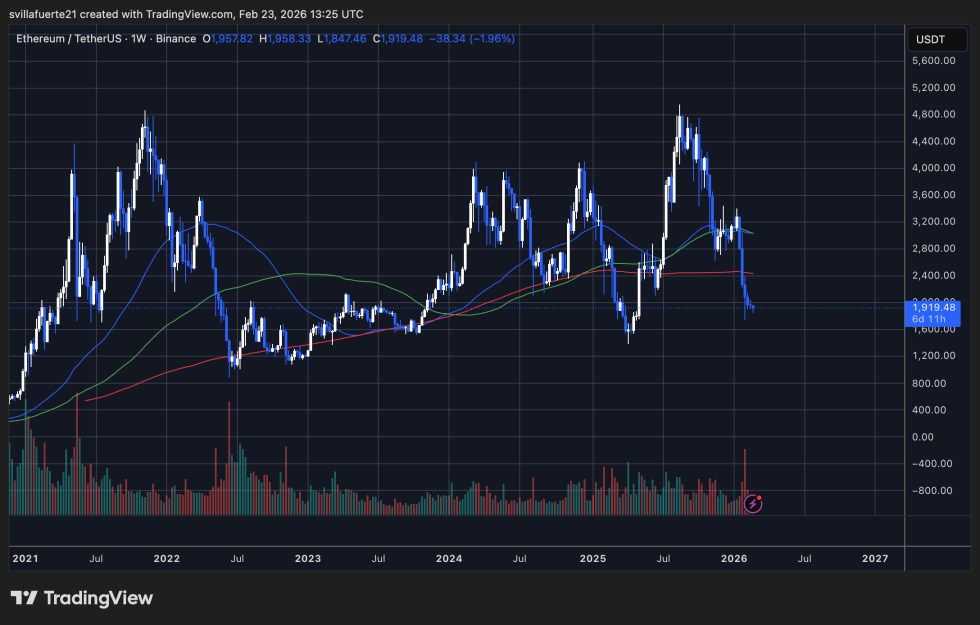
Technically, Ethereum is currently located below the major moving average that served as dynamic support during the up phase. These averages have reversed and are now acting as a resistance zone, limiting any recovery attempts unless there is a decisive recovery. The recent rejection near $3,000 has strengthened this bearish trend and accelerated downside momentum towards the current ~$1,900 area.
Volume trends show a decline in participation compared to the expansion period, suggesting less speculative enthusiasm. However, if selling pressure is removed, a decline in volume during a correction may precede a stabilization.
From a structural perspective, we believe that near-term support lies around the $1,800-$1,900 range where consolidation occurred earlier. A sustained break below this zone could expose deeper retracement levels towards the historical accumulation area. Conversely, a return to the high-volume area of $2,200-$2,400 would be necessary for short-term momentum to return to a neutral or constructive bias.
Featured image from ChatGPT, chart from TradingView.com
editing process for is focused on providing thoroughly researched, accurate, and unbiased content. We adhere to strict sourcing standards, and each page is carefully reviewed by our team of top technology experts and experienced editors. This process ensures the integrity, relevance, and value of your content to your readers.


