



Ethereum continues to be under selling pressure as broader sentiment in the crypto market turns cautious, with some segments in outright panic. In recent weeks, price action has struggled to regain stability, with repeated attempts at rebounding failing to generate sustained upward momentum. Rising volatility, tight liquidity conditions, and continued macro uncertainty have led to increased defensiveness among both retail and institutional participants, leaving Ethereum vulnerable to further short-term declines.
A recent CryptoQuant report provides additional context through on-chain activity. According to the data, ETH Binance user deposit address indicator recorded a sharp increase. The number of unique addresses depositing Ethereum on Binance jumped from approximately 360,000 to more than 450,000, marking the highest level since August 2025. As assets transferred to exchanges are typically more available for liquidation, use of collateral, portfolio rebalancing, etc., metrics that track deposit addresses often serve as a proxy for potential sell-side intent.
However, such a spike does not automatically lead to an immediate sell-off. In some cases, it reflects positioning adjustments, hedging activities, or preparations for derivative transactions. Still, the size of the recent increase signals growing market anxiety and warrants close monitoring as Ethereum navigates an increasingly fragile market environment.
Foreign exchange deposits soar as price adjustments become more serious
The report highlights that the breakout of this indicator occurred with a severe price correction. Ethereum has plummeted from a peak around $4,900 in October to around $1,900. The drop in prices and the proliferation of exchange deposit addresses simultaneously suggest two major on-chain interpretations that merit careful consideration.

The first scenario shows retail capitulation. Rapid growth in unique deposit addresses often reflects panic behavior on the part of small investors. Participants who held out through the initial stages of the decline may now be moving assets to exchanges to unwind their positions, reinforcing short-term sell-side pressure.
The second interpretation concerns the positioning of the derivatives market. Some deposits may represent collateral replenishment as ETH trades below the $2,000 threshold. Traders facing liquidation risk may be adding margin to maintain leveraged long positions rather than selling their holdings outright.
In the short term, increased deposits increase the potential supply on exchanges, which could increase volatility if a selloff materializes. However, historically, extreme spikes in deposit activity have often occurred during late-stage corrections. This situation can occur before seller exhaustion.
Monitoring currency outflows, spot volume absorption, and derivative positioning is important to determine whether this activity signals continued downside risk or the early formation of a domestic market bottom.
Ethereum tests structural support as downtrend continues
Ethereum continues to trade under sustained pressure, with the weekly chart showing a clear loss of bullish momentum following a rejection near $4,800 to $5,000. Prices are now moving back toward the $1,900 area, which previously served as consolidation support early in the cycle. The inability to sustain above the mid-cycle moving average suggests that sellers still maintain structural control.
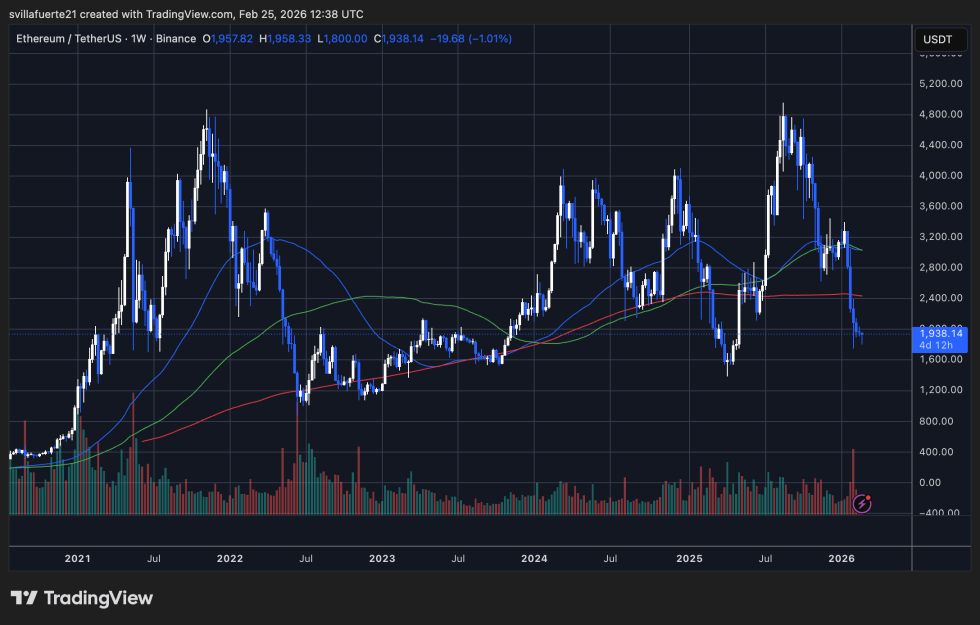
The 50-week moving average has reversed and is now acting as overhead resistance, while the 100-week average appears to be flattening. Meanwhile, prices are approaching the long-term 200-week moving average, a level that has historically been associated with major cyclical support. A definitive breakdown below this region could expose a deeper downside, but stabilization here could encourage medium-term accumulation.
The volume pattern shows intermittent spikes during declines, which typically reflects distribution rather than sustained buying interest. This reinforces the interpretation that the market is in a defensive phase, rather than a confirmed recovery trend.
Despite the weakness, compression of volatility around the long-term average can precede the transition period. However, confirmation requires a sustained close above recoverable resistance levels and an improvement in the participation indicators. Until then, Ethereum remains in a weak technical position, with risks skewed toward continued price action and a downtrend rather than near-term bullish continuation.
Featured image from ChatGPT, chart from TradingView.com
editing process for is focused on providing thoroughly researched, accurate, and unbiased content. We adhere to strict sourcing standards, and each page is carefully reviewed by our team of top technology experts and experienced editors. This process ensures the integrity, relevance, and value of your content to your readers.


