


Stablecore, a digital asset infrastructure company, has joined the Jack Henry Fintech Integration Network to enable banks and credit unions on the platform to offer stablecoin and tokenized asset services through their existing systems.
Jack Henry provides core processing and digital banking technology to approximately 1,670 banks and credit unions in the United States. Many of these institutions also rely on the Banno Digital Platform, which powers online and mobile banking services for more than 1,000 financial institutions.
Stablecore said on Monday that the integration will connect its blockchain-based products to traditional core banking infrastructure.
Participating institutions may deploy stablecoin accounts with 24/7 payment capabilities, on-ramps and off-ramps for cryptocurrencies for assets such as Bitcoin ($BTC), digital asset-backed lending, tokenized deposits, and staking capabilities where permitted.
Incorporating these services within existing banking apps reduces dependence on standalone wallets and external crypto platforms. It also reflects a broader shift towards incorporating blockchain-based assets into regulated financial channels, as demand for compliant, on-chain cash management tools increases.
Related: Wall Street’s virtual currency debate ends with banks’ all-out war $BTCstablecoins, tokenized cash
Stablecoin infrastructure competition accelerates
As reported by Cointelegraph, Stablecore raised $20 million last year to help small banks and credit unions integrate digital asset services, particularly stablecoins, following the passage of the landmark US GENIUS Act, which established a federal framework for payments stablecoins.
Stablecore is part of a growing group of companies building stablecoin infrastructure to expand access to the digital dollar. Proponents argue that stablecoins can speed up settlement times, reduce cross-border payment costs and provide uninterrupted money transfer capabilities compared to traditional banking rails.
Momentum is building across both fintech and traditional finance.
Last week, payments provider Modern Treasury announced an integrated payments service that supports stablecoin transactions alongside wire and ACH transfers through a partnership with the Paxos network, signaling increased interoperability between blockchain-based dollars and traditional payment systems.
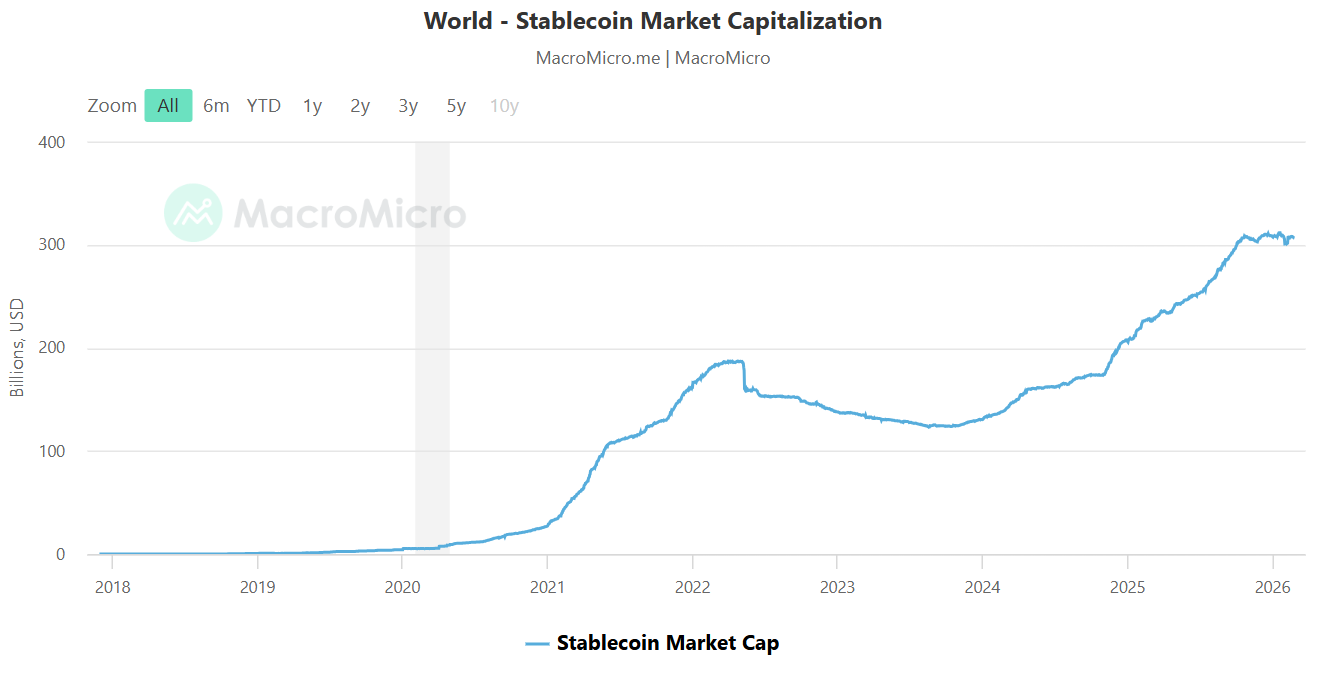
After experiencing explosive growth, stablecoin issuance has plateaued in recent months and remains at just over $300 billion. sauce: macro micro
Meanwhile, asset management giant Fidelity Investments has introduced Fidelity Digital Dollar, a stablecoin scheduled to be launched this month, designed to facilitate faster and more efficient international payments.
Major banks are also considering issuing their own bonds. Citigroup executives have publicly discussed the possibility of launching a native stablecoin as the financial institution seeks to modernize cross-border payments and liquidity management.
Related: USDCx arrives on Aleo as privacy-focused blockchains seek access to stablecoins


