

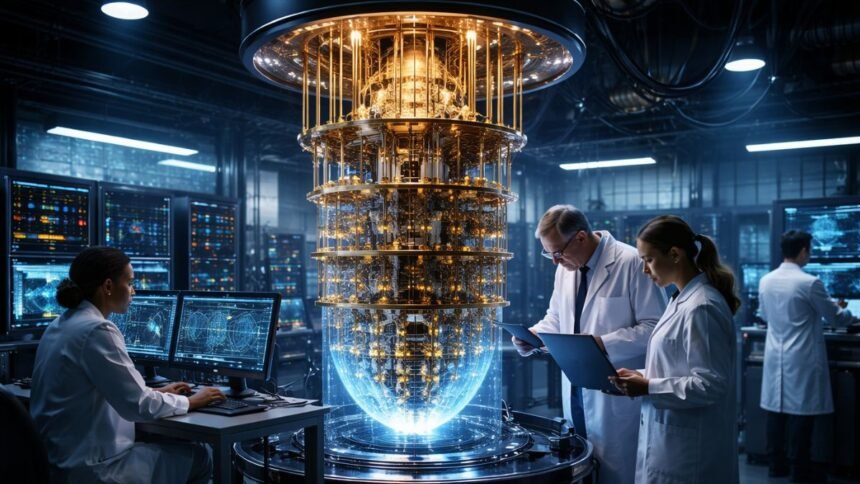
Chi Chen, senior director of quantum applications at IonQ, and Matthias Troyer, corporate vice president at Microsoft Quantum, published a joint paper on March 2 proposing a hybrid architecture that combines quantum computing and artificial intelligence (AI). The purpose is Accelerate the discovery of new materials and chemical reactions.
The document says there will be benefits in areas such as medicine, energy and the environment, including more effective medicines and cleaner, more durable batteries. Toward a catalyst that captures carbon in the atmosphereimproved agricultural fertilizers and biodegradable or recyclable plastics.
Currently, the discovery of these materials and chemical reactions relies on chemical simulations. Classical computers solve with inaccurate approximations or have prohibitive computational costs.
“By combining quantum precision and AI-driven speed, we can design new materials with unprecedented properties at a fraction of the cost,” said the document signed by both executives.
Quantum computing often comes up in public discussions as having the potential to break the encryption systems that currently protect digital security systems, such as online banking, digital communications, and government data.
For example, in a network like Bitcoin, a sufficiently powerful quantum computer can solve mathematical problems that would take thousands of years today with traditional hardware. Compromise private keys and transactions.
IonQ and Microsoft’s proposal shows that the same computing power can also be used to solve high-impact scientific problems in medicine, energy, and the environment.
However, the document does not detail the different technical roles between IonQ and Microsoft, nor does it specify what hardware each company will provide or at what stage each company will participate.
The role of artificial intelligence in IonQ and Microsoft’s design
Quantum computers can simulate the behavior of electrons (particles that determine how matter reacts and behaves) with precision unattainable by classical computers, but each quantum computation Expensive, slow and requires specialized hardware It is currently not available on a large scale.
IonQ and Microsoft aim to use quantum computing, which is at the heart of the proposal, to generate high-precision data rather than directly solving each problem. these are, Train an AI model Once trained, it runs on a classical computer and predicts material properties quickly, without repeating quantum calculations for each query.
In reality, researchers can evaluate millions of candidate molecules in a matter of days with a level of precision that only today’s quantum computing can provide.
According to the report, the only empirical precedent that partially supports this direction is Microsoft’s previous collaboration with Pacific Northwest National Laboratory (PNNL). That is, using an AI trained on classical (non-quantum) data, Evaluated 32 million potential battery materials in less than a weeka process that takes 20 years using traditional methods.
IonQ and Microsoft advance quantum computing development
This proposal comes as IonQ continues its own roadmap. As CriptoNoticias reported in June 2025, the company promised to build a quantum computer by 2030. 2 million physical qubits and 80,000 logical qubits.
Physical qubits are the building blocks of quantum hardware, but they are sensitive to environmental influences and often make mistakes. Logicians are groups of physical qubits that compensate for each other, producing a more reliable computing unit. Today, it takes hundreds to thousands of physicists to build a high-quality computing unit. The logical 80,000 number promised by IonQ represents an unprecedented leap forward.
IonQ’s roadmap received another boost on January 26, when the company announced the acquisition of SkyWater Technology, a foundry that specializes solely in manufacturing chips for third parties.
The integration will allow IonQ to control the design, packaging and manufacturing of its own quantum hardware in the United States, which the company says could accelerate the start of quantum hardware testing. 200,000 physical qubit quantum processing units (QPUs) by 2028enabling more than 8,000 high-fidelity logical qubits.
The acquisition could bring forward development of the 2 million qubit chip promised in 2030 by up to a year, but IonQ has not disclosed a specific operational start date.
Finally, in September 2025, Microsoft announced: Construction of quantum research center Located in the University of Maryland’s Discovery District, it was conceived as a platform for the development of next-generation quantum technologies.
(Tag translation) Bitcoin (BTC)


