


Due to rising geopolitical tensions, the crypto market faces volatility in 2026, further increasing risk-off sentiment. However, one sector is showing strong growth..
The stablecoin market soared to an all-time high in March 2026. This trend highlights how stablecoins are being used for more than just crypto trading.
Stablecoins reach record market cap as new use cases emerge
According to DefiLlama, the stablecoin market capitalization exceeded $313 billion on March 8, hitting an all-time high. At the time of writing, it was $312.99 billion. This milestone reflects the increase in issuance and liquidity of the stablecoin.
Follow me on X Get the latest news on the spot
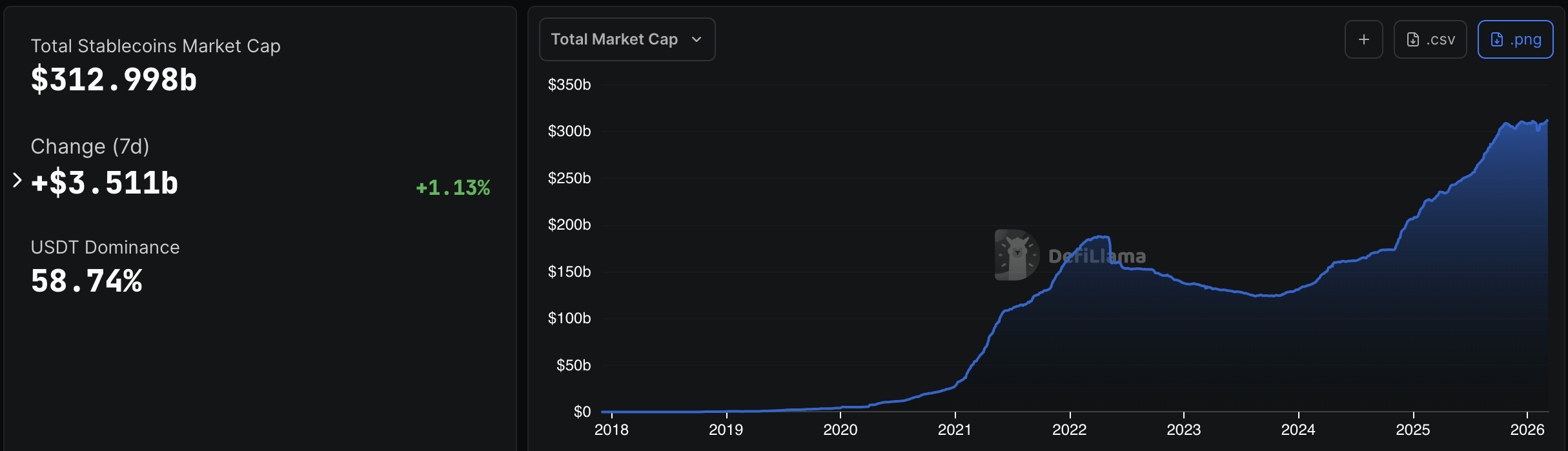
Stablecoin market capitalization. Source: Defilama
Furthermore, the market capitalization has increased by approximately 1.8% by 2026. Analysts often describe stablecoins as the “dry powder” of the cryptocurrency market. Investors widely use them as a base currency for trading.
When supply increases, analysts typically read the signal as new liquidity flowing into the ecosystem and funds available to investors to invest in crypto assets right away.
However, this “dry powder” story doesn’t always hold true. According to analyst Dirkforst, the net flow of stablecoins to crypto exchanges has remained negative since the beginning of 2026.
Among the major platforms, Binance has monthly net outflows of around $2 billion, followed by Bitfinex with around $336 million. However, the pace of these capital outflows appears to be slowing. As of February 15th, it was approximately $6.7 billion, or approximately $443 million.
Still, the magnitude of the outflows clearly shows that liquidity is being diverted elsewhere. The increase in stablecoin supply does not necessarily reflect demand only from crypto traders. Instead, it also points to increased adoption across the broader financial ecosystem.
An International Monetary Fund report highlights the growing role of stablecoins in cross-border remittances. A BVNK survey of 4,658 adults across 15 countries found that these assets are creating opportunities where traditional payments infrastructure may present barriers.
The findings suggest that for individuals who are paid in stablecoins, these assets account for approximately one-third of their annual income. The usefulness of these assets in business-to-business (B2B) payments is also increasing.
“Stablecoins were originally used for cryptocurrency trading, but we have seen their use cases expand, including escaping high-inflation currencies, trading tokenized stocks, and even investing in GPUs that will power the AI revolution,” the report says.
In particular, Circle Internet Group and Stripe are developing a future-oriented payment system where autonomous AI agents can perform transactions using stablecoins. This initiative highlights new use cases for stablecoins.
“Over the past 30 days, x402 has traded only $24 million in trading volume. There are 40,000 (half-decent) agents on-chain. Their total payment activity is $50 million. Yes, it won’t be replaced anytime soon, but all these big payment giants wouldn’t be able to enjoy this if they didn’t think the opportunity was significant!” the analyst pointed out.
These developments highlight that the use of stablecoins extends far beyond crypto trading. According to Dirkforst, if the liquidity that is currently being drained or redirected returns to the digital asset market, a positive trend could emerge in the market.
The article Stablecoin market cap reaches all-time highs: Why liquidity isn’t flowing into cryptocurrencies appeared first on BeInCrypto.


