

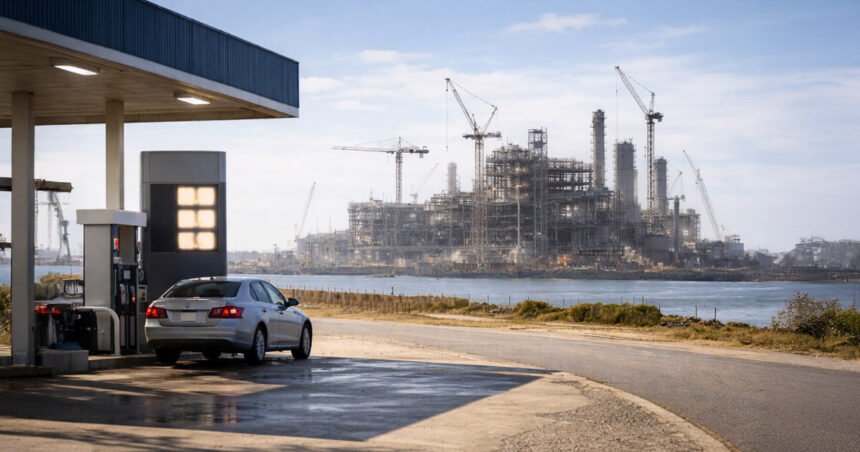
As gasoline prices become a political issue and energy returns to inflation, President Donald Trump announced the construction of the first large-scale refinery in the United States in nearly 50 years.
The Brownsville project is being pitched as industrial revival and consumer relief. Still, the sharper question is whether refineries that won’t produce fuel for years can cope with inflationary pressures now.
If energy-driven price pressures persist, the Fed could become more cautious and liquidity conditions for risk assets such as Bitcoin could tighten. At the same time, some investors still see persistent inflation and geopolitical commodity shocks as part of the long-term case for scarce non-sovereign assets.

Encounters historic first same-week price shock
President Trump said the 168,000-barrel-per-day refinery, backed by India’s Reliance Industries, will be built at the Port of Brownsville, Texas, with a binding 20-year offtake term sheet, and construction is planned to begin in the second quarter of 2026.
The company said the project would improve the U.S.-India trade balance by $300 billion, including $125 billion in shale oil purchases, $175 billion in refined product value, and $300 billion in improved bilateral deficits.
Reuters reported that the company disclosed a nine-figure investment at a ten-digit valuation, but typical refinery construction calculations mean a plant of this size would cost about $6.7 billion.
The announcement comes as the average retail price of gasoline in the U.S. reached $3.58 per gallon on March 11, an increase of nearly 60 cents since February 28.

The U.S. refining system faces a true compositional mismatch.
Although many U.S. refineries are optimized for heavy, sour crude oil, much of U.S. production is made up of lighter, sweeter shale oil, according to the Energy Information Administration.
This may help explain why U.S. crude oil exports reached a new record of more than 4.1 million barrels per day in 2024, even though the U.S. remained a net oil importer.
U.S. refining capacity was 18.4 million barrels per calendar day as of January 1, 2025, roughly unchanged from the same period last year. The most recent refinery with significant downstream production capacity is Marathon’s Garyville plant, which came online in 1977.
Brownsville will be a true greenfield expansion in a system that has grown primarily through debottlenecking and upgrades.
Reuters reported in June 2024 that entrepreneur John Carruth was already working on building a large-scale refinery in South Texas under the Element Fuels banner. Current America First Refining documents still reference Element Fuels research, suggesting that President Trump has elevated the existing Brownsville initiative into a symbol of national energy.

Why energy inflation still matters for Bitcoin
Oil shocks are rarely confined to the fuel market. Rising oil prices directly affect headline inflation through gasoline, transportation and production costs, complicating central bank policy and delaying interest rate cuts.
This has implications for the cryptocurrency, as the liquidity situation remains one of the biggest macro factors in Bitcoin’s price cycle. As inflation accelerates and the Federal Reserve becomes cautious about easing, risk assets often lose some of the financial tailwinds that supported their rally from 2023 to 2025.
Recent geopolitical tensions have already made oil prices highly volatile, raising concerns that energy inflation could force policymakers to keep interest rates higher for longer than markets expected.
In the short term, this dynamic tends to weigh on speculative assets. Traders often treat Bitcoin more like a high-beta macro trade than a pure inflation hedge, meaning higher oil prices and higher CPIs can trigger risk-off positions across crypto markets.
However, looking longer term, some investors still frame persistent commodity shocks and currency instability as part of the structural argument for scarce digital assets. The result is a contradiction. While energy inflation weakens Bitcoin in the short term, it could strengthen Bitcoin’s story in the long term.
Consumer Relief Frame Encounters Timing Problem
Political promises will be realized soon, but the impact on physical supplies will be years away.
Construction is scheduled to begin in the second quarter of 2026, with all fuel production in late 2026, but gasoline pain is currently occurring.
Reuters quoted analyst Tom Kloza as saying that if Brownsville were a construction site, it would be an export refinery because local demand is limited and there are no pipeline connections to transport the product inland.
This changes the narrative from “Trump found a way to lower domestic pump prices” to “Trump is touting export-oriented refining projects as the answer to affordability.”
EIA’s March 10 outlook predicts that Brent will rise from $71 on February 27 to $94 on March 9, and remain above $95 for the next two months.
Republicans are already worried that rising fuel prices could hurt the midterm elections. The refinery gives President Trump a symbol of fresh energy at a time when voters are most concerned about the price at the pump. Even so, schedule discrepancies still remain. Politics now, molecules later.
The Office of the United States Trade Representative announced that the United States’ trade deficit with India in goods will reach $58.2 billion in 2025.
The project’s claimed $300 billion in improvements is more than five times last year’s bilateral deficit and helps explain why the figure functions more as a political package than disclosed refinery costs.
| metric | What is claimed/disclosed? | why is it important |
|---|---|---|
| planned capacity | 168,000 barrels/day | Make sure this is an actual major project proposal and not a token facility |
| breakthrough target | Q2 2026 | Indicates long lead time from announcement to actual supply impact |
| offtake | 20 year term sheet | Increase credibility and propose long-term commercial plans |
| Trade balance bill | $300 billion | Better understood as a framework of political/economic influences than the mentioned refinery capital investments |
| Billing breakdown | $125 billion in shale purchases + $175 billion in refined product value | Explain how the heading numbers were assembled |
| Disclosed investment language | 9-digit investment amount / 10-digit valuation amount | Much smaller than literally reading “$300 billion refinery” |
| Comparable structural calculations | Approximately $6.7 billion is expected for a plant of this size. | Show why analysts doubted economics |
| US-India goods trade deficit (2025) | $58.2 billion | The claimed $300 billion impact represents more than five times last year’s bilateral deficit |
India’s Reliance’s endorsement of a 20-year offtake commitment suggests the refinery is designed to serve both domestic shale monetization and long-term export flows.
On March 11, Brent crude oil prices settled at $91.98 and WTI crude oil prices settled at $87.25, but stocks fell sharply and strategists said higher energy prices could squeeze profit margins and force investors to reconsider their 2026 profit assumptions. HSBC raised its 2026 forecast for Brent to $80 from $65.
Iran has warned the world should be prepared for $200 oil as markets react to the risk that 20% of global fuel supplies could be cut off through the Strait of Hormuz.
This turns the Brownsville announcement into something bigger than a single construction project. President Trump is simultaneously turning refinery capacity into a political solution to three problems: gasoline inflation, energy security, and the trade deficit with India.
Absorption scale and political challenges
U.S. refinery capacity utilization had already risen to 91% in mid-February, and gasoline demand rose to 8.75 million barrels per day.
This suggests that the U.S. refining system is further ramped up to meet strong demand, weakening the argument that newly announced refineries will change the landscape for consumers in 2026.
The IEA’s February 2026 Oil Market Report predicts that global oil supplies will increase by 2.4 million barrels per day in 2026 to 108.6 million barrels per day. So Brownsville’s strongest defense is not, “The world desperately needs more refining,” but rather, “The United States needs better structured refining for its crude oil slate.”
Supporters tout Brownsville as an industrial revival. The United States is finally building refineries geared toward domestic shale production rather than exporting light crude oil.
Skeptics, on the other hand, characterize it as campaign-stage theater, an export-biased project with uncertain economic conditions presented as a consumer price solution that cannot be realized immediately.
While analysts questioned the economic situation and said the Trump administration’s early announcements may contain “a lot of hyperbole,” the company unveiled binding order commitments and a groundbreaking concrete timeline.
The basic case is akin to a political symbol meeting a backward industrial payoff.
| scenario | Oil/Market Background | What Brownsville means politically | What the price of the pump means |
|---|---|---|---|
| basic case | After this shock, crude oil will cool down as predicted by EIA. | Trump captures symbol of energy dominance and talk of industrial revival | Most relief comes from crude normalization, not from Brownsville itself. |
| bear case | Hormuz chaos continues, gasoline remains in the sky $3.50 | The project is more like optics than relief. | There is little short-term consumer benefit. Refinery schedule becomes a liability |
| bull case | Conflict de-escalates quickly, oil falls faster than feared | Mr. Trump can claim both momentum for symbolic industries and lower prices. | Price drop still mainly due to oil risk mitigation, not new molecule in Texas |
Brownsville moves forward with early-stage work, the oil cools as predicted by the EIA, and the story goes like this: President Trump used long-cycle refinery construction to demonstrate energy superiority, but the real relief at the pumps is due to normalization of crude oil, not the new Texas molecule.
The bearish case sees prolonged disputes and sustained price pressures.
If the damage to the Strait of Hormuz continues and gas prices remain above $3.50, Brownsville will see more optics than relief.
Converting industrial policy to inflationary politics
President Trump’s announcement in Brownsville is more important as a macropolitical test than a construction story.
The project seeks to sell the historic “first major refinery in nearly 50 years” as evidence that fossil fuel expansion can ease energy insecurity and inflationary pressures, even though real supply effects will take years to materialize.
President Trump is converting refinery capacity into a solution to inflation, trade, and energy security all at once, and a long-term industrial project into a response to gas sticker shock and geopolitical oil risks in the same week.
Brownsville may be a genuine industrial project with a real strategic logic for shale processing and export flows, but the pro-consumer promise is political because the timeline is measured in years.
Trump is now getting an energy symbol. Voters could get tangible fuel cost relief depending on variables that the Brownsville announcement cannot control, including how quickly the Iran conflict is resolved, how price risks in the oil market fluctuate through 2026, and whether refineries designed in part for export can serve as the domestic affordability answer that President Trump is touting.
In markets beyond energy, inflationary dynamics constantly feed back into cryptocurrencies.
If oil price pressures persist and the Federal Reserve remains cautious about cutting interest rates, the liquidity conditions that have supported Bitcoin’s recent rally could tighten again.
In that sense, the Brownsville Refinery announcement sits at the intersection of politics, energy markets, and macro liquidity. Although it may take years for the project to produce fuel, an inflationary narrative surrounding oil prices could impact risk assets like Bitcoin almost immediately.
(Tag translation) Bitcoin


