

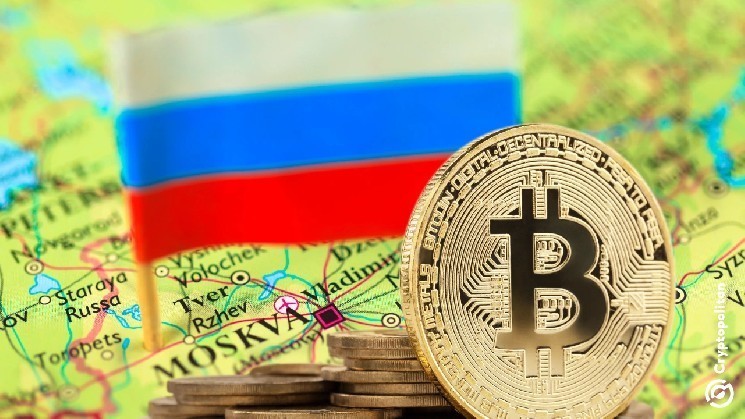
The Russian government is set to receive millions of rubles in tax revenue from cryptocurrency miners, but not as much as originally expected.
While the expanding sector’s profits have been hurt by rising electricity prices, local regulations and the decline in the US dollar and Bitcoin, crypto farms have largely continued to mint money in obscurity.
Mining companies pay a tenth of what they expected to pay to Moscow
Companies and sole traders involved in cryptocurrency mining will transfer approximately 567 million rubles of taxes to the Russian state in 2025.
This figure, equivalent to just over $7 million at current exchange rates, was announced by Denis Kuzmichev, head of taxpayer registration and accounting at the Federal Tax Service (FNS).
The official detailed during the presentation that 84 million rubles will be submitted as personal income tax, and a further 483 million rubles will be paid as corporate income tax.
Kuzmichev pointed out that the maximum tax payment for the second quarter of last year was calculated at about 180 million rubles, RIA Novosti news agency reported.
At a meeting on the issue, Sergei Bezderov, director of the Russian Industry and Mining Association (APM), pointed out that previous estimates suggested that tax revenues from mining would amount to 6 billion rubles (about $74 million).
His remarks came after his colleagues cited several negative factors that could significantly lower current estimates, including rising electricity prices in Russia and the Bitcoin network’s currently high hash rate globally.
See also Why is the Commission so keen on banning Facebook Libra in the EU?
Kuzmichev also highlighted the deterioration of the exchange rate of the greenback against the Russian ruble and the decline in Bitcoin prices, as well as the limited level of legalization in the domestic coin minting industry.
In 2024, Russia adopted a law allowing legal entities, individual entrepreneurs, and even citizens to participate in the country’s first legal cryptocurrency business, regulating mining.
The first two categories require registration with the tax authorities, but ordinary Russians are free to mint without registration if their monthly electricity consumption is less than 6,000 kWh.
At the same time, all cryptocurrency miners are obliged to inform FNS about the amount and type of digital currency extracted, its value, and the mining hardware used in the process.
However, according to previous statements from other Russian officials, more than two-thirds of active mining companies are still unregistered and are exiting the shadow economy.
Russia’s growing mining sector faces restrictions and fines
Legalization has certainly contributed to the expansion of mining in the Russian Federation, which is rich in energy resources and has cool climate conditions suitable for the activity.
The APM chief also pointed out that the industry’s annual electricity consumption is 16 billion kWh, according to the Department of Energy. As quoted by TASS, he emphasized:
“This corresponds to about 2% of Russia’s electricity demand.”
The total capacity of grid-connected mining farms and data processing centers will reach 4 GW in 2025, an increase of 33% year-on-year.
See also List of countries with the most changes in crypto regulation in 2019
To address power shortages in some parts of the country blamed on miners, the Russian government has imposed a complete ban on electricity shortages in 10 regions, from the Far East and Siberia to the republics of the Caucasus and the occupied territories of eastern Ukraine.
In two other regions, Buryatia and Zabaikalsky Krai, seasonal mining bans during the colder months expired on March 15, but the federal government is considering introducing year-round restrictions there as well.
The issue was discussed at a June meeting of the Government Committee on the Development of the Electricity Industry, but a decision was deferred at that time.
Mining companies will soon face hefty fines if they violate these limits. On Monday, the Legislative Committee of the State Duma, the lower house of Russia’s parliament, approved a bill introducing new financial penalties and recommended its adoption.
According to the draft law, individuals would be fined between 100,000 and 150,000 rubles, and businesses would be required to pay between 1 and 2 million rubles (approximately $25,000) or be suspended for up to 90 days. In both cases, mining equipment may be confiscated.
If registration is mandatory, mining without registration will also result in fines. These are levied on citizens, entrepreneurs and legal entities, and range in amount from 100,000 rubles to 500,000 rubles (more than $6,000).


