

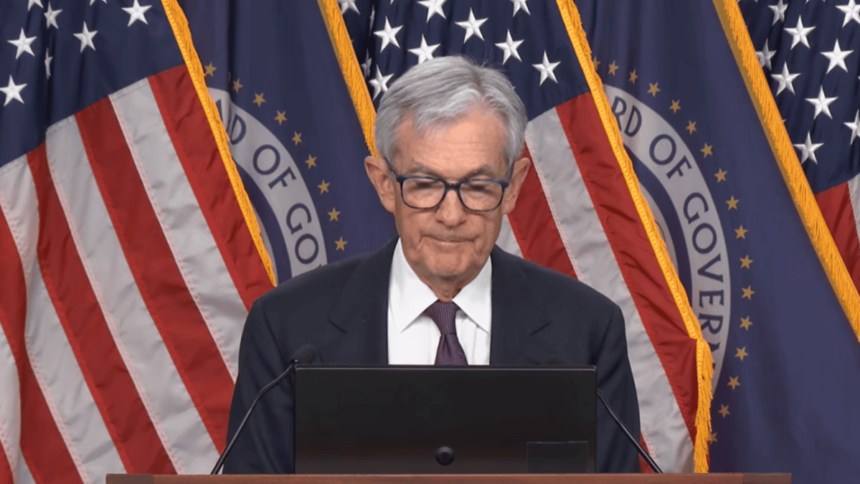
US Federal Reserve Governor Jerome Powell warned this Wednesday, March 18, that the central bank will not cut interest rates if the economy does not show clear signs of progress in the fight against inflation.
The statement was issued after a meeting of the Federal Open Market Committee (FOMC). decided to keep the federal funds rate unchangedcompared to the previous year was 3.75%.
Powell said this at the beginning of the press conference. Diagnosis that combines solidity and caution. He acknowledged that inflation “remains somewhat high” and job growth remains modest, but said “the U.S. economy is expanding at a solid pace.”
Officials pointed out that Current monetary policy stance ‘appropriate to foster progress’ Toward the Fed’s dual mandate goals of maximum employment and 2% inflation.
A major obstacle remains the rise in prices caused by tariffs. Chairman Powell was blunt about this: “Half to three-quarters of core inflation is actually tariffs.”
Core PCE inflation was 3.0%, 1 percentage point above target; The Fed president acknowledged that “we are not making net progress.”. But he believes progress will come as the tariffs wear off and move through the system, which he estimates could take “eight to 11 months or even a year.”
A new element of uncertainty has been added to this basic scenario: the Middle East conflict and its impact on oil prices. Chairman Powell warned that rising energy prices would “drive headline inflation” in the short term, but he was cautious about the underlying impact.
“It is too early to know the extent and duration of the potential economic impact,” he said, adding that while it is standard practice to ignore energy shocks, the decision “always depends on whether inflation expectations remain robust and stable.” With inflation running above target for five years, this situation cannot be taken for granted.
When asked about the outlook for the SEP (a summary of the FOMC’s economic outlook), Powell acknowledged that several participants thought this was a cycle where there was a good chance of skipping the exercise because there was so much uncertainty: “If we were going to skip the SEP, this would be a good forecast, because we just don’t know.”
Nevertheless, the median forecast still considers a rate cut this year, although conditional on the economy’s actual performance. The message was clear. “If we don’t see progress on that, we won’t see rate cuts.”
On the labor market, Powell urged people not to jump to conclusions from February’s negative data, which showed 92,000 job losses. “We need to consider the January and February reports together,” he said, blaming climate factors and strikes for the negative employment result of about 80,000 people.
The unemployment rate has remained at 4.4% since September“The labor market is clearly not a source of inflationary pressures,” the official said.
Mr. Powell concluded with a message demonstrating the robustness of the system. Asked if he would step down if a successor is not confirmed by May 15, he said he would become president. for now As required by law, he stressed, “I do not intend to resign from the board until the investigation is fully completed.”
He concluded that the Fed will continue to operate “with objectivity, integrity, and a deep commitment to serving the American people.”
Why are interest rates important to Bitcoin price?
Bitcoin market is closely monitoring every move of the Federal Reserve Because in the global economy, interest rates determine the cost of borrowing money.
As explained on Criptopedia (Education section of CriptoNoticias), when interest rates are high, credit becomes more expensive. Both companies and investors pay more money for financing, which reduces the liquidity that can be allocated to assets considered “risky” such as Bitcoin.
On the other hand, when interest rates fall, borrowing becomes cheaper, liquidity increases, and some of that money flows into assets such as cryptocurrencies in search of higher returns.
This dynamic became especially evident during 2020 and 2021, when the Fed kept interest rates near zero in response to the pandemic, cheap credit flooded the market, and Bitcoin reached an all-time high.
The aggressive interest rate increase cycle that began in 2022 has made financing more expensive, dried up liquidity, and been accompanied by a sharp decline in the prices of digital assets.
Since then, traders and investors have included the FOMC decision as a central variable in their models. Every FED meeting is also a Bitcoin market event.
(Tag Translation) Economy


