

Coinbase (COIN) could lose one of the tools it uses to attract users to hold digital dollars on its platform if lawmakers ultimately ban stablecoin rewards under the proposed CLARITY Act, but analysts say the impact on the exchange’s business may be limited.
As lawmakers debate the future of stablecoin regulation in Washington, one unanswered question in the proposed CLARITY Act could have a significant impact on the business model of Coinbase and other stablecoin partners: whether companies will be allowed to share yields with stablecoin holders.
The bill, which has been stalled in Congress since January, aims to establish a regulatory framework for stablecoins (digital tokens typically pegged to the US dollar). The central issue is whether crypto companies should be allowed to pass on the yields they earn from the reserves backing their tokens. Banks and some lawmakers are pushing for a ban on interest payments, while crypto companies including Coinbase argue that limiting rewards would undermine the usefulness and competitiveness of stablecoins.
But there was a glimmer of hope from DC this week. One possible agreement could be for stablecoin issuers and their partners to tweak the language of their offerings to distinguish them from bank deposits, Sen. Cynthia Lummis said Wednesday.
Read more: Leading US senator says ‘I think we understand’ virtual currency market structure bill negotiations
Still, for Coinbase, stablecoins, especially USD coin ($USDC), has become an important source of revenue and user engagement.
The current draft of the CLARITY Act would prohibit stablecoin issuers from paying interest directly to holders. But the language leaves room for alternative structures that could deliver rewards to users, according to an industry source familiar with the bill who requested anonymity.
“When it comes to stablecoin yields, the CLARITY Act has so many loopholes that it’s like the genie is already out of the bottle,” a source told CoinDesk. Although the bill prohibits issuers from paying interest, it does not explicitly prohibit exchanges and platforms from distributing incentives such as rebates, credits, or other rewards.
The difference between “profits” and “rewards” is thin, the person added. Marketing incentives and loyalty programs can effectively replicate the economic impact of yield while remaining technically compliant. This reflects a similar debate over guidance related to the GENIUS Act, where the line between limiting yields and shaping how they are distributed through partners remains unclear.
Another provision of the bill could further complicate enforcement. The legislation includes carve-outs for activity-related payments. This means that if the stablecoin is used for trading, lending, or other financial activities, yield may be distributed. In practice, this could allow for a structure where stablecoins are routed through decentralized finance protocols and generate revenue before rewards are passed on to users.
Partnerships between issuers and exchanges have the potential to achieve similar results. For example, issuers can earn yield on Treasury reserves, share a portion of that revenue with exchange partners, and have exchanges distribute rewards to users. The arrangement, which regulators have warned could constitute evasion, is not explicitly prohibited in the bill’s current form.
“It feels like even a mediocre marketing expert could come up with some creative structure to follow,” the source said.
Not “existential”
Wall Street analysts say the discussion will impact Coinbase but is unlikely to threaten the company’s broader business model.
Clear Street analyst Owen Lau said the ability to share stablecoin yields is just one of the many ways the company is attracting users to its platform.
“It’s important, but it’s far from existential,” Lau said. Coinbase already generates revenue from trading, derivatives, and the Base blockchain ecosystem, and many users come to the platform for services beyond stablecoin rewards.
While transaction revenue remained the exchange’s main source of revenue in 2025, stablecoin revenue grew sharply from the previous year, bringing in $1.35 billion in 2025 compared to $910 million in 2024, making it the second-largest driver of revenue, according to recent filings.
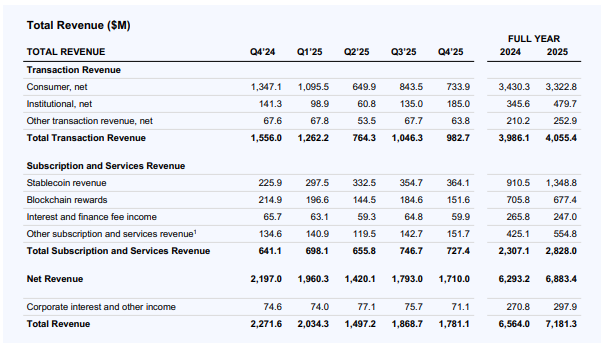
Coinbase’s 2025 Revenue (Coinbase)
However, Coinbase has a slightly different take on this discussion.
“Ironically, if the ban on crypto rewards were enacted into law, we would be more profitable because we would pay more to the customers we hold.” $USDC” Coinbase CEO Brian Armstrong wrote in a February post on
However, stablecoin incentives play a strategic role.
Clear Street’s Lau said Coinbase benefits from customer retention. $USDC This is because the company can capture the full amount of yield generated by the reserves backing the token. If users move those assets to an external wallet or decentralized platform, Coinbase may only receive a portion of the proceeds.
“If you can’t incentivize your customers enough, they might move.” $USDC “We will move away from Coinbase wallets,” Lau said, adding that this could reduce the company’s share of stablecoin-related revenue.
At the same time, the short-term financial impact is likely to be limited. Lau pointed out that Coinbase passes on a large portion of the stablecoin’s yield to its users, which means that revenue is often offset by expenses.
“From a revenue perspective, it doesn’t really change much,” he said, adding that the bigger question is whether regulation could slow a company’s long-term growth. $USDC Adopted.
Even if activity-based rewards and loyalty-style incentives are allowed in the final rule, Coinbase can continue to use these programs to incentivize customer ownership and usage, Lau said. $USDC This could increase the market capitalization of the stablecoin and increase the revenue that Coinbase shares with Circle.
For now, the outcome remains uncertain as lawmakers continue to negotiate the bill’s language.
But analysts and industry insiders say that even if strict limits on yields remain, crypto companies are likely to adapt, ensuring that stablecoins remain a competitive feature of the digital payments ecosystem.
Coinbase stock is down about 12% since the beginning of the year, while Bitcoin is down 19%.


