


Cardano is at a critical stage in its upgrade roadmap as it prepares to release protocol version 11, known as the van Rossem hard fork.
Central to this transition is the anticipated release of Cardano Node 10.7.0. This is a significant software upgrade that allows us to prepare and test our entire ecosystem before deploying to mainnet.
Important points
- Cardano is nearing an important upgrade stage in preparation for the van Rossem hard fork associated with protocol version 11.
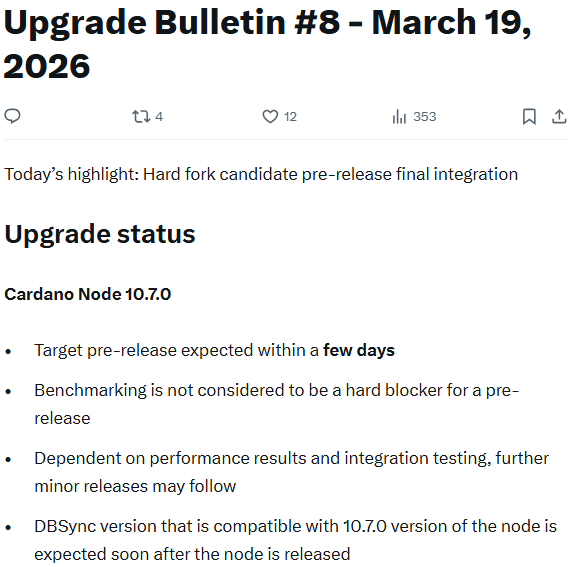
- Node 10.7.0, which is essential for the upgrade, will be available in the next few days.
- A compatible DBSync version will be released soon to ensure seamless data synchronization.
- The 10.7.x series will transition to protocol version 11 through gradual testnet deployments prior to mainnet deployment.
Cardano approaches key upgrade
Cardano is nearing a major upgrade milestone, with a pre-release of Node 10.7.0 expected in the coming days, Intersect announced. This release represents one of two critical node versions required to activate version 11, known as the van Rossem hard fork.
Previously, node 10.6.2 started preparing for upgrade in February. Node 10.7.0 advances the process and brings the network closer to activation.
Node 10.7.0 introduces new features and improvements that go beyond basic hard fork support and require ecosystem-wide integration and testing. Developers, infrastructure providers, and stake pool operators all play a role in this phase. Meanwhile, Intersect hinted that it plans to roll out additional minor updates depending on performance results.
Additionally, a compatible DBSync version supporting seamless data synchronization will be released shortly after release. During that time, no serialization changes have been introduced, ensuring continued compatibility with hardware wallets and minimizing disruption.
The 10.7.x series will then move to protocol version 11, allowing for gradual upgrades across the testnet before reaching mainnet.
Cardano upgrade
What’s new in version 11
When activated, version 11 introduces several new Plutus built-in features at the protocol level to enhance smart contracts and decentralized applications.
These include modular exponentiation operations (CIP-109), droplist operations (CIP-132), multiscalar multiplication using BLS12-381 (CIP-133), array processing (CIP-138), and MaryEraValue support (CIP-153).
Notably, these features are already live for testing in the upgraded SanchoNet. At the same time, tools such as the Scalus smart contract tool were upgraded to support early development.
This upgrade is structured as a non-disruptive intra-era fork, thus preserving the transactional format while increasing functionality and performance.
Timeline and ecosystem outlook
The exact release date of protocol version 11 is still unknown, but there is speculation that the mainnet could go live later this month following the release of Midnight. In the meantime, Intersect will provide continued updates through our Discord channel.
Looking ahead, these developmental milestones strengthen the case for 2026 to be Cardano’s breakout year.
As the van Rossem hard fork and Midnight launch approach, Cardano founder Charles Hoskinson also hinted at introducing Ouroboros Leios to improve network scalability. Similarly, broader efforts to expand DeFi activity and strengthen its competitiveness continue to gain momentum.


