

Bitcoin has room to rise if diplomacy between the US and Iranian governments continues to ease pressure on oil.
There have been signs of significant detente since March 23, with President Donald Trump ordering a five-day pause for “constructive dialogue.”
At the same time, there are reports that the United States sent a 15-point proposal to Iran through Pakistan, and that Turkey also communicated messages between the two countries.
A ceasefire has not yet been reached, and there is no sign that negotiations will be on track. Iran has publicly denied any direct talks with the United States, and an Iranian military spokesman said the United States was “negotiating on its own.”
Still, the signs of diplomacy were real enough for markets to react, with Brent crude falling 5.2% to $99.01 per barrel and US West Texas Intermediate crude falling 5.1% to $87.62 per barrel.
Meanwhile, Bitcoin rose 1.6% and remained resilient above $71,000 as traders eased some of the inflation and interest rate concerns that had built up during the nearly four-week war.

Why this tentative diplomacy moves markets
The supply side explains the unusual reaction to headlines that are nothing more than mediated messages.
Iran is OPEC’s third-largest producer, supplying about 3.3 million barrels per day of crude oil and an additional 1.3 million barrels per day of condensate and other liquids. Approximately 90% of crude oil passes through the Strait of Hormuz via Kharg Island, with recent exports ranging from 1.1 million barrels to 1.5 million barrels per day.
According to data from the US Energy Information Administration, flows through the Strait of Hormuz averaged 20.9 million barrels per day in the first half of 2025, representing about 20% of global oil liquids consumption. In 2024, approximately 20% of the world’s liquefied natural gas trade will pass through the strait.
But the volume has largely stopped, with Bitwise’s head of European research, Andre Dragosch, pointing out that “one ship passed this route today.”
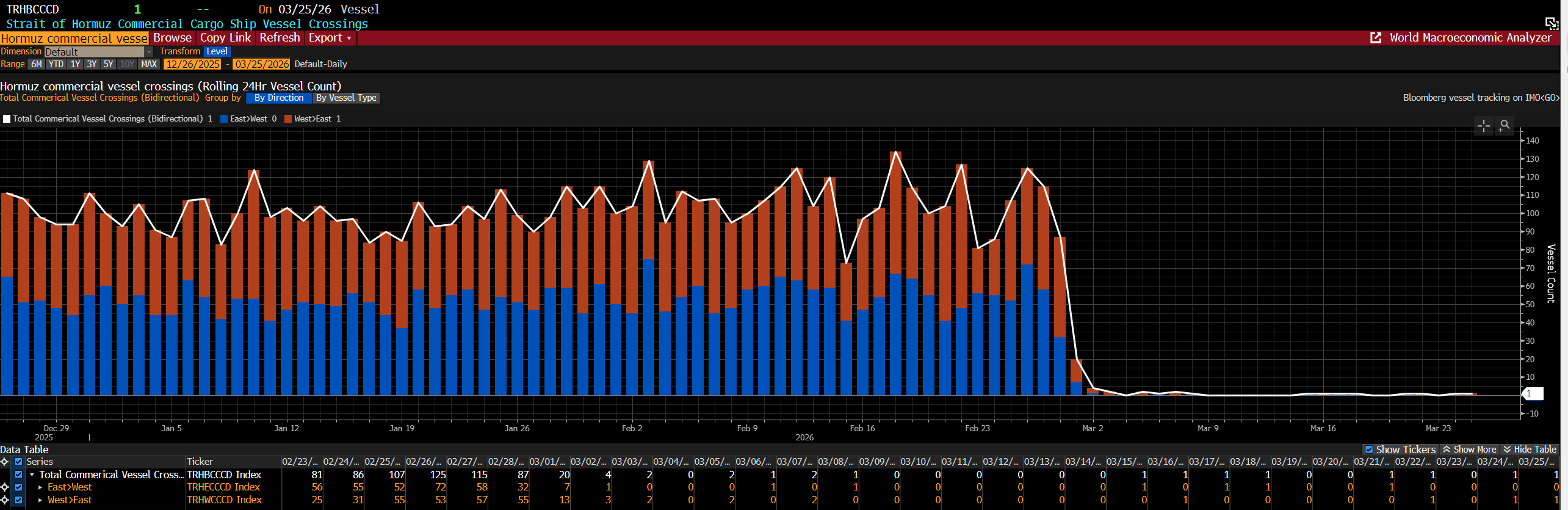
Any discussion of ceasefire terms, shipping access, or sanctions relief therefore has direct quantitative market relevance for the oil market.
The front curve makes the case look sharp. In its March outlook, EIA expects Brent to remain above $95 a barrel for the next two months, but fall below $80 a barrel in the third quarter and head toward $70 a barrel by year-end if disruptions ease and inventories recover.
The agency projects that global oil inventories will rise by an average of 1.9 million barrels per day in 2026 if production again exceeds consumption.
This means that a credible diplomatic process does not need to generate any immediate surplus supply. All you need to do is make that soft path seem more likely.
The European Central Bank’s March 2026 staff forecast quantifies that risk. The ECB modeled an unfavorable energy scenario with oil prices at $119 per barrel and gas prices at 87 euros per megawatt hour in the second quarter, pushing up euro zone inflation by 0.9 percentage points.
The Fed’s research separately finds that higher oil prices directly boost headline inflation, with small but statistically significant pass-throughs to food and core prices over about eight quarters.
With this in mind, cryptocurrency market maker Wintermute applied this to the trading conditions, explaining that if Brent prices stabilize around $100 and diplomacy can be maintained, inflation concerns associated with the energy disruption should be sufficiently eased and “some of the interest rate cut expectations that were extinguished last week” should return.
Transmission from oil to rate
The rationale for Bitcoin bullishness here is that lower oil prices will ease inflationary pressures. Additionally, central banks are less likely to keep interest rates tight for an extended period of time, improving the liquidity background for risk assets more broadly.
Notably, Bitcoin has primarily been traded as a high-beta representation of the global liquidity situation during the ongoing US-Iran conflict, rather than a geopolitical hedge.
For context, the recent rebound above $70,000 in top cryptocurrencies was not caused by any crypto-native catalysts. Rather, this occurred amid a sharp recovery in technology stocks and stabilization of broader market risks.
Flow data supports that reading. According to CoinShares, digital asset investment products received $230 million in inflows last week, with $219 million of that going to Bitcoin, despite an outflow of $405 million following the Federal Open Market Committee meeting.
CoinShares attributed the pressure not to the Iran conflict but to the Fed’s hawkish stance. The dominant factors are interest rates and liquidity, not geopolitics in isolation.
That is why resetting interest rate futures prices is so important. Over the past few weeks, the conflict has threatened to cause a stagflation shock as oil prices soar to record levels.
crypto slate He previously reported that interest rate futures suggest there is virtually no chance the Fed will cut rates until mid-2027 as energy rises due to the conflict. But after Tuesday’s foreign policy headlines, bets on a rate hike in December fell from 25% to about 16%.
Federal Reserve President Michael Barr on March 24 underlined his hawkish background, saying policymakers may need to keep interest rates on hold for “some time” and need to see evidence of “sustained declines” in inflation before considering further rate cuts.
What happens next?
Even if the diplomatic process drags on without a formal solution, even if oil prices are curtailed, it could help Bitcoin. If Brent crude oil remains near current levels or falls as shipping concerns ease, pressure on yields is likely to be contained and there will be less urgency for policy price increases over time.
The EIA’s path to sub-$80 oil in the third quarter provides a macro framework for that outcome. Under this kind of easing, BTC will have more clear scope to revisit and push up to the highs reached earlier this month.
On the other hand, a more credible path to a ceasefire would strengthen this argument. The bigger effect will come from convincing markets that Hormuz is returning to normal use, that the region’s energy infrastructure is no longer a target, and that the inflationary shock from the war is beginning to wear off.
The ECB’s forecasts show how much of a difference it could make. Even small changes in the assumed oil path lead to meaningful changes in inflation and growth forecasts.
However, if negotiations break down, the entire chain will be reinstated. Oil prices are likely to rise again, shipping risks will reignite, and markets will need to factor in a tougher policy path from the Fed and other central banks.
Past market performance has already shown how quickly that correction can occur. Within days, traders were pricing in a meaningful possibility of a rate hike in December after forecasting production cuts later this year, but eased their bets as oil prices fell amid diplomatic headlines.
Bitcoin can rise during wartime, but a cleaner upward path will emerge once the energy shock begins to ease.
(Tag translation) Bitcoin


