


Google has set a 2029 deadline for transitioning to post-quantum cryptography (PQC), warning that the “quantum frontier” may be closer than it looks.
Google said Wednesday that rapid advances in quantum computing hardware and quantum error correction, as well as updated estimates of how quickly quantum machines can break through current encryption standards, heighten the need to act quickly.
“Quantum computers will pose a significant threat to current cryptographic standards, particularly encryption and digital signatures,” Google said, while also pointing out that a transition to PQC is necessary for users to use authentication services securely.
This is the first time Google has set a schedule for rolling out post-quantum features across its products. The 2029 timeline is faster than some industry predictions for Q-Day, the point at which quantum computers would be powerful enough to break current public-key cryptography.
“It’s our responsibility to lead by example and share our ambitious timeline, which we hope will provide the clarity and urgency needed to accelerate the digital transition not only at Google but across the industry.”
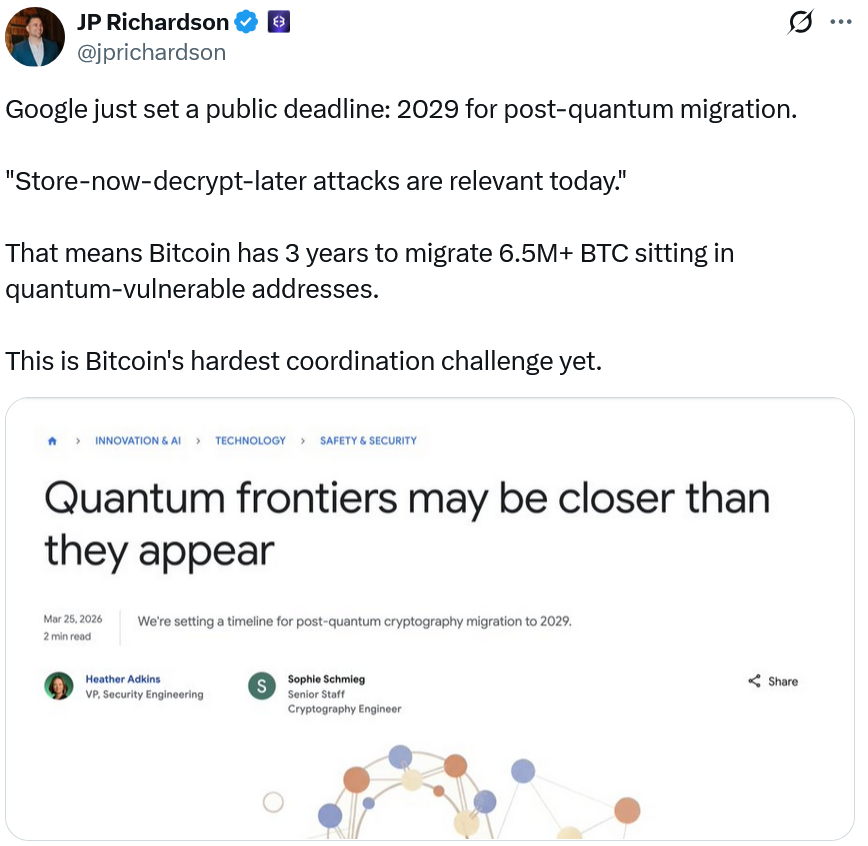
sauce: JP Richardson
Google’s urgency comes as the company continues to develop its Willow quantum chip, the industry’s most powerful quantum chip with 105 qubits of computing power.
There are also growing concerns that quantum computers could seriously disrupt the crypto industry by breaking the cryptographic algorithms used to protect digital assets. However, there is still debate as to whether only crypto wallets with exposed public keys are vulnerable, or whether all coins are at risk.
Crypto networks also focus on post-quantum upgrades
The Ethereum Foundation on Tuesday launched a “post-quantum Ethereum” resource hub focused on securing the blockchain from future quantum computing threats and securing billions of dollars of value on the network.
The post-quantum team plans to implement quantum-proof solutions for Ethereum at the protocol level by 2029, followed by solutions targeting the execution layer.
In January 2025, Solana developers created a quantum-proof vault on the Solana blockchain to protect users’ funds from quantum threats by implementing a complex hash-based signature system that generates a new key every time a transaction is made.
However, to access this feature, Solana users will need to store their funds in a Winteritz vault rather than a regular Solana wallet, as it is not a network-wide security upgrade.
Meanwhile, the Bitcoin ecosystem is increasingly divided over what actions, if any, developers should take.
Blockstream CEO Adam Back, one of the most influential voices in the Bitcoin ecosystem, says quantum risks are widely exaggerated and won’t require action for decades.
Meanwhile, security researcher Ethan Heilman and colleagues proposed a new output type for Bitcoin called the Pay-to-Merkle route through Bitcoin Improvement Proposal 360 (BIP-360). This is intended to protect Bitcoin addresses from potential short exposure quantum attacks.
However, its implementation could take seven years, Heilman told Cointelegraph in February.


