


Ella Huff, a fourth-year student at Cornell University and a Bitcoin supporter, has released an interactive calculator that models Strategies’ STRC preferred stock as a retirement benefit that replaces Social Security.
Among Ivy League and top-tier schools, Cornell University stands out as one of the largest schools in terms of size and enrollment, while maintaining an elite academic reputation. This is why Ella Huff’s role there (founding Bitcoin Club and pioneering custom degrees) is so important in the Bitcoin community.
What if Gen Z could trade their Social Security for MicroStrategy’s STRC?
Huff’s model assumes a 22-year-old earning $100,000 a year directs his 6.2% employee payroll tax into Strategy, Inc. (MSTR) variable rate Series A Perpetual Stretch Preferred Stock (STRC).
The product currently pays an 11.5% annualized dividend and trades at a par value of nearly $100 on the Nasdaq.
Over the past 30 days, $STRC has been less volatile than all S&P 500 companies and all major asset classes, with a dividend yield of 11.5%. pic.twitter.com/BXz6lPC15L
— Michael Saylor (@saylor) March 29, 2026
If dividends are reinvested monthly and the yield decreases linearly to 6% by retirement age, the calculator predicts a portfolio worth approximately $2.69 million by age 67. This translates into monthly dividend income of $13,405.
By comparison, the average Social Security benefit is $2,074 per month. The 2025 SSA Trustee Report predicts that the consolidated trust fund will be depleted by 2034, after which only 81% of scheduled benefits will be paid.
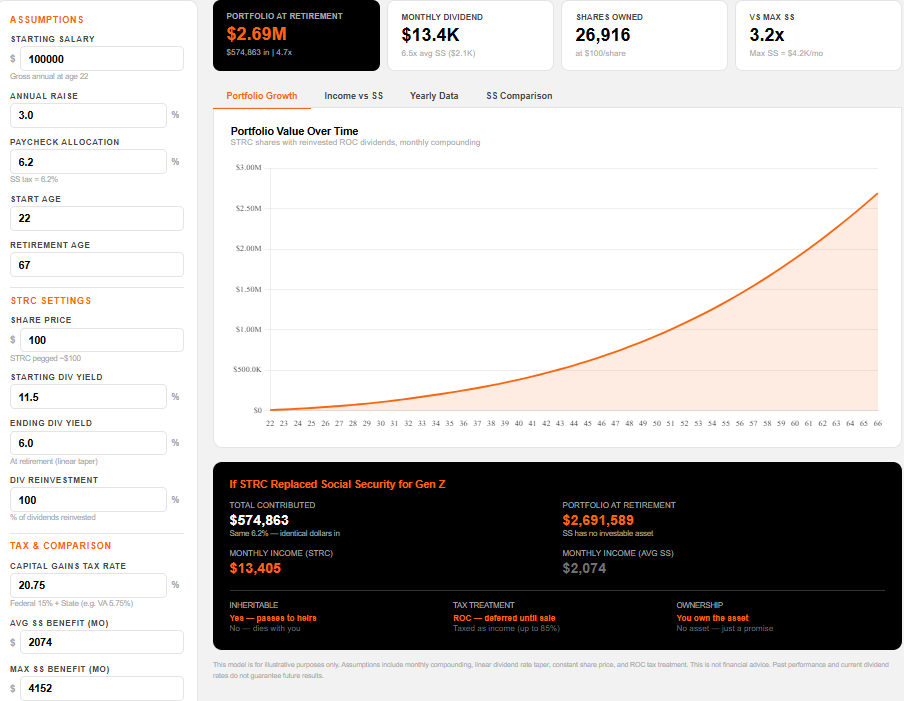
STRC retired model
Digital Social Security — What if Gen Z had the option to allocate their 6.2% payroll tax to STC instead? Source: Ella Hough / 21mmforthe21st.github.io
Risk and reaction
However, multiple assumptions carry significant risks. STRC’s dividends are not guaranteed and are subject to monthly adjustment by MicroStrategy’s Board of Directors.
The preferred stock is not directly collateralized by Strategy’s 762,099 Bitcoin treasury.
“Weekend thought experiment: What if Social Security for Gen Z looked a little more like $STRC?” Ella Hough posed.
In their responses, critics pointed to 45 years of declining returns due to inflation, the dividend cut scenario, and the fact that redirecting FICA taxes would require an act of Congress.
Some argued that direct exposure to Bitcoin or MSTR common stock would outperform yield-focused products.
Still, the model highlights a widening generational disconnect. Many Gen Z workers are already expecting reduced or no federal retirement benefits.
Huff’s tool gives that fear a concrete, numbers-driven framework, even if the political path to opting out of the payroll tax remains long.
The post What if your payroll taxes go into MicroStrategy’s STRC instead? appeared first on BeInCrypto.


