

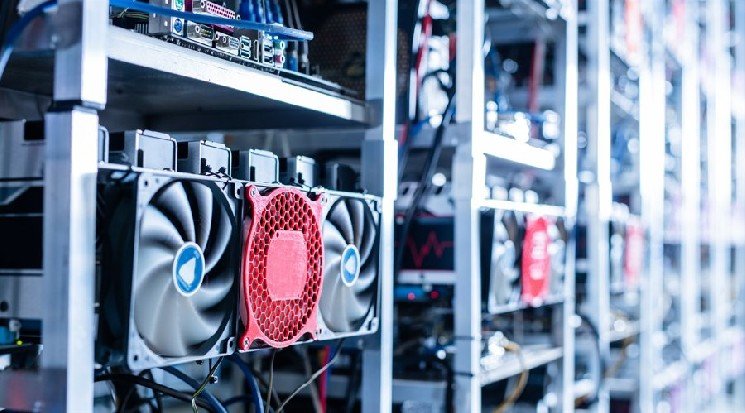
Bitcoin miners are pivoting to AI infrastructure as the revenue per megawatt from serving AI workloads is 5-10 times higher than mining Bitcoin, and the post-halving crunch has turned that difference into a strategic imperative.
Singapore Summit: Meet the biggest Asia-Pacific brokers you know (and the ones you don’t!)..
The clearest sign so far is BitFarms (NASDAQ: BITF), which announced it would change its address, change its name to Keel Infrastructure, and halt all new Bitcoin mining investments.
“We are no longer investing in Bitcoin mining,” executive Ben Gagnon said, describing the company as an “infrastructure developer and owner.”
We’re officially Keel Infrastructure! Built to meet the accelerating demand for HPC and AI, we have the power, space, and execution power to deliver.
Visit our new website → https://t.co/3VI028F01M pic.twitter.com/D6ubEMP1lc— Keel Infrastructure (@keelinfra_) April 1, 2026
clear trends
It’s not a one-off case. Core Scientific (CORZ) and TeraWulf (WULF) have significantly repositioned themselves as HPC operators, signing multi-year deals with hyperscalers.
Riot Platforms (RIOT), Iris Energy (IREN), and Hut 8 each announced plans to direct significant power capacity to AI clients.
Analysts estimate that up to 20% of the Bitcoin mining industry’s total power capacity could be repurposed for AI and HPC workloads by the end of 2027.
Why are miners advantageous?
This pivot works because miners already have something the AI industry can’t immediately acquire: large sites with high-voltage power contracts and matching infrastructure.
Hyperscalers face delays of two to four years just to connect new data centers to the grid. Miners will be able to bring AI capacity online in 1-2 years.
Goldman Sachs predicts that U.S. data center power demand will grow at an average annual rate of 15% through 2030, driven primarily by AI.
Evaluation strategy
Financial logic is just as important as operational logic. Bitcoin miners typically trade at 6-12x EBITDA. Data center operators trade at 20-25x.
A successful transition from volatile commodity production to infrastructure-as-a-service with long-term leases and predictable cash flows will mean multiple substantial reratings. That’s what these companies are betting on.
For brokers and investors, the practical outcome is sector reclassification. What used to be trading as a pure crypto mining cohort is becoming a heterogeneous mix of infrastructure companies, AI-powered real estate businesses, and remaining Bitcoin producers.
Applying uniform crypto cycle logic to the entire group is increasingly becoming the wrong framework.


