

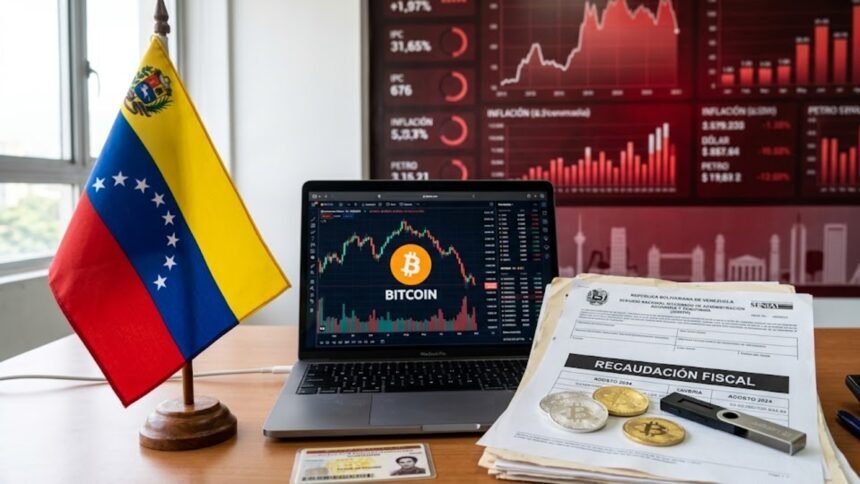
Despite the sharp increase in the use of Bitcoin (BTC) and other digital assets in Venezuela last year, this dynamism has not translated into a proportional increase in revenue for the state treasury. According to certified public accountant Yan Dominguez, the income tax (ISLR) collection equivalent to 2025 will be Does not include relevant percentages Total transactions with these financial instruments. Experts estimate that the impact of the digital economy on the amounts reported by tax authorities will be minimal and “will not exceed 1% of total collections.”
The discrepancy between the country’s transaction realities and tax reports occurs in the context that the State General Administration of Customs and Taxation (SENIAT) reported collections of 723.5 billion bolivars in March 2026 alone, and 1.4 trillion bolivars from January to March.
Although official statistics show large-scale compliance by Venezuelan taxpayers, technical gaps in digital asset declarations suggest that much of the wealth mobilized on decentralized networks and other digital asset platforms remains under the country’s fiscal radar. That’s no small thing: It will be at least 14 billion bolivars.
This figure is staggering considering that reports from companies such as Chainalysis show that as of June 2025, Venezuela had mobilized more than $44 billion in digital assets. This is a product of the country’s expansion in popularity triggered by its economic difficulties. This is significantly lower than the reported value of SENIAT, which reported an estimated recovery of $2.9 billion (based on the official exchange rate set by the Central Bank of Venezuela).
Now, according to Mr. Dominguez, the domestic business volume estimated by Chainalysis is: There was probably an explosive jump in the second half of last year..
“We believe Chainalysis reported more than $44 billion through June 2025, which tripled in the second half of last year,” explained Dominguez, who is also CEO of Cointable, a digital asset accounting management platform.
This rally was due to the rise in USD Tether (USDT) in Venezuela in 2025 as a result of stablecoin oil liquidation. This led to the massive use of this cryptocurrency by businesses and natural actors last year.
However, Dominguez insisted: This capital flow did not appear in the process closed on March 31, 2026.According to a report by CriptoNoticias, natural and legal persons who spent six months in Venezuela and earned a high income of 30 to 40 USDT have a deadline to report their earnings in virtual currencies.
Venezuelan Cryptocurrency Accounting Sub-Record
Dominguez suggests that one of the main factors explaining this low recovery rate is accounting underreporting. Many companies and businesses accept Bitcoin or process payments in digital currencies They have chosen to register the above operations under a different concept.
According to Dominguez, many companies “didn’t take into account these gains and losses on trading crypto assets. They definitely recorded them as exchange differences.” This management method hides the true nature of the transactions and avoids the specific treatment that regulations require for digital assets.
In practice, this accounting treatment assimilates crypto assets to foreign currencies, ignoring the category of digital assets. An example of this occurs when a company sells products and records its accounts receivable in bolivars. If the value of the asset relative to the local currency has increased at the time you receive the payment in cryptocurrency; The surplus is simply recorded as a profit due to exchange rate fluctuations (foreign exchange gain).
Dominguez said that even if companies kept proper records of their Bitcoin operations, there were failures in transferring that data to the SENIAT system.
The expert noted that those who considered the profit and loss “probably did not even reflect it on the Democratic Party 26 form, which is the official document of the final income declaration.”
This means that if a company owns Bitcoin and its bolivar price increases at the end of the year, there will eventually be an adjustment in the general exchange account. This practice makes it impossible for SENIAT to identify whether gains are due to the revaluation of the digital market or the devaluation of the bolivar.
After all, all this is expected to be collected and controlled by the Venezuelan state, but Not compatible with the realities of a digitalized economy Last year it accelerated.
Period of transition and professionalization regarding cryptocurrencies
Considering this scenario, 2026 is marked as a period of transition and specialization For collection companies. Dominguez suggested that the lack of effective oversight in the past was largely due to gaps in technical knowledge within institutions.
However, this situation is changing. The chartered accountant revealed that there are “pending tasks for 2026” that focus on everything from coordination to mayors to updating and training SENIAT staff.
“That is already happening, and in fact, I know that there are staff members at major universities that have training on crypto assets and the digital economy who are already receiving this guidance from their institutions,” he said.
This training aims to provide personnel with the necessary tools To understand the traceability of Bitcoin and other digital assetsThis will lead to more aggressive verification procedures, audits and inspections being applied to digital operations in the near future, Dominguez said.
The low proportion of digital assets held in Venezuela’s national treasury in 2025 reveals that the tax system continues to struggle to capture the wealth generated in the digital economy.
SENIAT is consolidating projects based on traditional collections, but its goals for the rest of 2026 seem clear. It is about bridging the technical and regulatory gaps to ensure transactions with Bitcoin and other digital currencies. Start paying taxes effectively and transparently.
(Tag Translation)Bitcoin (BTC)


