

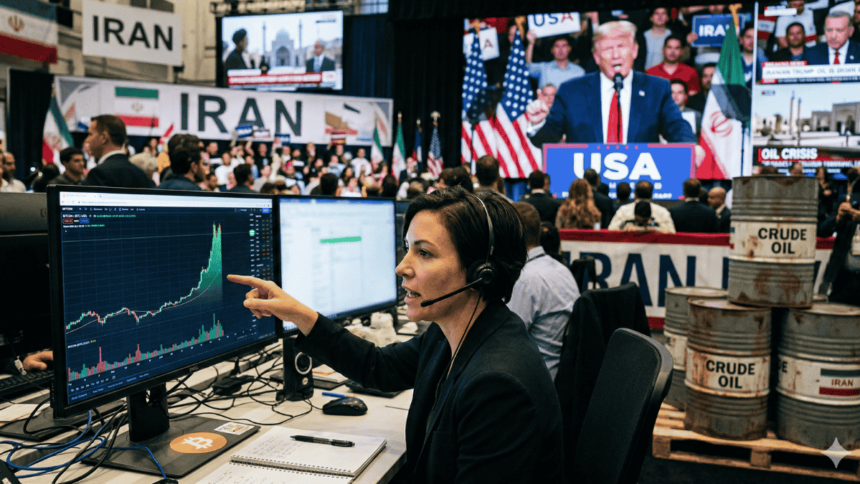
As of this writing on April 8, 2026, Bitcoin (BTC) is trading around $71,700. Last night, the rise in asset prices was immediate. It rose soon after US President Donald Trump announced a bilateral cease-fire with Iran conditional on the reopening of the Strait of Hormuz.
Seeing this news, the market reacted with relief. Crude oil falls, Bitcoin and cryptocurrencies risesocial networks were filled with optimistic opinions.
The following graph shows Bitcoin’s performance over the past 24 hours.
but… We recommend not to confuse this with a trend change signal.
The ceasefire will last two weeks. It’s not a peace agreement. This is a moratorium negotiated under pressure with technical and military conditions that neither party has resolved.
Keep in mind that Iran’s foreign minister has stated that safe passage through the Strait of Hormuz “will be possible through coordination with the Iranian military,” as reported by CriptoNoticias, suggesting that Iran maintains operational control of the strategic route.
President Trump justified the bombing halt by saying, “We have already met and exceeded all military goals.”
Ray Dalio: “We’re in a world war”
And just hours before the market celebrated, Ray Dalio published an analysis in X magazine that was more noteworthy than the price rebound. His diagnosis: “Most importantly, we are in a world war and it’s not going to end anytime soon.” Dalio is the founder of Bridgewater, the world’s largest hedge fund, and has more than 50 years of experience in global macroeconomic cycles. His warning has empirical, rather than rhetorical, weight.
analysis of Dalio pinpoints the mechanisms that are distorting the view of the market at this time. “Most people tend to focus on and react to the most shocking events of the moment, such as the current situation with Iran, and overlook the more important and far-reaching factors.” Bitcoin’s rally on Tuesday night is an example of just that mechanism at work.
What matters is not whether the Strait of Hormuz is currently open. What matters is the complete map explained by Dario: The war between Russia and Ukraine, the conflicts in Gaza, Lebanon, Yemen, Sudan, and now the war against Iran between the United States, Israel, and the Gulf states. Add to this what Dalio calls “unarmed wars”: commercial wars, technological wars, capital wars, and geopolitical wars. His conclusion: “Taken together, these conflicts constitute a very typical world war.”
In the case of Bitcoin, that means President Trump’s statement on TruthSocial does not erase the context of structural geopolitical uncertainty.
Oil prices: a continuing problem
After the ceasefire was announced, Brent crude oil fell below $100 per barrel. That was a relief from the $115 it hit just a week ago.
However, prices remain historically high and have tangible effects. Rising oil prices are fueling global inflationary pressures and reducing the incentive for the US Federal Reserve (and central banks around the world) to lower interest rates. And a high interest rate environment is unfavorable for assets considered risky, a category in which Bitcoin continues to be classified by most institutional investors.
This scenario could be alleviated if the ceasefire holds and the River Brent continues to fall. If the conflict resumes, or if it erupts in other areas mentioned by Dalio, oil prices will rise again and pressure on the Fed will increase accordingly. Bitcoin will feel it too.
Fundamental Issue: Quantum Computing
Regardless of geopolitics, Bitcoin has technical challenges that the market has started to cut into this year. On March 30, Google released a report claiming that a future quantum computer, where the technology is not yet developed, could derive the private key of a Bitcoin wallet within 10 minutes.
Charles Edwards’ firm Capriol Investments warned that the market is already discounting Bitcoin’s fair value by 24% for this risk. And we predict that if quantum computing-resistant cryptographic updates are not implemented, that discount could increase to 40% in 2027 and 60% in 2028.
Updates require consensus and an implementation period that can take several years. Time is running out.
Cryptocurrency winter may not be over yet
Analyst Willy Wu noted on March 29 that the most traditional on-chain model points to the lower end of Bitcoin in the $46,000 to $54,000 range. He did so with the nuance that “there have only been four bear markets in history,” but he also included a direct warning: If the stock market falls into a sustained downward trend, the impact on Bitcoin could be even greater. than what historical models would predict.
The pullback to $71,500 is real. However, the two-week ceasefire, pending military conditions, does not necessarily justify seeing the move as the beginning of a new upward trend.
For Bitcoin, 2026 is a year primarily defined by four variables that are not resolved in two weeks.
- Global geopolitical conflict. Dalio describes it as a world war in its early stages.
- The Fed’s monetary policy remains conditional on expensive oil.
- Technical challenges of quantum computing. Even though the community has not reached a consensus on how to respond to this, the market is already discounting it.
- The crisis in the private credit industry could spread to other sectors and negatively impact financial markets (including the Bitcoin market).
If the ceasefire holds, prices could continue to rise in the short term. but The fundamentals that will determine this year remain unfavorable. A difficult 2026 awaits for Bitcoin.


