

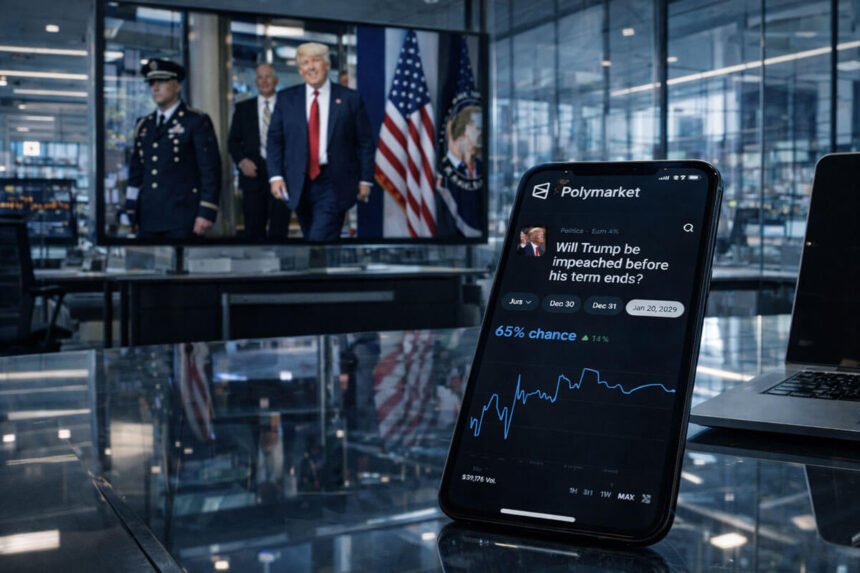


Polymarket projects a 64% chance that President Donald Trump will be impeached by the end of his term on April 7, near the highest level for the deal since it began on March 19.
A comparable Kalsi contract, resolved against Library of Congress records and lasting through January 1, 2028, traded for approximately 67% of its value over the same period.
Beyond current events, what’s moving the market is the polymarket odds that Democrats will control both houses of Congress in November’s midterm elections. With an 80% chance in the House and 55% in the Senate, a full-fledged path to impeachment and removal in 2026 becomes a realistic possibility.
Taken together, these numbers compress a vast geopolitical story into a real-time political stress gauge for Bitcoin traders, but the key market regime for Bitcoin has changed after Washington, the Iranian government, and Israel agreed to a two-week ceasefire.

President Trump’s April 7 ultimatum to Iran sent Brent crude oil prices above $109 and WTI crude oil prices above $114, as markets priced in the risk of a broader conflict centered on the Strait of Hormuz, which carries about 20% of global oil and LNG flows.
The shock began to reverse after the ceasefire was announced. Oil prices fell sharply as markets reassessed the imminent risk of prolonged supply disruptions and macro pressures that had dominated the previous session eased.
Bitcoin reacted in the same direction as the broader risk complex. Assets rallied as oil prices fell, Treasury yields fell, and stock prices rose, confirming that the cryptocurrency’s transmission mechanism is still operating through energy, inflation expectations, and the Federal Reserve, rather than the impeachment negotiations themselves.
Axios reported renewed calls for the Cabinet to consider the 25th Amendment and push for the impeachment of Defense Secretary Pete Hegseth, indicating that takedown rhetoric may remain high even as macro pressures on Bitcoin begin to ease.
Rising odds still serve as the market’s fastest read on political conflict, as Republicans control both the House and Senate, but it remains second only to oil, interest rates, and liquidity as a direct driver of Bitcoin.
| market | contract language | resolution cutoff | Resolution source/trigger | Situation on April 8th | recent high/context | Volume/Liquidity Notes | Why is it important for BTC? |
|---|---|---|---|---|---|---|---|
| Polymarket | Trump will be impeached before his term ends | Before President Trump’s term ends | Contracts are resolved in impeachment cases based on market rules. | Still on the rise after the ceasefire | Remains near recent highs despite market transition to easing mode | How quickly public opinion moves regarding political stress | Useful as a live stress gauge, but secondary to crude oil, yield, and liquidity in the BTC direction |
| Karushi | equivalent impeachment contract | January 1, 2028 | Resolution for Library of Congress Records | It also maintained a high | Confirmed that constitutional risk pricing did not disappear with the Armistice | Various rules and deadlines allow for convenient cross-checking | Shows that political tensions remain high even though macro impulses towards BTC have turned more supportive |
The chain that actually moves Bitcoin
Bitcoin price movements in geopolitical crises still proceed in a specific order.
The soaring oil prices caused by the war will reignite inflation concerns, further boost expectations for interest rate cuts, and tighten financial conditions for risk assets. That was the prevailing market logic heading into President Trump’s April 7 deadline.
By April 8, the ceasefire had turned the chain in another direction. Lower oil prices eased immediate inflationary pressures, helped lower U.S. Treasury yields and supported a broad rebound in stocks and other risk-sensitive assets.
Since risky assets are priced based on liquidity expectations, this correction in the interest rate path has a direct impact on the Bitcoin environment. As the Fed’s flexibility tightens and real yields rise slightly in line with oil, capital flows out of speculative positions. Once that pressure eases, BTC typically stabilizes along with stocks.
As Bitcoin and the broader crypto market recovered after the ceasefire, the market stopped reflecting an actual escalation shock and started reflecting a conditional relief rally.
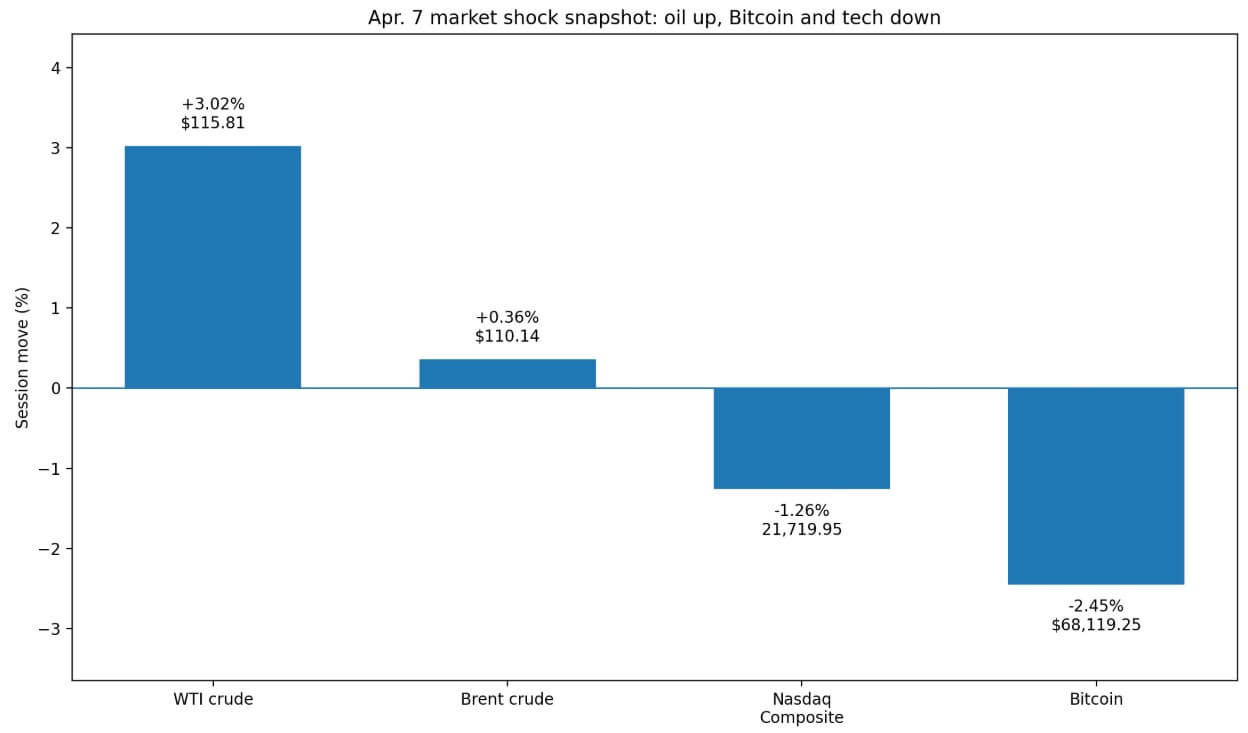
The same pattern appeared in February, when Bitcoin plummeted to $60,017 intraday before rebounding above $70,000, a move tied to stabilization in tech stocks and other risk assets.
Bitcoin’s correlation with the broader risk complex in 2026 is consistent enough to abolish the “digital gold in every crisis” paradigm.
Goldman Sachs had already raised the probability of a U.S. recession to 30% ahead of the April 7 deadline, and IMF chief Kristalina Georgieva said that even if there was a quick solution, the risk of a shock slowing growth and rising inflation remained.
Even after the bailout measures, the macro environment remains fragile.
potential routes
A ceasefire changes the fundamental situation, but it does not remove the core variables that traders need to track.
Inflation and interest rate headwinds will further weaken if the two-week cease-fire holds, shipping through the Strait of Hormuz normalizes, and oil prices remain below $100.
Citi’s Nathan Sheets said the risk of a recession would increase if oil prices rose above $110 to $120. This threshold is still important, but since the ceasefire it has become a downside factor rather than the actual market situation.
In the case of Bitcoin, regardless of what moves the headlines – high oil prices, persistent inflation, delayed easing, further de-risking from speculative positions – the outcome will still be moving in the same direction.
During the last period of sharp pressure on BTC earlier this year, option demand was concentrated around the downside strike of $60,000 to $50,000. If oil regains $110 territory and the Fed leaves policy on hold until the summer, a retest of the low $60,000 range remains a defensible downside scenario.
With political noise still riding on top of macro structures that are already in motion, persistent macro penalties will likely drive asset reactions even if a ceasefire fails.
A version of this situation in which the impeachment talk helps Bitcoin is currently running through de-escalation, which is actually taking hold. If the ceasefire holds, oil will cool, interest rate cut expectations are back on the horizon, risk appetite will return, and Bitcoin will rise along with stocks.
Hopes for a easing of tensions had already driven more than $15 billion into global equity funds in the week to April 1. The ceasefire reinforced the same picture with a sharp drop in oil prices and a rebound in risk assets.
This precedent has conditions. De-escalation would only be bullish for BTC if oil runs out and interest rates headwind.
| scenario | trigger | Oil range/condition | Fed involvement | Impact on BTC | What does the possibility of impeachment mean in this case? |
|---|---|---|---|---|---|
| Base case for de-escalation/relief | Two-week ceasefire in place, transport normalized, negotiations continuing | Crude oil prices fall and remain below $100 | Expectations for a rate cut will resurface in 2026. Macro pressure eases | If the bailout price holds, BTC may recover along with stocks. | Odds continue to rise as a political signal, but are less important than low oil and interest rate headwinds |
| Fragile Ceasefire/Unstable Incidents | Ceasefire formalized, but implementation is uneven and headline risks remain high | With no definitive new surge in sight, oil remains volatile and elevated relative to pre-shock levels | The Fed remains cautious and holds policy on hold. Macro overhang remains unresolved | BTC remains headline-driven and volatile, with uncertainty over oil and yields holding back upside | Odds remain elevated as stress gauge while crypto traders continue to focus on macro variables |
| Breakdown/Bear case | Military exchanges resume, transportation is disrupted, or escalation increases again | Oil recovers $110 and could rise above $120 | The Fed’s flexibility will be further reduced. Relaxation will be delayed. Increased risk over a long period of time | This further reduces risk and makes the low $60,000 range a defensible downside retest. Previous acute stress concentrated option demand between $60,000 and $50,000 strikes | Odds increase as political tensions sharpen, but still reflect stress rather than directly boosting BTC |
A diplomatic shutdown that leaves energy markets unstable will not eliminate macro overhangs, even if it de-pricing constitutional risk in the news cycle.
The likelihood of impeachment remains high even as oil prices fall, which will remain a positive for Bitcoin. If oil prices stay below $100 and expectations for a 2026 rate cut return, BTC could recover toward a higher range even as prediction markets remain elevated.
While Polymarket and Calci’s related contracts still have editorial value as a dizzying public read on political stress, clearer directional signals for cryptocurrencies come from whether oil, yields, and broader market easing hold.
Traders monitoring the direction setting will now need to track whether Brent and WTI remain below the danger zone, whether the Fed’s next communication stabilizes rate cut expectations, and whether the ceasefire lasts long enough for the market to treat this move as more than a one-day rally.
These variables will determine the direction of BTC long before the House resolution reaches the floor.
(Tag translation) Bitcoin


