


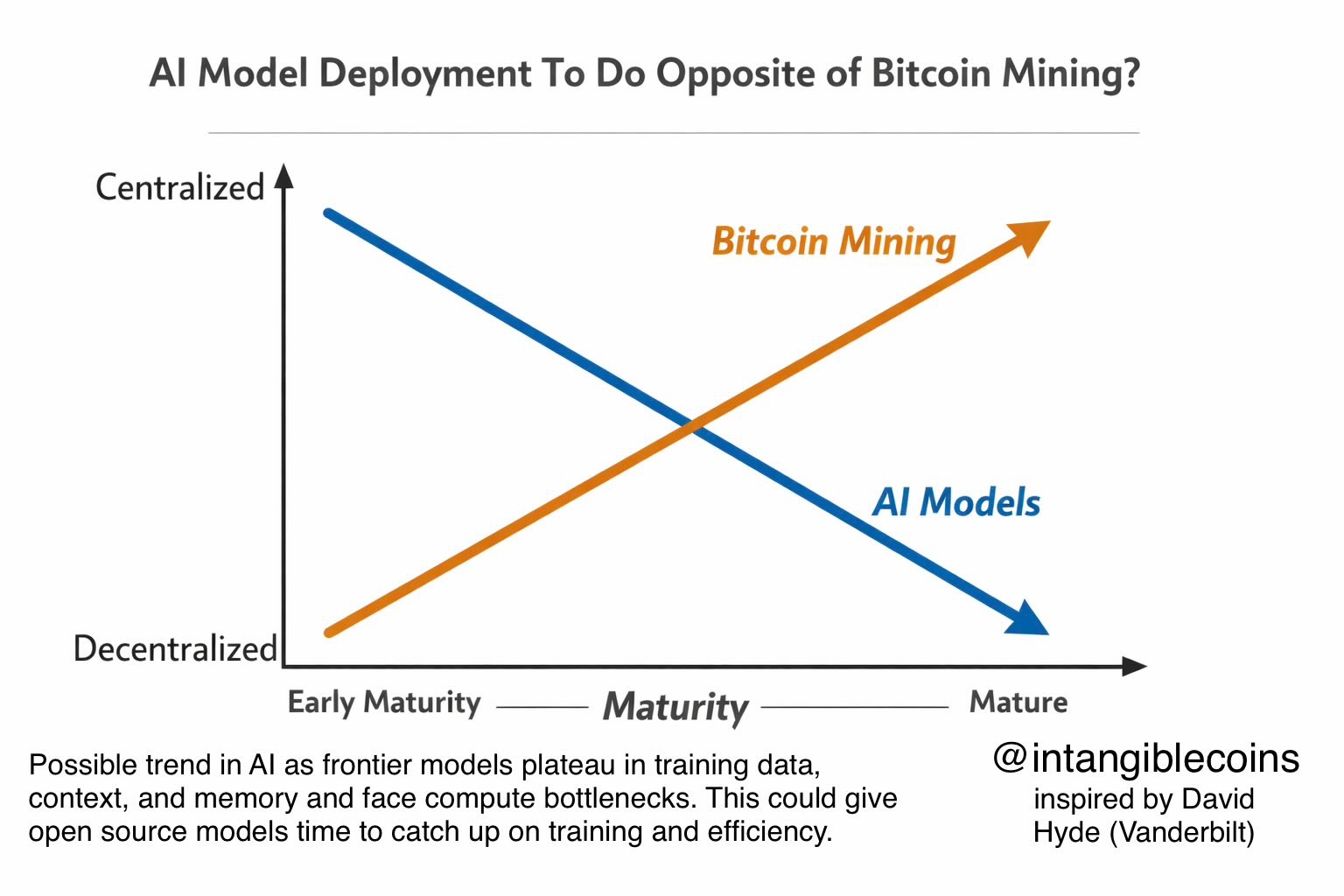
While Bitcoin mining risks becoming more centralized over time, artificial intelligence could move in the opposite direction, said Alex Thorne, head of Galaxy Research.
Thorne said Bitcoin mining started out decentralized, with users mining Bitcoin on their personal computers, but has since become much more centralized, requiring ASIC miners and industrial-scale farms.
“AI may go the other way,” Alex Thorne, head of research at Galaxy, said on Sunday, explaining that while AI has started to become centralized in large hosted clusters, frontier models experience “data scarcity, context limitations, and memory bottlenecks,” and open source models could fill the gap.
“As local models continue to get smaller, cheaper, and more efficient, AI could become increasingly personalized and on-device.”
This difference goes to the core of cryptocurrencies’ core promise: decentralization. If Bitcoin mining continues down the path of centralization, concerns may begin to arise about the long-term resilience of the network.
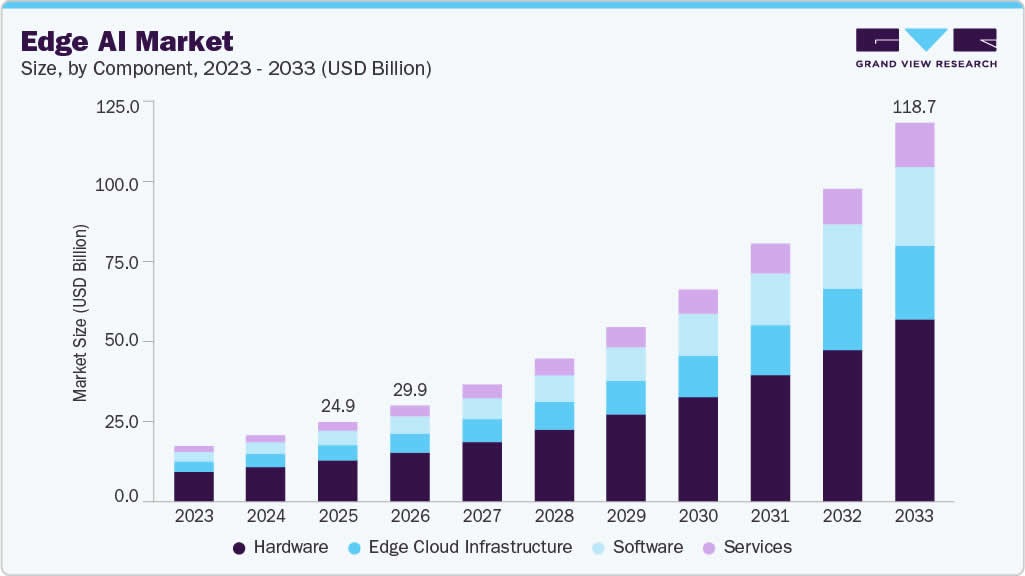
Edge AI market to grow 300% over next 8 years
Edge AI computing refers to deploying and running AI models directly on a local device or network “at the edge,” rather than sending all data to a central cloud server or large data center for processing.
The global AI edge market is expected to grow from approximately $25 billion in 2025 to $119 billion by 2033, according to Grand View Research.
Related: Researchers discover malicious AI agent router that can steal cryptocurrencies
The edge market is experiencing significant growth driven by the “rapid expansion of the Internet of Things (IoT) and connected devices,” GVR said.
This has driven demand for real-time, low-latency data processing, increased adoption of AI-powered automation across industries, and “increased focus on data privacy and localized intelligence at the network edge,” GVR added.
Bitcoin mining is geographically decentralized
Cryptocurrency exchange KuCoin reported on Friday that Bitcoin mining is becoming increasingly unfeasible in the United States due to the cost of a single mine. $BTC Rising energy costs have exceeded $100,000 in some areas.
The result is a geographic migration in which the hashrate is actively moving toward the “Global South,” with Paraguay and Ethiopia emerging as key destinations due to surplus hydropower.
This could help decentralize mining, at least from a geographic perspective.
“Decentralization of mining power across different continents reduces network vulnerability to political or environmental shocks in a single country and strengthens network security,” the report said.
magazine: Is Bitcoin quantum secure without upgrades? CZ’s 2031 Cryptocurrency Vision: Hodler’s Digest


