


While Ethereum strengthens its role as the primary liquidity platform, there is a bifurcation in stablecoin flows as activity spreads across other chains.
Ethereum has absorbed $8.4 billion in net supply, with total holdings approaching $180 billion, meaning capital prefers the depth and safety of storage.
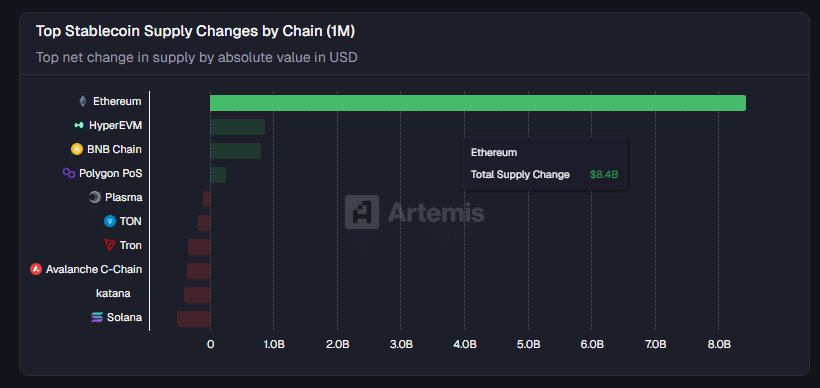
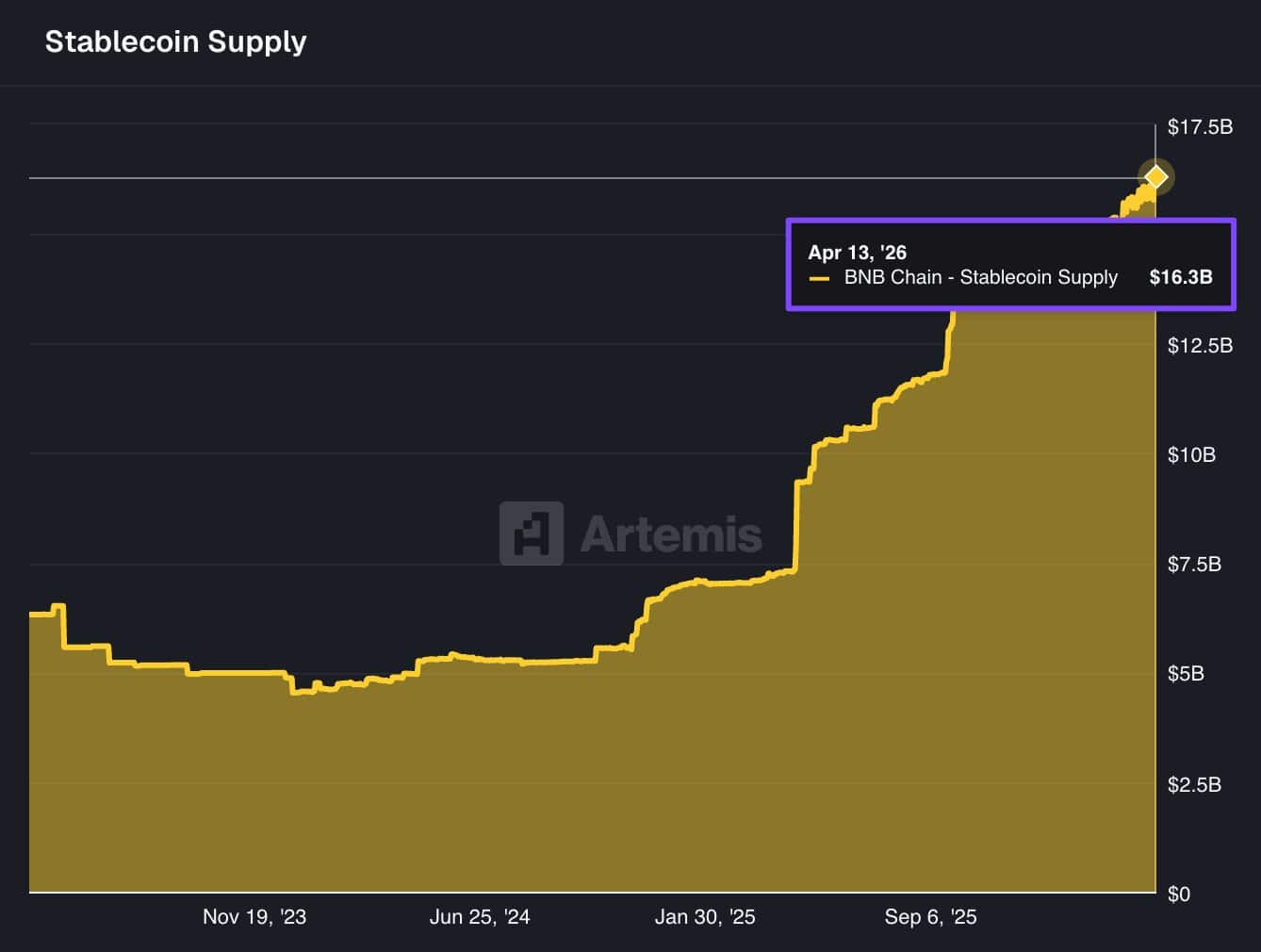
meanwhile, $BNB Chain ($BNB) rose to $16.3 billion, an all-time high. This indicates parallel growth rather than capital turnover. This is important because both chains expand simultaneously to reflect the new liquidity flowing into the market.
The supply table reinforces this and shows Ethereum ($ETH) leads by a wide margin, and smaller chains are slowly making gains. This distribution suggests that although capital is still locked in Ethereum, usage is spread across the network.
This move highlights the growing liquidity, where concentration and fragmentation coexist in an evolving market structure.
Bifurcation of stablecoin flows between chains
The movement of stablecoins across the chain reveals broader structural changes, as capital not only expands but also spreads across major ecosystems. Ethereum ranks first in DeFi TVL with $55.5 billion, reinforcing its role as a major liquidity hub. This concentration means institutions prefer the depth and security of mass storage.
On the other hand, Solana ($SOL), TVL is $5.77 billion, and $BNB With a TVL of $5.42 billion, the chain supports a more active environment with stablecoins circulating through higher DEX volumes of $1.94 billion and $1.2 billion daily. This reflects increased retail and trade-driven usage.
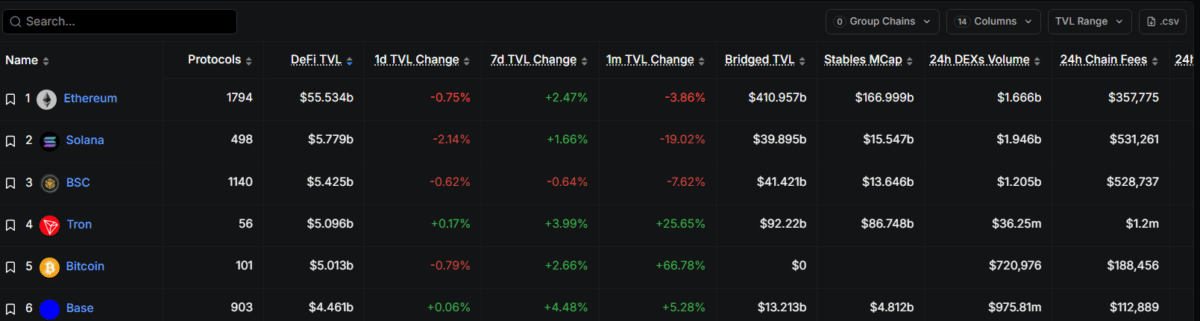
Tron ($TRX) adds another layer with its $86.7 billion stablecoin and increasing activity, bridging both storage and transfer use cases. This distribution suggests a multi-chain system where Ethereum locks in liquidity and other networks drive execution and flow.
Stablecoin liquidity distribution shapes market dynamics
Stablecoin flows will begin to shape how liquidity moves across markets as capital grows and begins to influence price movements.
Total supply rose to $319.9 billion, an increase of $2.52 billion over the week. This indicates that new money is flowing in rather than rotating. This is important as new liquidity seeks deployment and creates potential demand across assets.
Ethereum absorbed $166.95 billion, accounting for the largest share, meaning financial institutions continue to use Ethereum for collateral and structured positioning. The price is locked in at around $2,320 as loans and derivatives lock in capital and reduce sudden downward pressure.
However, the flow does not stop.
Solana, Arbitrum, and Base are seeing steady inflows as users seek speed and cost savings, allowing capital to circulate faster through trading and liquidity pools. This rotation often increases market activity and amplifies short-term price movements outside of Ethereum.
As a result, stability and momentum begin to be split between the chains.
While Ethereum benefits from depth and absorption, a faster network drives execution and volatility, shaping how liquidity is translated into price.
Final summary
- Ethereum ($ETH) fixes liquidity, while Solana ($SOL), $BNB Chain ($BNB), Tron ($TRX) Inflow will increase multi-chain execution and participation.
- Ethereum remains stable, but decentralized liquidity shifts momentum and volatility to faster chains.


