

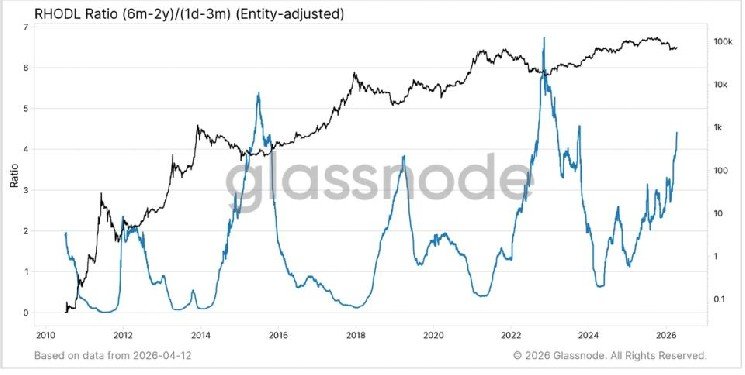
The RHODL ratio by Glassnode is a key on-chain indicator that tracks the balance between long-term and short-term Bitcoin holders, and after the ratio reached 4.5, it was flashing a signal more consistent with the market bottom than the cycle high.
The index, currently at its third-highest level on record, shows that wealth is increasingly concentrated in older coins, as younger, more speculative holdings have largely been shed during Bitcoin’s 50% correction over the past six months.
This ratio compares the value of a coin held by long-term investors (typically those holding for 6 months to 3 years) to the value of a coin held by short-term participants, defined as 1 day to 3 months. Measuring this balance provides insight into whether the market is dominated by veteran holders or by new demand from new entrants.
Rising ratios often reflect the coin’s aging and declining speculative activity, rather than an influx of new buyers. This movement typically follows sharp corrections like those seen in 2015, 2019, and 2022.
The RHODL ratio was higher than it is now twice: in 2015 (ratio 5) and 2022 (ratio 7), both of which were cycle lows, which could suggest further downside for Bitcoin.
But pushing it higher would typically require a deeper collapse in short-term holder activity and a near-complete depletion of demand, a situation that is less obvious today given the 25% price recovery from February lows, negative perpetual funding rates, and the broader macro risk environment that has driven the S&P 500 to new all-time highs.


