


Bitcoin mining difficulty eased this week, dropping 2.43% from the previous target to settle at 135.59 trillion. This adjustment follows a previous 3.87% increase and is the fifth downward revision recorded this year.
Important points:
- On April 17, 2026, Bitcoin difficulty decreased by 2.43% to 135.59T, and the mining situation eased.
- According to Hashrateindex.com, hashprice has increased by 13.65%, boosting Bitcoin miners’ profits in the short term.
- Bitcoin hash rate exceeds 1 ZH/sec. Faster blocks suggest an increase in difficulty by April 30th.
Signals of change in the Bitcoin network
So far, 2026 has seen a total of 8 difficulty adjustments, with 5 listed as a decrease and 3 as an increase. The downward revision has significantly lowered the target, making Bitcoin mining less demanding than it was at the end of 2025, at least in terms of difficulty.
Notably, the last example of this level of difficulty dates back to September 2025 with block height 913248. The latest adjustment in block 945504 lowered the mining difficulty, decreasing it from 138.96 trillion to 135.59 trillion, a change of 2.43%.
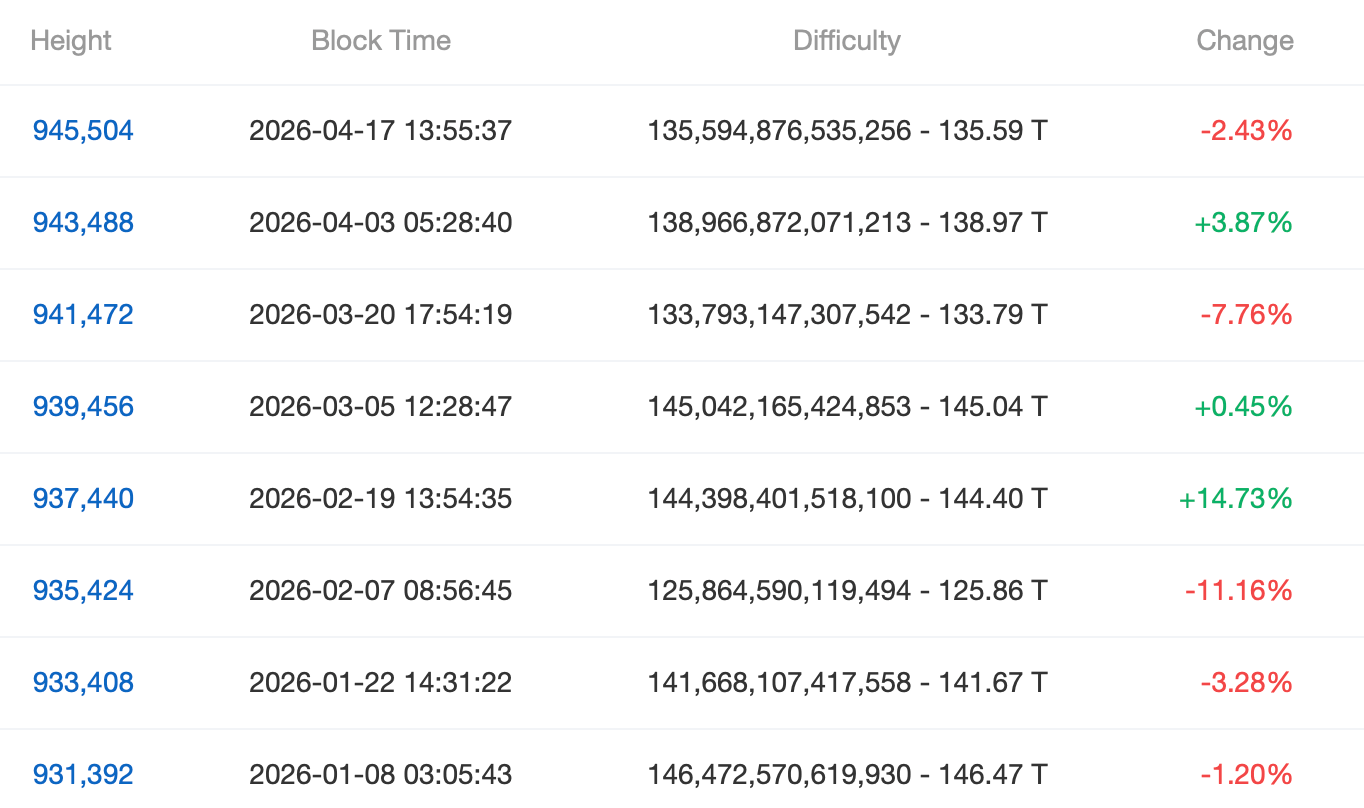
According to indicators recorded by hashrateindex.com, Bitcoin prices have increased, with Hashprice increasing by 13.65% between March 18th and April 18th. Hashprice basically represents the daily value of hashrate in 1 petahash per second (PH/s), but it can also be expressed in other units such as terahash or exahash.
The increased revenue associated with lower difficulty should provide some breathing room for miners in the short term, at least until the next correction expected around April 30th. Still, the network’s hash rate continues to exceed 1,000 exahashes per second (EH/s), or 1 zettahash per second (ZH/s), and block spacing is accelerating.
Although it is still too early to draw firm conclusions, the average interval of 9 minutes and 35 seconds indicates a possible upward adjustment. For mining participants, 2026 will unfold as a period of adjustment, with on-chain activity subduing in 2025, but there are now early signs of new traction.
Fees are still very minimal, with mempool.space and other Bitcoin data platforms showing an average of around 1 SATOSHI per virtual byte. Data from hashrateindex.com further shows that fees accounted for just 0.45% of the total block revenue distributed to miners over the past day.
The latest figures show that the mining environment is easing on the one hand and tightening on the other. Lower difficulty and stronger hash prices provide short-term relief, but sustained hashrate strength and faster block times suggest the network has already rebalanced.
If current conditions hold, the next correction could reverse course, further reinforcing how quickly the equilibrium shifts as miners react to prices, incentives, and competition.


