

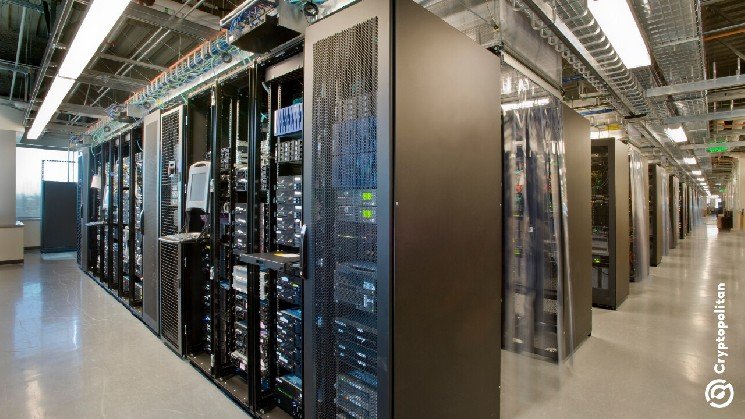
EcoHash Technology LLC, an HPC and AI inference specialist subsidiary of Cango Inc. (NYSE: CANG), announced the launch of its public digital portal and the start of commercial operations on April 13, 2026.
The company also announced plans to operate part of its 50 megawatt (MW) mining facility in Georgia as a live demonstration hub for the AI computing industry.
What is EcoHash? Why enter the market now?
Cango (CANG) founded EcoHash in 2025 as part of its goal to transform its global energy infrastructure into a decentralized AI computing network. EcoHash’s commercial launch is targeted at AI developers seeking low-latency, near-source computing power and energy-intensive computing operators seeking a modular path to infrastructure diversification. Cango (CANG) believes the latter is underserved by traditional data center providers.
The development comes at a time when Goldman Sachs researchers predict that U.S. data center power demand could reach 700 TWh by 2030, driven primarily by AI inference workloads.
However, the currently available supply is still just over 300 TWh, leaving a gap of around 400 TWh despite steadily increasing computing demand.
This is the commercial rationale on which EcoHash is built and was pointed out by Cango CEO Paul Yu. He calls the disconnect between growing AI computing demands and constrained grid capacity the “power gap.”
Jack Jin, Chief Technology Officer of EcoHash, said: “EcoHash is a core vehicle in our strategy to build a future-ready platform and serve as our next growth engine, and we are now in a phase of accelerated commercialization.”
The commercial launch of this subsidiary followed a period of intensive capital deployment. In April 2026, Cango (CANG) announced the completion of two financing transactions totaling $75 million, a $65 million equity closing from board insiders Xin Jin and Chang-Wei Chiu, and a $10 million convertible note closing from Hong Kong-listed DL Holdings Group Limited (HKEX: 1709).
Cango (CANG) also signed a memorandum of understanding with DL Holdings for further co-investments of up to $10 million.
These transactions followed an earlier increase of $305 million from the sale of Bitcoin holdings, which was used to pay down debt and reset the balance sheet.
What is the Georgia facility designed to demonstrate?
EcoHash’s launch strategy is underpinned by Cango’s 50MW Georgia mining facility, where the company has dedicated space to operate a full series of container models, and what it describes as a “living showroom.”
The site is designed to demonstrate real-world performance across a variety of thermal and power configurations, and serves as a strategic proof-of-concept hub for industry collaborators across the digital infrastructure and mining ecosystem.
Cango (CANG) intends part of its Georgia facility to serve as a replicable template for a globally distributed AI computing network, with ambitions to extend the model across high-potential sites within and outside of its existing mining footprint across North America, the Middle East, South America and East Africa.
The commercial viability of the plug-and-play module in Georgia will enable the company to attract global partners to the EcoHash network, operators that can integrate their existing infrastructure into the platform rather than building a new data center from scratch.
How will the EcoLink platform emerge?
EcoHash’s operational backbone is the proprietary EcoLink Orchestration Platform, a software layer that integrates and schedules geographically distributed computing power across the network.
EcoLink is built to deliver enterprise-grade uptime through intelligent failover and provision computing power to meet the demands of real-time workloads.
This is a mechanism that transforms a collection of repurposed mining sites into something resembling a traditional hyperscale product.
Jin said in a comment that EcoLink is “the central nervous system of our network,” built to enable intelligent real-time resource allocation that directly connects distributed energy assets to large-scale language model inference, generative AI, and the demands of growing compute-intensive applications.
According to Cango (CANG), the result is elastic, low-latency computing that can scale on demand without the capital investment and multi-year lead times associated with building new data center capacity.


