

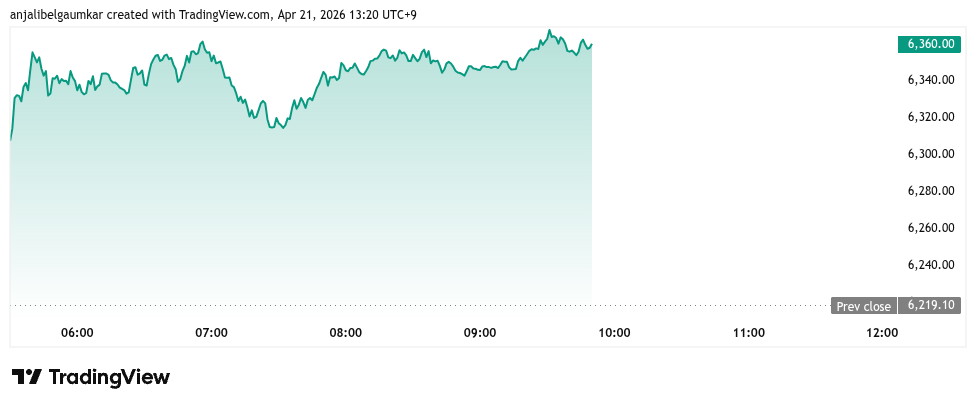
South Korea’s benchmark KOSPI index hit an all-time high of 6,360 on Tuesday, extending a bull run that has brought it up 25% in just 15 trading sessions. The immediate trigger was SK Hynix, which soared more than 4.6% after confirming the start of mass production of key memory modules for NVIDIA’s advanced AI processors.
The company is one of Nvidia’s most important suppliers and a direct representative of the organization’s beliefs in building AI infrastructure.
The rise wasn’t limited to chipmakers; it was widespread. LG Energy Solution rose 9.4%, SK Square rose 3.1%, Doosan Energy rose 2.3%, and HD Hyundai Heavy Industries rose 2.3%.
Export numbers justified this move
South Korea’s exports rose 49.4% year-on-year in the first 20 days of April due to a sharp recovery in semiconductor shipments, which surged more than 180% over the same period. This number is not a prediction. This is actual trade data that confirms that demand for Korean chips is increasing.
SK Hynix’s first quarter operating profit is expected to jump more than 368% compared to the same period last year, with the company scheduled to report its financial results on April 23. Goldman Sachs on Monday raised its 12-month KOSPI target to 8,000 points, citing improved semiconductor profits and broad market revenue growth of about 48% across the index.
Foreign investors also returned in droves, and the stock market recorded net buying of 1.192 trillion won on Tuesday.
speed problem
The basic story about Korean chipmakers and exports is true and well supported by data. The concern now is not whether the story is justified, but whether price trends are moving far beyond what is justified by the story alone.
A 25% increase in 15 sessions does not indicate measured institutional accumulation. This is a sign of excess liquidity actively rotating into stocks, following retail momentum, short covering, and amplifying the move.
Retail investors moved in the opposite direction on Tuesday, posting net sales of 1.489 trillion won, but the divergence shows that retail investors who rode the rally are starting to take profits against institutional buying, which continues to enter positions.
Rapid rallies driven by liquidity and momentum rather than gradual fundamental improvement tend to resolve with fatigue rather than stability.
Related: Global markets brace for volatile week as doubts linger over US-Iran talks


