

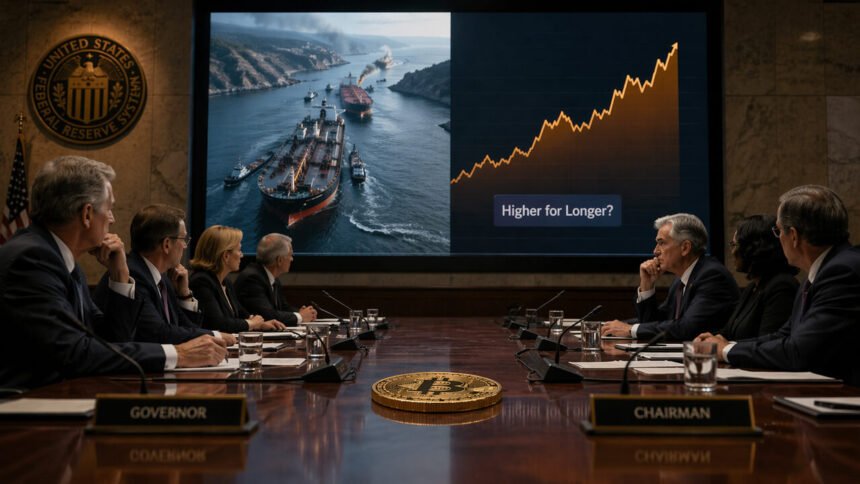


Just as investors were trying to stabilize the outlook for interest rates in 2026, the oil market presented the Fed with a new inflation problem.
The Federal Reserve will meet on April 28th and 29th. On April 30, the U.S. Bureau of Economic Analysis (BEA) is scheduled to release its advance forecast for first-quarter GDP along with March personal income and spending, which will include the Fed’s recommended PCE inflation measure.
Any of these events can shock the market in and of itself. But the event, packed into three days, is a stress test for the easing narrative that carried risk assets into the spring.
Bitcoin sits in the middle of that chain. BTC spent much of this cycle trading along broader paths of interest rates, liquidity, and risk appetite. When war threatens supplies, oil prices rise. As oil prices rise, energy begins to squeeze freight rates, manufacturing, and consumer prices. From there, the pressure will be on what the market doesn’t want to see again: the Fed’s inflation problems.
Bitcoin heads into the weekend with big questions that the cryptocurrency alone cannot answer. If oil policy tightening continues for an extended period, markets may need to reprice the entire expected relief path.

Oil turned April Fed meeting into an inflation test
Fed officials have already explained inflation risks in direct terms.
St. Louis Fed President Albert Moussalem said high oil prices will keep core inflation at around 3% this year, above the central bank’s 2% target, and that interest rates may remain unchanged for some time.
A day later, New York Fed President John Williams said developments in the Middle East were already adding to inflationary pressures and increasing uncertainty.
Such statements take the discussion out of the realm of market chatter. Fed officials are treating war-induced energy prices as an aggressive inflationary channel.
Investors have spent the past few months trying to figure out when the Fed will start easing again. That view was based on the fact that inflation continued to cool in a fairly orderly manner.
But now, with oil, that assumption has collapsed. A sharp rise in energy prices could slow disinflation, reignite concerns about second-order effects, and lead policymakers to be more cautious, even before the data has fully caught up.
As such, the April meeting may be more influenced by the Fed’s tone than the decision itself.
Markets will be listening for confidence, hesitation and signs that the path to rate cuts has narrowed since early April. If the Fed were to force its way through a major meeting with inflationary pressures suddenly heading in the wrong direction, one spike in oil prices would be enough to darken the mood.
Oil is at the center of the problem, as physical disruption remains severe. On April 20, ships passing through the Strait of Hormuz were stopped after warning shots and the seizure of an Iranian cargo ship. Only a few vessels made the crossing in a 12-hour period, well below the normal pace of about 130 vessels a day, according to ship tracking data.
Markets tend to rush toward a diplomatic end, but central banks have to live through an uncomfortable period until the end comes.
The time between headlines of a ceasefire and oil normalization will take time, as it will require all sorts of complex real-world actions.
Cargo still needs to be moved, insurers still have to price new risks, shipowners still have to decide whether to send their vessels through dangerous corridors, and refiners and buyers still have to absorb delays, reroutes and higher costs.
The Fed must focus on materializing inflationary pressures that are being felt on households and businesses through fuel, transportation, and input costs. If these pressures persist, the inflation debate will remain uncomfortably heated while traders look for the next peace headline.
The macro bullish case for Bitcoin rests heavily on the idea that we will get policy easing later this year. The energy shock of war undermines this idea by making cuts deferred, less certain, and more conditional on markets than they are now on an inflationary backdrop.
Cryptocurrency markets have seen a version of these pressures during previous FOMC periods and in part due to higher-than-expected inflation trends.
Bitcoin may be trying to absorb price changes across the rate path
The next FOMC meeting will be held from Monday, April 28th to Tuesday, April 29th. Advance forecasts for first-quarter GDP and March personal income and spending will both be released on Wednesday, April 30th at 8:30 a.m. ET.
This is a very narrow window in which markets have to absorb new inflation concerns, hear what the Fed has to say about them, and then go straight to the top economic indicators. First there will be a statement and press conference, followed immediately by the release of GDP and PCE. There is little time for the feel-good story to settle in between.
If GDP shows resilience and PCE shows sustained price pressures, the long-term high situation could quickly solidify. If there is enough data to offset some of the oil worries, the market could return to the view that production cuts this year remain plausible.
The market still wants to believe that the energy shock will fade over time. That instinct is understandable, as traders are conditioned to calm commodity panics and treat geopolitical price spikes as temporary. The Fed needs to decide on more difficult questions. The question is whether the shock subsides quickly enough that it does not reshape inflation expectations and interest rate paths in the meantime.
Bitcoin in 2026 is still trading with an eye on liquidity and policy. If expected interest rates continue to rise due to war oil, or if the market’s easing schedule is simply delayed, Bitcoin could be repriced along with stocks and other risk complexes. We have already seen the opposite move when more sobering inflation data supported Bitcoin.
The market is currently facing two scenarios.
One is that tensions will ease, oil will cool significantly and transportation conditions will improve, giving the Fed room to cut rates later this year. Bitcoin is likely to benefit as investors return to the softer trend in interest rates.
The other is that the turmoil in Hormuz continues to persist, inflation remains high, and the Fed is becoming more cautious about GDP and PCE. In that environment, Bitcoin will face a less forgiving macro regime re-pricing.
By the time this weekend turns into next week, markets will be focused on the unresolved oil shock, the upcoming Fed meeting in the next few days, and the major macro announcement scheduled for April 30th. Bitcoin faces a test of whether the market’s accommodative narrative can hold up after the war brought oil and inflation back to the center of policy.
(Tag translation) Bitcoin


