

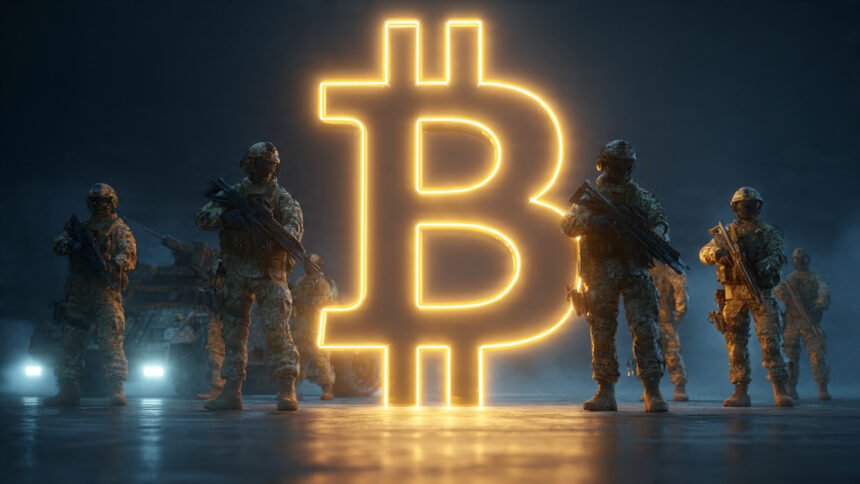

Iran’s decision to accept Bitcoin as payment for oil shipment tolls through the Strait of Hormuz has given new weight to a question already swirling in Washington. Does the U.S. military actually understand cryptocurrency well enough to use it as a tool of national power?
Waterways and Money
Approximately 20% of the world’s oil supply passes through the Strait of Hormuz. Iran announced that it would accept Chinese yuan, dollar-pegged stablecoins, and Bitcoin as tolls for passing ships.
An official at the Bitcoin Policy Institute told reporters that Iran prefers stablecoins but has high-quality stablecoins, not Bitcoin. Stablecoins can be frozen at the contract level by the issuer. Bitcoin can’t do that. No single entity controls the network. This means that no one can shut down the network or block transactions.
US Admiral Claims Bitcoin Is Key to Cybersecurity and Power Projection
Admiral Samuel Paparo saw Bitcoin as a strategic tool for U.S. cybersecurity and national strength, emphasizing the benefits of proof-of-work. (read more)
➤ https://t.co/ik53cB163F#strength #admiral #Bitcoin
— BTCN.it Short Cryptocurrency News (@bitcns) April 22, 2026
“This is one of the most important situations where Bitcoin is very clearly a strategic asset,” said Sam Lyman, head of research at BPI. He added that the reason Iran prefers BTC for certain transactions comes down to one thing: The point is that no one can freeze it.
That backdrop made what happened Tuesday in the Senate hearing room all the more clear.
BTCUSD trading at $78,030 on the 24-hour chart: TradingView
What the Admiral Said
U.S. Navy Admiral Samuel Paparo appeared before the Senate Armed Services Committee to discuss the posture of the U.S. Indo-Pacific Command.
During his testimony, he told the committee that the U.S. government operates Bitcoin nodes and described the cryptocurrency as “a combination of cryptography, blockchain, and proof-of-work,” framing it as both a computer science tool and a tool for power projection.
Lowkey loves fooling governments with Bitcoin as a tool for national security(tm). Now a decorated admiral is sitting in front of Congress raving about “Bitcoin as a valuable computer science project for American power projection.” lmao Send help https://t.co/s8dcvLssuY
– L0la L33tz (@L0laL33tz) April 21, 2026
Crypto educator Matthew Kratter wasn’t impressed. He said the admiral’s voice online sounded as if he was reading a Wikipedia page. Crater said neither Paparona nor Sen. Tommy Tuberville, who was also involved in the exchange, seemed to have a grasp of what they were actually saying.
“These two people are talking about something they don’t understand,” Kratter wrote. “All I can think is that they’re not saying anything at all.”
Journalist Lola Leetz called the testimony “babble.”
Substance behind criticism
The Bitcoin community’s response focused on basic concerns. As the U.S. military positions cryptocurrencies as strategic assets, vague language about “computer science tools” and “force projections” does not instill confidence that decision-makers understand the actual properties of the network, especially those that make it useful in high-stakes geopolitical situations.
Iran’s movements in the Strait of Hormuz have made the gap difficult to ignore. According to data from the Bitcoin Policy Institute, transactions linked to Iran’s Revolutionary Guard account for nearly half of the total cryptocurrency market size in Iran.
That’s not a peripheral use case. This means government and military agencies are actively using the network and using it for a clear purpose.
Featured image by MetaAI, chart by TradingView
editing process for focuses on providing thoroughly researched, accurate, and unbiased content. We adhere to strict sourcing standards and each page undergoes diligent review by our team of top technology experts and seasoned editors. This process ensures the integrity, relevance, and value of the content for readers.


