


- Bitcoin ($BTC) sustains above $81,000 as near-term momentum strengthens.
- Slowing network growth indicates caution in participating in the market.
- $BTC It faces significant resistance at $89,500.
Bitcoin has climbed above $81,000, extending its monthly recovery and testing its highest trading range in nearly three months.
At press time, $BTC It was trading at around $81,467, up 5.2% in the past 7 days and 17.6% in the past 30 days.
This move places Bitcoin in a key technical zone, with several fundamental indicators suggesting that the rally is still developing under conditions of caution rather than widespread market conviction.
Network activity and participation in derivatives remains suppressed
Bitcoin’s spot price has improved, but on-chain data shows weaker user participation than during previous big rallies.
Active addresses and trading activity are not increasing at the same pace as price, indicating that retail demand remains limited.
This disconnect between price and blockchain activity often suggests that current momentum is supported by institutional and large-scale investors rather than widespread organic adoption.
Institutional investor participation, particularly through spot Bitcoin ETFs, has surged, with billions of dollars of capital inflows helping to stabilize prices above key support zones.
However, participation in derivatives markets remains relatively subdued compared to previous breakout cycles, and lower speculative leverage and softer futures trading indicate traders are cautious.
Additionally, the Crypto Fear & Greed Index is currently at 50 and sentiment is in neutral territory.
This reflects neither euphoria nor fear in the market, supporting the idea that Bitcoin’s recent strength has not yet sparked widespread speculative enthusiasm.
Technical indicators show bullish momentum
Bitcoin’s short-term technical structure remains positive, with 12 of the 23 major technical indicators currently trending bullish.
moreover, $BTC is trading above its 10-day, 20-day, 50-day, and 100-day exponential moving averages, supporting continued bullish momentum.
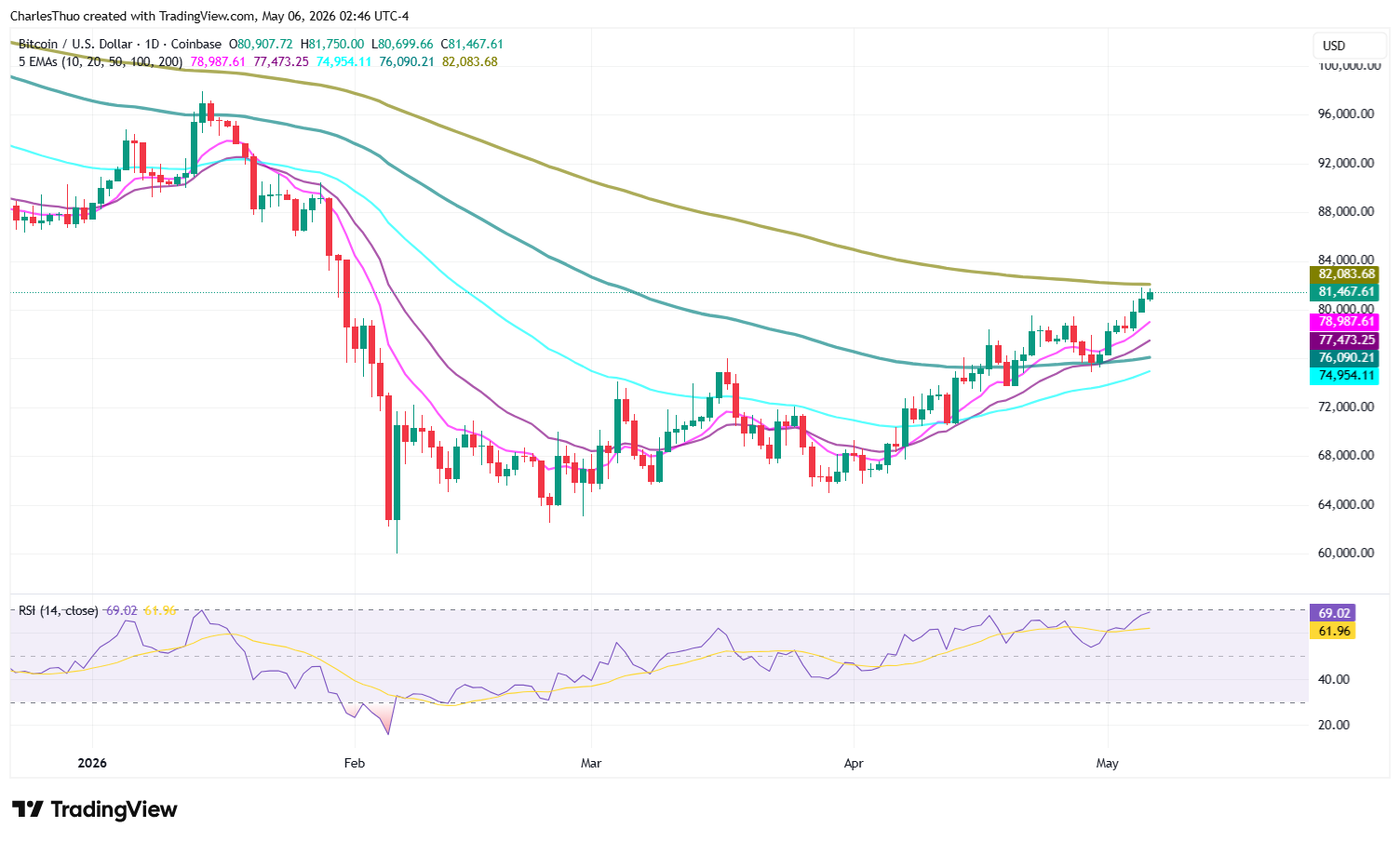
However, Bitcoin remains below its long-term 200-day EMA, indicating that macro resistance is still intact.
The 14-day relative strength index is 69.5; $BTC Just below overbought territory.
Although this suggests strong momentum, traders should closely monitor the possibility of depletion if the RSI rises above 70 without stronger volume.
Post-half-life cycles suggest late-stage expansion
Bitcoin’s fourth halving took place in April 2024, reducing miners’ rewards to 3.125. $BTC block by block.
The asset is currently approximately 25 months into its post-halving cycle.
Historically, this stage often coincides with a larger price expansion, increased volatility, and the final cycle peak before a larger retracement.
Bitcoin’s bullish cycle so far has seen new highs every 1,405 to 1,477 days.
Based on this pattern, there may still be upside room in the current cycle, but historical trends also suggest that correction risk increases as the cycle matures.
Short-term Bitcoin predictions remain cautiously bullish
Looking at the current market structure, the immediate resistance zone is at $89,479.
A confirmed close above this level could pave the way to the next resistance level near $90,975.
However, in the event of a pullback, especially if it reaches oversold territory, the key support level is $75,109.
A break below $75,109 could weaken the bullish structure and increase the likelihood of a deeper correction.
Going forward, traders should closely monitor Bitcoin ETF inflows, whale accumulations, and RSI movements to see more clearly whether the current move has the potential to develop into a larger sustained rally.


