

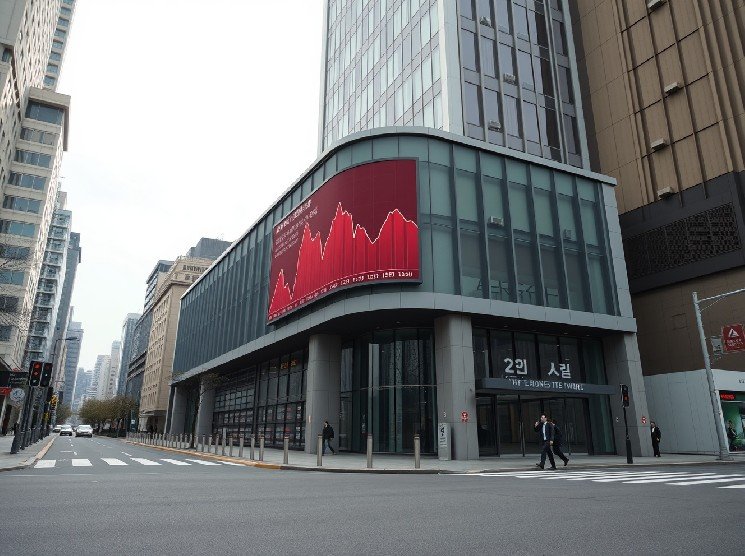
The continued rise in South Korea’s domestic stock market is taking money away from the country’s crypto sector, with small and medium-sized exchanges bearing the brunt. According to CoinGecko data recorded at 4:30 a.m. UTC on May 11, the total 24-hour trading volume of South Korea’s top five cryptocurrency exchanges reached approximately $2.39 billion (3.51 trillion won). This figure represents a decrease of approximately $100 million compared to February 11 of this year.
Smaller platforms will be hit hardest
Although the overall market is experiencing a gradual contraction, the impact on small trading platforms has been severe. On Coinone, one of the country’s mid-sized exchanges, daily trading volume fell by about 78%, from about $200 million in February to just $43.46 million. Corbitt’s decline was even greater, with trading volume plummeting by about 92% over the same period, from $245 million to $19.49 million.
These numbers highlight the growing disconnect between South Korea’s traditional financial market and the cryptocurrency ecosystem. The benchmark Kospi index has been steadily rising in recent months on strong corporate earnings and a rally in tech stocks, attracting retail investors who would otherwise have put their money toward digital assets.
Why this matters for the crypto market
The change in retail investor behavior is not entirely unexpected. South Korea has long been known for its active retail trading culture in both stocks and cryptocurrencies. If the stock market delivers higher returns while perceiving lower volatility, many traders will rebalance their portfolios accordingly. For smaller exchanges that rely heavily on retail volumes, the impact is immediate and significant.
Larger platforms like Upbit and Bithumb dominate the market with deeper liquidity and a wider range of listed tokens and are more resilient. However, the data suggests that even top-tier exchanges are not immune to broader trends in capital turnover.
Market structure and regulatory background
South Korea’s cryptocurrency market operates under a strict regulatory framework. Only exchanges that have obtained real-name account affiliation with local banks are permitted to offer Won-based trading. This creates barriers to entry and limits the number of fully licensed platforms. The current downturn for smaller exchanges could accelerate consolidation as weaker platforms struggle to maintain operational viability amid declining revenues.
Regulatory uncertainty also remains a factor. The government has signaled plans to introduce a comprehensive digital asset framework, which could impose additional compliance costs on small businesses. Combined with current market pressures, further exits and mergers in this space are likely.
conclusion
The strength of the South Korean stock market has taken retail capital away from smaller crypto exchanges, with Coinone and Korbit experiencing dramatic volume declines. While larger platforms have shown greater resilience, this trend highlights the competitive pressures faced by mid-sized and smaller exchanges amidst a tougher regulatory and market environment. Investors and industry observers should monitor whether this capital turnover sustains or reverses as conditions in the global cryptocurrency market evolve.
FAQ
Q1: Why are small-scale cryptocurrency exchanges in South Korea decreasing their trading volume?
A1: The main reason is that the strong performance of the Korean domestic stock market is attracting retail investors who are reallocating capital from cryptocurrencies to stocks.
Q2: Which exchanges were most affected?
A2: Coinone and Korbit have seen the steepest declines, with trading volumes decreasing by approximately 78% and 92%, respectively, since February 2025.
Q3: Could this lead to exchange closures or consolidation?
A3: Yes. Smaller exchanges are facing increasing pressure from declining revenues, stricter regulatory requirements and competition from larger platforms, which could lead to further consolidation of South Korea’s crypto market.


