



JPMorgan has launched a tokenized money market fund on Ethereum, marking another step for a major Wall Street institution into public blockchain-based fund infrastructure. The new JPMorgan On-Chain Liquidity Token Money Market Fund will offer token class shares under the ticker JLTXX, according to JPMorgan Trust IV’s registration filing.
The application positions the product as a government money market fund that seeks ordinary income while maintaining liquidity and stability of principal. The net expense ratio for that token class is listed as a net expense ratio of 0.16% after fee waivers and refunds, and a total annual operating expense of 0.71%. These exemptions are expected to remain in effect until June 30, 2028, unless renewed or revised.
Bloomberg ETF analyst Eric Balchunas said the fee structure was a notable part of the launch. “JP Morgan has applied for a tokenized money market fund,” he wrote to X. “Big Deal BC JPM is moving further into crypto, and Big Deal BC’s fees are pretty low at 16 bps for a stable NAV (something you can’t do with an ETF). Vanguard’s is around 11 bps, but cheaper than most money funds.”
JP Morgan uses Ethereum for tokenized treasury fund
The fund’s strategy is conservative by design. Under normal circumstances, the Company invests only in U.S. Treasury bills, bonds, bonds, and overnight cash forward contracts that are fully collateralized by Treasury securities and/or cash. JPMorgan said the fund aims to maintain a NAV of $1.00, purchase only U.S. Treasury securities with remaining maturities of 93 days or less, maintain a dollar-weighted average maturity of 60 days or less, and invest exclusively in U.S. dollar-denominated securities.
Related article: Ethereum leverage ratio drops significantly: What it means
The relevance of cryptocurrencies is in the rails, not the portfolio. According to the filing, the fund will use blockchain technology to enable investors to submit trading instructions for fund shares, while the official record of ownership will remain the transfer agent’s traditional transfer register. While token balances attributable to an investor’s blockchain address are intended to correspond one-to-one with shares in the fund, JPMorgan has made clear that the investor register, not blockchain balances, determines legal ownership.
This structure reflects the institutional compromise currently being formed around public chain connectivity, but tokenization within a managed market infrastructure. JPMorgan said the blockchain system was designed, implemented and maintained by Kinexys Digital Assets, a business unit within JPMorgan Chase Bank. The system runs as a permissioned framework on a public blockchain and requires an approved wallet address and permission list registration before investors can purchase, redeem, or transfer their token balances.
Currently, Ethereum is the only blockchain available to investors, but the filing states that expansion to other blockchains is anticipated.
This detail caught the attention of Vivek Raman, CEO and co-founder of Etherealize, who wrote via X: “Five months after MONY, JPMorgan launches second tokenized money market fund on Ethereum, the largest and most institutionalized public blockchain. BlackRock and JPM launch on Ethereum in the same week…”
BlackRock is preparing two tokenized money market funds aimed at investors who hold cash in stablecoins. That includes a digital stock class associated with the approximately $6.1 billion BlackRock Select Treasury Liquidity Fund. Following BUIDL’s success, these tokenized shares will also operate on Ethereum alongside traditional share classes, reinforcing the chain’s role as the preferred public payment method for a growing array of institutional money management products.
At the time of writing, Ethereum was trading at $2,303.
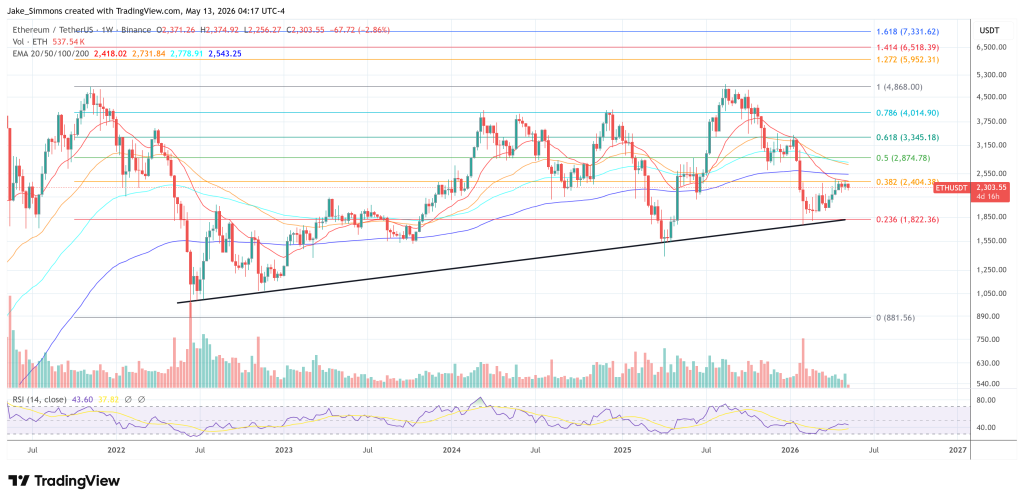
Featured image created with DALL.E, chart on TradingView.com
editing process for is focused on providing thoroughly researched, accurate, and unbiased content. We adhere to strict sourcing standards, and each page is carefully reviewed by our team of top technology experts and experienced editors. This process ensures the integrity, relevance, and value of your content to your readers.


