

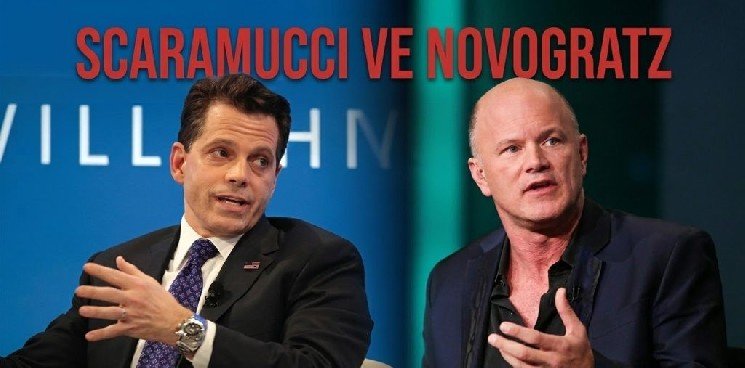
Prominent investors Michael Novogratz and Anthony Scaramucci discussed the deepening US debt burden and Bitcoin’s place in this economic climate on the show “All Things Market.”
The discussion, which ran parallel to Ray Dalio’s debt warning, discussed the performance of cryptocurrencies in current market conditions and future expectations.
One of the most impressive aspects of this program is Bitcoin’s reduced dependence on traditional technology stocks (NASDAQ). Anthony Scaramucci described Bitcoin’s inability to catch up with the Nasdaq’s all-time high as a “discontinuity.”
According to Galaxy Digital CEO Michael Novogratz, the main reasons for this situation are:
Investor attention has shifted to areas such as artificial intelligence (AI) and data centers that are considered more “attractive” compared to last year.
While some retail investors are turning to areas such as prediction markets, institutional investors are conversely starting to show more serious interest in the cryptocurrency space.
Related news Will the NFT boom that has taken the world by storm make a comeback?
Novogratz argued that Bitcoin should still be considered in the same “basket” as gold, silver and palladium in terms of its function as an inflation hedge and store of value. While Novogratz acknowledged that crypto investors may be disappointed with this year’s results, he said the sector’s infrastructure is strengthening and momentum continues.
Novogratz said he is optimistic that Bitcoin will reach the $100,000 level by the end of the year. However, he was pessimistic about gold’s chances of outperforming Bitcoin over the next 12 months, saying he believes Bitcoin will outperform gold.
Both were cautious about the possibility of Bitcoin becoming an official US reserve asset by 2028.
Based on contacts in Washington, Novogratz said political polarization is slowing down legal work on crypto market structures and stablecoins. He pointed to the influence of lobbying by bankers in the process and argued that regulatory clarity would be an important “litmus test” for the U.S. economy.
*This is not investment advice.


