



Ethereum has shed the $2,150 level amid renewed selling pressure, and the market faces a wave of uncertainty that has canceled out weeks of cautious recovery. This decline has specific origins, made visible by CryptoQuant’s data, and understanding it changes how the current weakness should be interpreted and what is needed to reverse it.
Binance’s Exchange Netflow data tells the story of what was building throughout the first half of May before the price crash. Across multiple sessions, Binance continuously recorded positive netflow measurements. This means that large amounts of ETH were deposited onto exchanges in a sustained repeating pattern rather than in a single discrete event. Each positive reading represents more coins moving from cold storage or external wallets to the venue where they can be sold most immediately and efficiently.
The supply accumulated on Binance during these sessions did not disappear. It waited. Exchange deposits represent potential selling pressure rather than a firm sale. This means that the coin is most easily located at the exit, ready to move to the market when the holder decides that the moment is right, or when the stop loss level triggers the decision.
CryptoQuant data suggests that with supply arriving ahead of the sale and Ethereum losing $2,150, the market may finally be starting to clear the inventory that has been building up on Binance throughout the first two weeks of May.
Supply arrives and prices follow suit: now the market needs time
CryptoQuant analysis directly links inflow patterns to subsequent price reactions. The order is not ambiguous. Binance accumulated a large amount of ETH deposits throughout the first half of May. The price, which had been hovering around $2,400, reacted negatively immediately after these inflows, dropping by about $300 to its current level of about $2,100.
The supply arriving at the exchange proved insufficient for demand to absorb without price concessions, and the market adjusted downward until buyers and sellers reached a temporary equilibrium.

The component identified in the analysis is the most recent session. ETH deposit pressure on Binance has cooled in recent days, and the pattern of large positive net flow readings that characterized the first half of May has not continued at the same pace. The immediate supply pipeline that caused the decline appears to have eased.
But mitigating is not the same as resolving. This analysis is accurate about what cooling sediment pressure actually means for future prospects. Supply that arrived during the inflow period does not disappear simply because new deposits slow down. Before Ethereum finds a new equilibrium point where a sustainable recovery is possible, it will remain on exchanges and available for sale, the market will require true accumulation activity, i.e. buyers willing to absorb inventory at current levels.
The current $2,100 level is where the market is testing whether that accumulation exists. Deposit statistics show that selling pressure has eased. Check the price to see if the demand has arrived to match it.
Ethereum struggles below key weekly resistance as long-term trend weakens
Ethereum is trading near $2,110 on the weekly chart after failing to sustain momentum above the key $2,300-$2,450 area, which currently serves as the market’s main resistance zone. This structure reflects a market caught between expectations for long-term recovery and sustained distributional pressure from large participants.
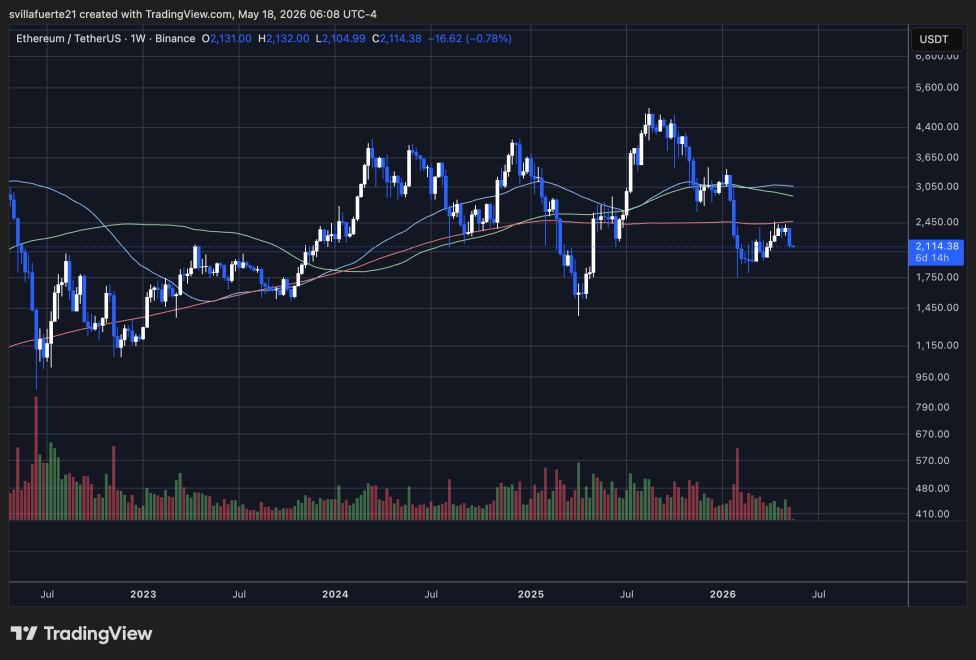
This chart shows that Ethereum lost its bullish momentum after sharply rejecting the $4,000 to $4,500 range in late 2025. Since then, Ethereum has been in an extended correction structure characterized by falling highs and repeated failures of major moving average recoveries. The recent rebound from the March lows briefly improved sentiment, but the recovery stalled as prices approached the weekly 50 and 100 moving averages around $2,400-$3,000.
Importantly, Ethereum is now trading below the weekly 200 moving average once again, indicating that the broader market structure has weakened significantly compared to previous recovery stages. Volume during the recent decline also remains high compared to recent weeks, suggesting supply pressure is still active rather than completely exhausted.
The $2,000-$2,100 zone is currently a crucial support area for the bulls. Losing this level could expose Ethereum to a fresh move towards a broader demand area between $1,700 and $1,800, where buyers aggressively defended the price after a capitulation event earlier this year.
Featured image from ChatGPT, chart from TradingView.com
editing process for is focused on providing thoroughly researched, accurate, and unbiased content. We adhere to strict sourcing standards, and each page is carefully reviewed by our team of top technology experts and experienced editors. This process ensures the integrity, relevance, and value of your content to your readers.


