

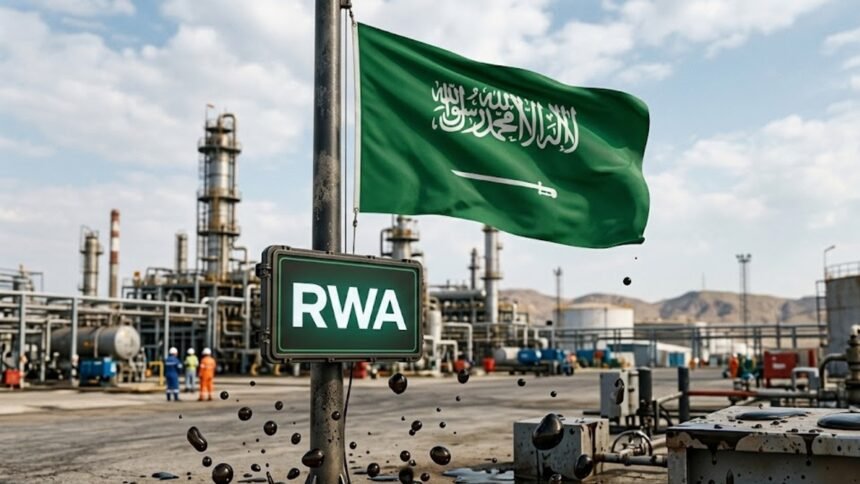
Saudi Arabia is integrating real world asset (RWA) tokenization directly into the country’s financial infrastructure with strong government support. According to tokenization firm TokenFi, Arab countries are aware that sovereign infrastructure for these instruments will be followed by other countries.
Having completed the first national decentralized infrastructure, the country has demonstrated the feasibility of reducing real estate settlement times from days to seconds and is at the forefront of digital transformation through the use of decentralized networks. This is a movement that contrasts with the pace of development in Western countries.
The country’s asset managers’ decision to accelerate this transition is in response to recent strategic factors. When geopolitical tensions first erupted between the US and Iran earlier this year, crypto markets remained the only financial channel operating 24 hours a day. Meanwhile, traditional stock exchanges have ceased operations.
This scenario demonstrated the value of a digitally native payments infrastructure that remains active regardless of global conflicts. This is a quality directly inspired by the uninterrupted operation of the Bitcoin protocol.
For Saudi Arabia, one of the world’s richest oil nations, the move to a decentralized network represents a logical step in its financial evolution. Additionally, the Saudi economy has already digitized payments through the national SADAD system, processing around $250 billion in 2025, according to figures cited by TokenFi. The current step is to move that efficiency to an on-chain environment. To ensure certainty of ownership and transactions without intermediaries.
Additionally, Arab countries have the advantage of being able to simultaneously build both technical and regulatory frameworks from scratch. Through direct central bank intervention, This strategy allows you to overcome the limitations of legacy systems. TokenFi points out that technology adoption has been slow in Western countries, where the definition of these assets is still being debated.
The designed ecosystem allows ownership of real assets such as real estate, energy, and manufacturing to be represented with digital tokens on a decentralized network. This mechanism allows for instant purchase, sale, division, and liquidation operations. TokenFi emphasizes that the country’s ambitions are not limited to real estate. But it covers a multi-million dollar energy production sector.
The company also highlights that the structure operates under the supervision of the General Real Estate Authority (REGA) and the Capital Markets Authority (CMA). Similarly, the Saudi Central Bank (SAMA) is responsible for monitoring payment channels.
Pilot testing in a controlled regulatory environment (sandbox) Companies such as the National Housing Company are participating, along with a variety of investors and technology companies. Therefore, TokenFi predicts that the real estate payment system based on stablecoins will be officially implemented at the end of 2026.
This development coincides with the expansion of the global market for tokenized assets, which has reached a valuation of $33 billion, up from $7 billion the previous year, as shown in the chart below.
This growth has been driven by the tokenized US Treasury bond and stablecoin market, which accounts for $15.5 billion of the total. Its total capital already exceeds $320 billionas seen in the following graph.
Panorama of the Gulf and Wall Street correspondence
Saudi Arabia’s efforts are running in parallel with other efforts in the region. In Dubai, the Ministry of Lands manages: sandbox Meanwhile, the Virtual Assets Regulatory Authority (VARA) oversees over 80 licensed digital asset service providers and is accelerating the tokenization of physical goods such as gold and oil. Meanwhile, Abu Dhabi is strengthening its own regulatory framework through the ADGM financial free zone.
In contrast, Wall Street is moving forward through entities such as BlackRock and JP Morgan under the guidelines of the Clarity Act, which was approved by the U.S. Senate Banking Committee on May 14, 2026.
However, TokenFi emphasizes that the structural difference lies in the fact that North American companies are trying to adapt tokenization to existing regulatory frameworks, whereas the Gulf region has been building an institutional financial ecosystem with state support from its origins.
Despite government optimism and the predictions of companies like TokenFi, tokenization faces debates of a technical and geographical nature. The Pantera Capital report for Q1 2026 shows that the majority of current tokenized assets serve only as receipts or digital replicas backed by off-chain processes.
Dunning Sui, the company’s research director, likens this stage to the early days of the Internet, when print media was limited to replicating static formats within web pages. This is because tokenized assets have not yet adopted the inherent programmable nature of Bitcoin technology.
In addition to technical limitations, stablecoin expansion creates institutional friction with incumbent banks. As reported by CriptoNoticias, Juan Carlos Reyes, president of El Salvador’s National Commission for Digital Assets (CNAD), pointed out in the framework of the Salvadoran Digital Assets Summit conference that the integration of these financial tools would mean regulatory battles in each country due to traditional financial resistance.
Reyes contrasted El Salvador’s political agility with the panorama of other Central American countries. In Honduras, for example, commercial banks will maintain restrictions on interacting with digital assets after 2024.
In Guatemala, there is no specific regulation in this area, while in Costa Rica, traditional financial institutions are operating with extreme caution in the face of legislation proposing restrictions on the use of Bitcoin.
The contrast between the introduction of sovereignty in the Gulf region and regulatory hindrance in other regions shows that the development of on-chain infrastructure is highly dependent on national policies.
By introducing these systems, Saudi Arabia believes tokenization is not a temporary trendBut it is a decisive transformation in global finance that aims to set operating standards for years to come, challenging both the technological skepticism of Wall Street and the barriers of banks elsewhere.
(Tag to translate) Cryptocurrency(s) Inversion(s) Related


