

Coinbase Derivatives will introduce perpetual-style stock index futures to the U.S. regulated market on June 8, giving traders direct exposure to artificial intelligence (AI), Chinese stocks, defense, and a wide range of technologies through four new thematic contracts.
Important points:
- Coinbase Derivatives will launch perpetual-style stock index futures on June 8, 2026 for U.S. regulated markets.
- The four contracts, covering AI, China, defense and technology, allow traders to gain thematic exposure through a funding rate mechanism.
- Retail access to Coinbase’s AIP, CHN, DEF, and TEK Perp contracts is planned for the coming months.
US traders get regulated stock PERP from Coinbase derivatives on June 8th
The exchange announced the launch on Thursday. “We’re adding more ways to trade stocks on Coinbase,” the company wrote. “Trade long or short the most popular sectors and trends.” The contract covers four indices: AI10 (AIP), China10 (CHN), Defense10 (DEF), and Tech100 (TEK).
Perpetual futures, commonly referred to as perps, are derivative contracts that allow traders to speculate on the price of an asset without an expiration date. Unlike traditional futures that settle on a fixed date, PERP can be held indefinitely. To bring the contract price closer to the actual market price, exchanges use a funding rate mechanism.
If Purp trades above the spot price, long holders pay a fee to short holders. If it trades below, short holders will pay out their longs. Fundraising typically occurs every 8 hours. This system locks in prices without the need for contract rollovers.
Coinbase Derivatives applied the same structure to its stock index. Each contract is cash settled and represents 1x the underlying index. For example, if the Marketvector US Listed Innovators 100 Index is priced at $4,000, the notional value of the Tech100 contract is $4,000. The AI10 Index Perpetual-Style Futures tracks the top 10 U.S. publicly traded companies that generate at least 50% of their revenue from AI infrastructure, data, and applications.
The underlying Market Vectors U.S.-listed AI 10 index covers four segments: big data, fabless semiconductors, hyperscalers and AI-as-a-service, and hardware and data center solutions. Constituents are weighted by float-adjusted market capitalization of up to 15% per stock and rebalanced quarterly.
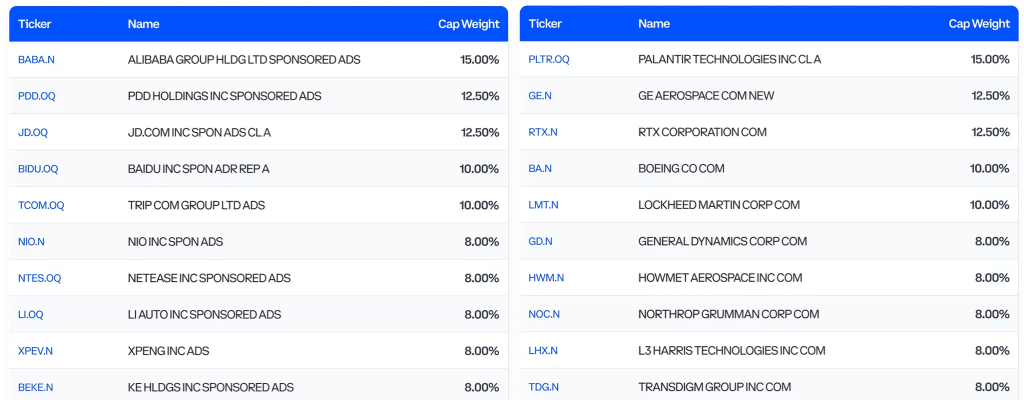
The China10 contract tracks the 10 largest and most liquid Chinese companies listed on US exchanges as American Depositary Receipts on Nasdaq and the New York Stock Exchange. Similar to AI10, a 15% concentration cap and quarterly rebalancing apply.
Defense10 targets the top 10 publicly traded U.S. aerospace and defense companies that derive at least 50% of their revenue from defense-related businesses. The same 15% cap and quarterly rebalancing apply. Tech100 is the broadest of the four.
Tracks 100 Nasdaq-listed companies across technology, communications, consumer goods, industrials, materials, healthcare, consumer staples, and energy. There is no concentration cap applied to this index, so the weighting is driven by the market’s natural leadership.
It owns the top 80 companies by float-adjusted market capitalization, and adds or removes the largest and smallest shares of the top 120 companies to maintain a holding of 100 shares. For US traders, regulated access to perpetual-style contracts associated with stock themes is limited.
Offshore exchanges offer a similar structure, but without the oversight of a registered U.S. futures exchange. Coinbase Derivatives says it operates on a regulated market infrastructure with centralized liquidity and transparent price discovery.
The deal also has tax benefits. As a futures, it falls under the 60/40 rule where 60% of the gain is taxed as long-term capital gain, regardless of the holding period. Such treatment is not available when trading the same exposure directly through stocks or exchange-traded funds (ETFs).
But criminals come with real risks. High leverage magnifies losses on small price movements. If a trader holds a position on the wrong side for a long period of time, funding fees will accumulate. And, as with all centralized exchange products, users assume counterparty risk.
Coinbase said it will provide further details on trading access through partner platforms in due course. Retail sales are expected to begin in the coming months. The June 8 launch marks the first time Coinbase Derivatives has applied the perpetual-style framework it developed for crypto futures to the equity space in a U.S. regulatory environment.


