

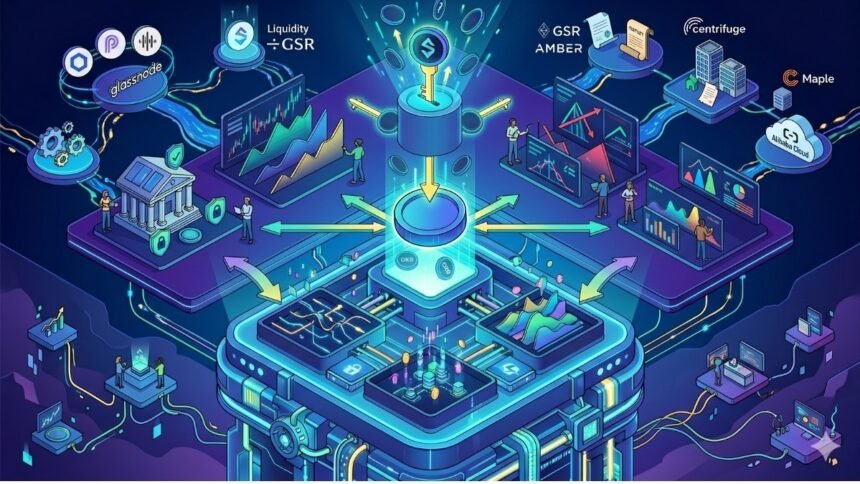
On May 26th of this year, OKX announced Exchange OS, a protocol built on an X-tier Layer 2 network that exposes technology trading infrastructure to the public. This system allows Web3 developers, institutions, and teams to deploy their own exchanges using spot, perpetual, or prediction markets without having to build order matching, margin, clearing, and settlement components from scratch.
The company claims that This launch is in response to the structural limitations of the market: On-chain trading infrastructure is fragmented across unconnected platforms, forcing duplication of engineering efforts with each new project.
According to OKX, Exchange OS moves core trading functionality such as matching, margin, settlement, and risk management to the protocol level, while traders maintain control over interface design, market structure, and regulatory compliance models.
To access the system, developers must stake OKB (OKX’s native token) into an X Layer staking contract. The company has not specified a minimum requirement, but specialized media has pointed out that the barrier is significant and the requirement has become a de facto financial filter. Despite its declared open nature of the protocol.
The model is without permission In theory, mandatory OKB staking acts as a financial filter; Centralize privileges in native OKX tokens. Some analysts compare it to Hyperliquid, which follows a similar logic.
How the protocol works
Exchange OS operates in two environments within the X layer. The first, X-layer EVM, anchors assets and performs governance. The second one is X Layer TradeZone; Manage high frequency order matching. Both environments are synchronized using protocol-specific state synchronization mechanisms.
within Protocol restrictions, each platform can set its own risk rules And access. OKX suggests that the same operator could, for example, offer institutional services with KYC while another could operate a fully open marketplace. It uses the same infrastructure base.
protocol too The company says it includes a unified account system.This eliminates the need to split capital between platforms and allows you to operate the same balance in spot, perpetual, and prediction markets at the same time.
Phased rollout and initial partners
launch Follows a 3-step plan. The first is currently active and includes a select group of partners who will build the protocol before its public availability in Q3 2026. Protocol improvements are planned for Q4 And since then, according to white paper Published by OKX.
Announced partners include data providers such as Chainlink, Pyth Network, and Glassnode. Liquidity companies such as GSR and Amber Group. It also includes real-world asset projects such as Centrifuge and Maple Finance. OKX also mentions Alibaba Cloud as an infrastructure provider and Chainalies as a compliance component.
OKX says its model is not designed to compete with other exchangesbut they will be the layers that are built. However, the mandatory staking of OKB makes the token an operational requirement for attackers seeking to introduce it into the system, giving it a role beyond its current role as an X-layer gas token.
In this way, the platform not only competes for users, but also aims to become the infrastructure layer that other platforms build on top of. A movement to redefine our role in the ecosystem.
However, while Exchange OS promises the possibility of more diverse markets, faster execution, and spot, persistent, and predictive operations in the future, the actual benefits will depend on actual adoption and the number of projects that decide to launch their markets on this infrastructure.
(Tag translation) Casa de Cambio (Exchange)


