


The Bitcoin network received a new difficulty increase this week with block height 951552, dialing it up by 1.72% by the protocol. Meanwhile, the network’s hashrate continued to go strong, passing the threshold of 1,000 exahashes/second (EH/s) or 1 zettahash/second (ZH/s).
Important points:
- On May 29th, Bitcoin difficulty increased by 1.72% as the hashrate exceeded 1.02 ZH/s.
- Hashprice has fallen 13.56% from the month’s high, weighing on miner margins in May, according to Hashrate Index data.
- Renewablox co-CEO sees Bitcoin mining evolving beyond hashing power as the June 12th hard times approach.
Bitcoin difficulty approaches 139 trillion, causing a revolution in the industry
According to market data, the price of Bitcoin has fluctuated between $72,800 and $77,700 for the past seven days. These price levels are putting pressure on mining profitability, weighing on Bitcoin mining revenue and the value generated by 1 petahash per second per day (PH/s) of computing power, a metric better known across the industry as the hash price.
According to data from hashrateindex.com, as of this weekend, the hash price remained at $33.71 per PH/s per day, which means that miners’ income is 4.99% lower than 30 days ago. What makes this decline all the more remarkable is that Hashprice briefly touched the $39 per PH/S mark twice in the past month. At current levels, the indicator is 13.56% below its recent high.
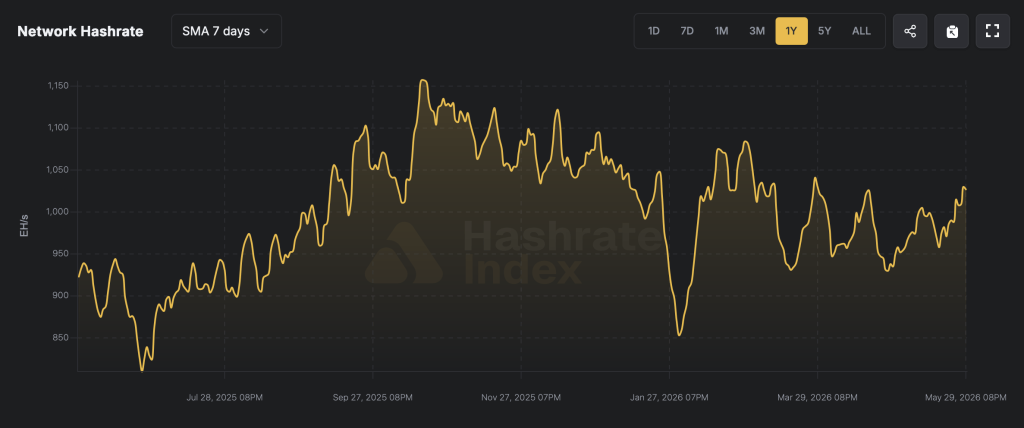
Meanwhile, Bitcoin miners continue to add computing power despite the hit to revenue. Network processing power continues to increase, even as margins shrink. This week, Bitcoin’s hashrate once again crossed the 1 ZH/s threshold, standing at 1,018.59 EH/s, or approximately 1.02 ZH/s, as of Saturday, May 30, 2026. Total hashrate has increased by 6.32% since reaching 958 EH/s on May 18th.
Jason Dean: “The Bitcoin mining industry is changing”
Renewablox co-CEO Jason Dean said this week that Bitcoin’s recent difficulty increase to 139 trillion has returned the network to levels first seen around September 2025, while pointing out that over the past eight months, difficulty has hovered between roughly 126 trillion and 156 trillion. He added that while large miners continue to shift resources to artificial intelligence (AI) infrastructure, the network’s natural growth is offset by the exit of unprofitable miners due to pricing pressures, so hashrate has remained “little changed overall.”
Dean believes the industry has evolved beyond pure mining and is focused on grid balancing, heat generation, decarbonization and reducing wasted energy. “The Bitcoin mining industry is changing and, in my view, will likely become less focused over time,” he wrote to X.
This growth accelerated block generation and ultimately led to a difficulty adjustment on May 29th with a block height of 951,552. According to data from Cloverpool.com, network difficulty increased by 1.72%, from 136.61 trillion to 138.96 trillion. Meanwhile, Bitcoin miners continue to add computing power despite the hit to revenue. Even as margins get thinner, network processing power continues to increase.
With the hashrate remaining above 1 ZH/s, blocks will arrive a little faster on average at 9 minutes and 53 seconds, and the next difficulty adjustment is predicted to occur on June 12th. For now, the network continues to exhibit the usual contradictions. That said, competition among miners remains intense even though mining revenues have cooled.
If the hash rate remains above 1 ZH/s and block times continue to execute ahead of schedule, Bitcoin could be headed for further difficulty increases in mid-June, adding further pressure to an industry already weathering tough economic times.
If this trend continues, the results could be consistent with Dean’s view that Bitcoin mining is gradually expanding beyond raw hash power into a more decentralized industry focused on energy efficiency, grid services, and infrastructure innovation.


