

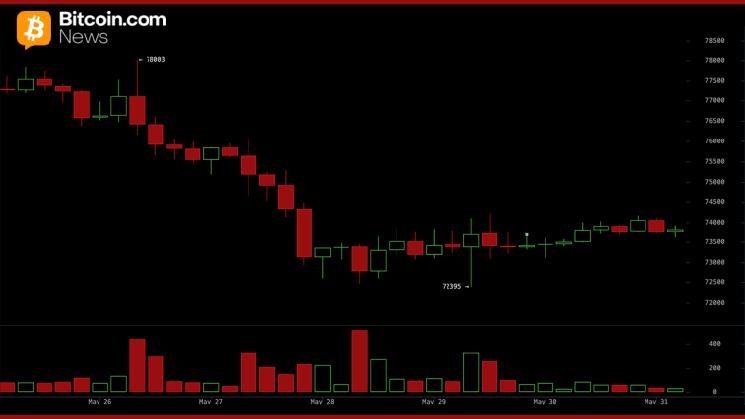
On May 31, 2026, Bitcoin traded around $73,840 and got stuck in a narrow range between $73,412 and $74,110 as technical indicators indicated bearish pressure and institutional investors moved in the opposite direction. As stablecoin dominance rises, with Tether burning more than $1 billion in 24 hours and BlackRock offloading $2.1 billion worth of Bitcoin in the past 10 days, traders are keeping an eye on a few key levels to determine whether the next move is a recovery or a flush towards $70,000.
Important points:
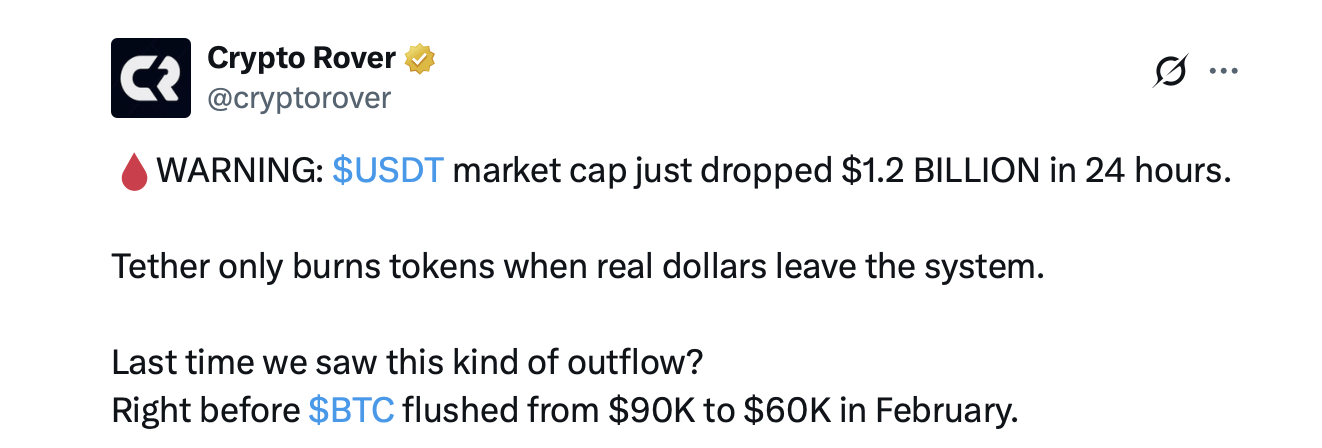
- Tether burned $1.2 billion in 24 hours on May 31st, matching a pattern from before Bitcoin fell from $90,000 to $60,000 in February 2026.
- BlackRock removed $2.1 billion in Bitcoin in 10 days, while companies like Strive retrieved $1,100 $BTC in a single session, reflecting a split in beliefs within the organization.
- Polymarket projects an 85% chance that Bitcoin will reach $70,000 before $90,000, and TradingView’s moving averages support a strong sell position at current levels.
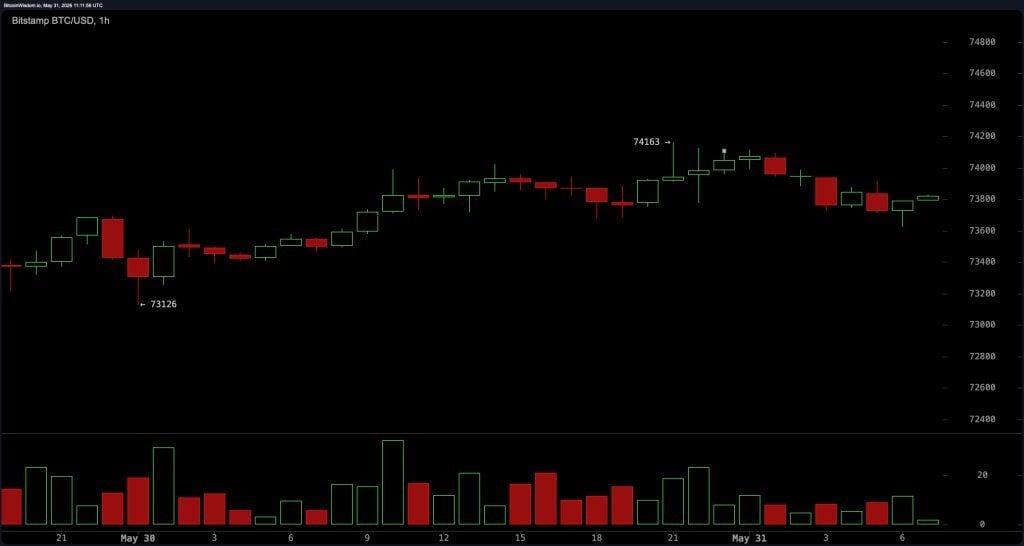
1 hour chart: compression during resistance
On the hourly chart, Bitcoin has made a series of new lows since testing $73,100, a structure that suggests short-term buying interest. However, the price has been repeatedly rejected around $74,100 to $74,200, and repeated ceiling tests have compressed the price into an increasingly narrow range.
The intraday support zone lies between $73,600 and $73,700, with $73,100 serving as an important floor below that. If the hourly closing price is confirmed above $74,200, it will open the way to $75,000 and then $76,000. If the price closes below $73,500, the short-term structure will turn bearish and bring $73,100 and then $72,400 back into focus. Momentum is slow in this time frame and the volume does not confirm any direction in either direction.
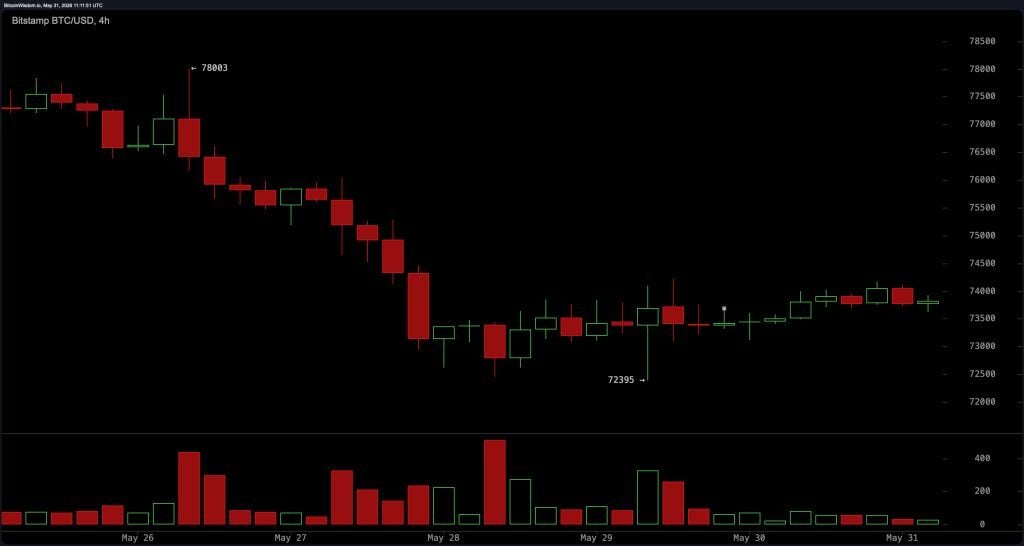
4-hour chart: flat after a sharp decline
The 4-hour chart tells a story of consolidation after a significant drop. Bitcoin plummeted from around $78,000 to a low near $72,400, and since that drop, the price has hovered between $73,000 and $74,500. During the sideways period, volume has been steadily decreasing, indicating that neither buyers nor sellers are compressing positions at current levels.
This structure is similar to a cumulative range, but no visible breakout has occurred. Traders looking for an aggressive entry point are eyeing the $73,000 to $73,300 zone, while a more conservative entry would require a sustained close above $74,200 to $74,500. The first meaningful upside target is $74,500, followed by $76,000 and $77,500 on a broader recovery. A break-and-hold below $72,400 invalidates the consolidation thesis and risks starting a move towards $71,000 to $70,000.
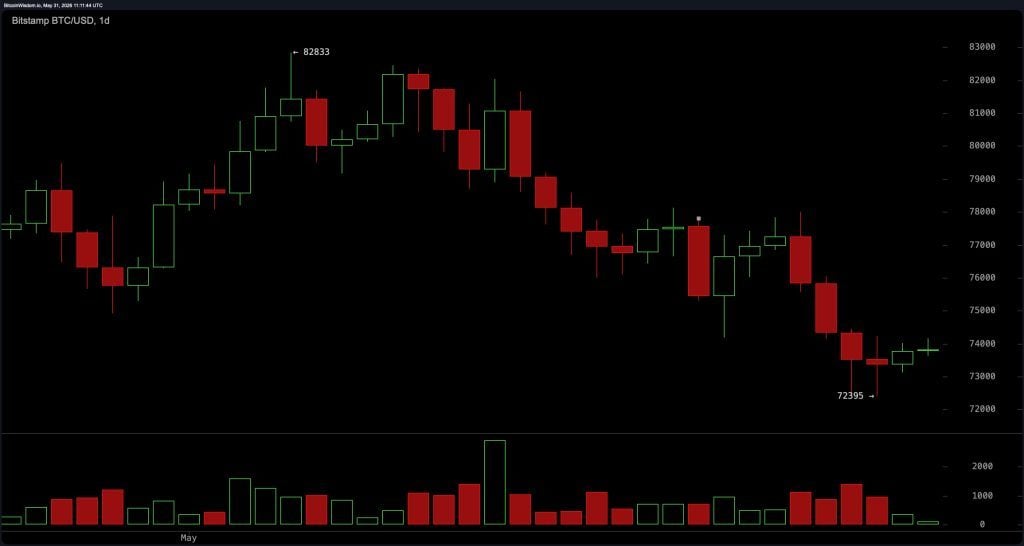
Daily chart: bearish structure remains
The daily chart remains the most difficult for bulls to read. Since Bitcoin broke through around $82,800, it has repeatedly experienced falling highs and falling lows, forming a clear downward trend. The most recent daily low was around $72,400, and although there has been a slight rebound since then, there has been no reversal candle or recovery of the high, confirming that the downtrend is over.
Volume has increased during the decline, but analysts see this as a full-scale distribution rather than a temporary shakeout. Daily resistance lies at $74,500, $76,000, and $77,500. The broader trend bias remains neutral to bearish until Bitcoin regains the $76,000 to $77,000 zone at the daily close. TradingView’s Aggregate Moving Averages panel reflects this, with 11 of the 15 moving averages issuing sell signals relative to the current price, including the 10, 20, 30, 50, and 200 period exponential moving averages and simple moving averages.
Influencers and prediction markets issue a warning
Some of the most popular voices in the Bitcoin industry directly issued a warning at the end of May. Crypto Rover, a YouTuber with over 200,000 subscribers, reported on Sunday that Tether’s market cap had fallen by $1.2 billion in 24 hours, noting that token burn only occurs when real dollars leave the system. As a comparison, he pointed to a similar Tether outflow that occurred before Bitcoin fell from $90,000 to $60,000 in February.
In another post from the same morning, Crypto Rover observed the dominance of stablecoins measured as USDT.D plus USDC.D, regaining the bull market support band above 10.5%, and described this as a classic risk-off rotation from Bitcoin to its cash equivalent. Furthermore, Polymarket data shows that there is an 85% chance that Bitcoin will reach $70,000 before hitting $90,000. Meanwhile, multiple market participants also noted that BlackRock’s IBIT has leaked $2.1 billion worth of Bitcoin in the past 10 days.
Oscillators and moving averages: neutral and strong sell combinations
The technical situation as of Sunday morning (7:30 a.m. ET) is split into several readings that are not pointing in the same direction. The Oscillator Composite Index is neutral, the 14-period Relative Strength Index (RSI) is 37, the Stochastic RSI First is 10, which is a bullish sign, and the Commodity Channel Index (CCI) is -117, again suggesting upside. The Moving Average Convergence/Divergence (MACD) level sits at -1,105 and is pointing down, and the momentum indicator at -3,843 also reflects that reading. The final result of most oscillators is a neutral aggregate, reflecting price movement within a range rather than a committed directional movement.
The Moving Average (MA) panel tells us something different. The 10, 20, 30, 50, and 200 period exponential and simple moving averages are all above current price and flag bearish pressure. Only the 100-period simple moving average of $73,167 and the Hull moving average of $72,795 are bullish. The volume-weighted moving average of $77,393 further strengthens the bearish trend. The overall moving average summary shows a strong bearish trend, which means the current price is below most medium- and long-term trend benchmarks. Until Bitcoin regains those levels, the technical backdrop will continue to favor the downside, even if short-term charts indicate stabilization.
Bullish verdict:
Bitcoin remains above $72,400 due to sustained selling pressure, with corporate buyers still pushing into current levels with record single-day purchases, and short-term chart structure pointing to higher lows forming. If the hourly closing price is confirmed above $74,200, the door opens to above $76,000.
Bear verdict:
11 of the 15 moving averages are lower, BlackRock pulled $2.1 billion from the market in 10 days, Tether burned $1.2 billion in 24 hours, matching the pattern before the $90,000 to $60,000 drop, and Polymarket puts an 85% chance of Bitcoin touching $70,000 before hitting $90,000. The daily trend continues to be lower highs and lower lows, with no reversal confirmed.


