



Ethereum is trading below $1,700 as the market faces a key test that will determine whether current levels hold as support or give way to further deterioration. Prices are already down about 28% from recent levels, and CryptoQuant analysts say developments in derivatives data have identified that the current weakness has a structural backdrop that goes far beyond short-term price movements.
The most important signal is not the price decline itself, but the way open interest reset across major exchanges during the decline. Derivative positioning accumulated over 2025-2026 is being unwound, and the scale of that unwinding has now returned multiple venues to levels last seen in April 2025, effectively erasing more than a year’s worth of leveraged exposures in a compressed period.
On Gate.io, ETH open interest decreased from $4.84 billion on May 7th to $2.68 billion on June 9th. That’s a drop of about $2.16 billion, or about 45%, in just over a month. The current figure almost exactly matches the $2.67 billion recorded on April 11, 2025. Bybit shows a similar pattern, with open interest near $805 million, effectively matching the $795 million level on April 9, 2025.
Two major exchanges simultaneously returned to the April 2025 market structure. The leverage that had built up throughout the subsequent period was de-leveraged. The fact that Binance’s funding rate has turned negative confirms that the remaining futures contracts are not showing bullish conviction. It shows uncertainty at best and mild bearish bias at worst.
Funding tells the true story
CryptoQuant analysis identified asymmetry between venues as a detail that prevents the open interest reset from being read as a clean structural liquidation. Gate.io and Bybit have both returned to April 2025 levels. Leverage accumulated over more than a year of market activity was erased in a matter of weeks. Binance is not following the same path. Binance’s ETH open interest is hovering around $2.76 billion, hovering around that high, while other major exchanges have seen sharp declines around this.
Binance’s sustained positioning does not automatically indicate a bullish intention to remain in the market. Funding rates provide more accurate information. At around -0.0038, Binance’s funding turned negative again. Traders are not paying a premium to hold long exposures. Open interest exists, but the belief behind it has moved from directional to defensive.

Ethereum Funding Rates Binance | Source: CryptoQuant
This combination creates a specific market message that the report identifies. The derivatives reset is real, but uneven. While some exchanges have fully deleveraged, Binance has maintained its position on the back of funding that reflects caution rather than confidence. Negative financing during price declines represents one of three conditions: defensive positions by participants hedging existing exposures, short pressure by traders betting on a recovery, or simply a lack of active long conviction from participants who may be paying to hold bullish exposures.
All three of these conditions indicate that the market is preparing to move higher. Together these describe a partially reset derivative structure, but the most important venues retain their remaining positioning without any directional commitment to make that positioning constructive.
Ethereum breaks out of February lows — can bulls defend the last major weekly support?
Ethereum is trading around $1,670 after suffering one of the most severe weekly collapses of the cycle, with the price now below February lows and reaching levels not seen since early 2023. This move is significant as it invalidates a broad trading range that includes ETH for most of 2026 and confirms the continuation of the bearish structure that has developed since the rejection from the cycle peak at $4,800.
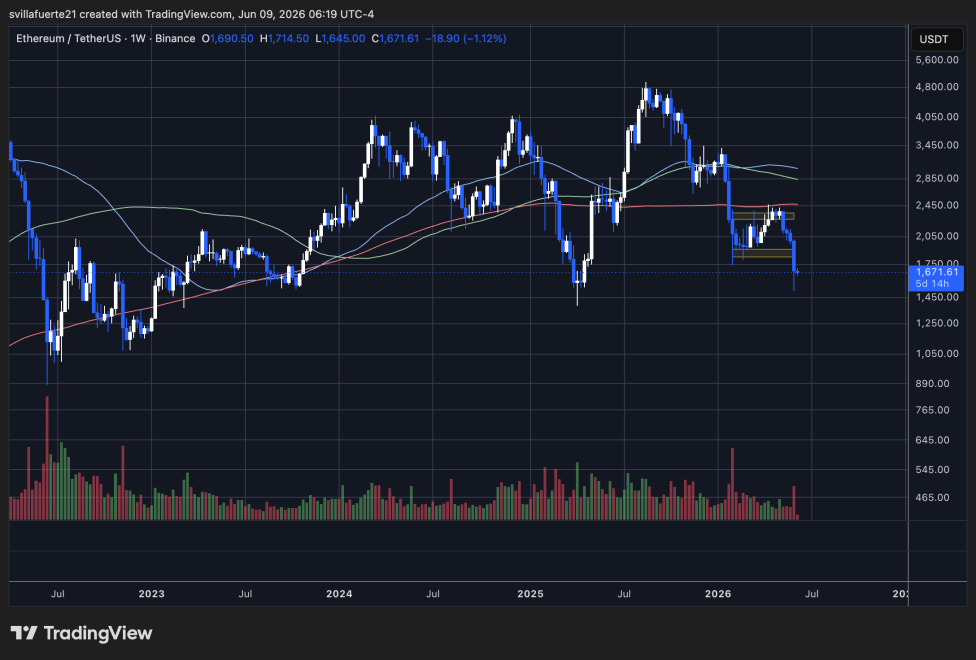
Ethereum consolidates below $1,700 level | Source: ETHUSDT chart on TradingView
From a market structure perspective, a chart is defined by a clear sequence of falling highs and lows. After failing to break above the $2,250-$2,350 resistance zone, Ethereum lost the key $1,800 support area that had served as the lower bound of the February-March consolidation. This collapse triggered a rapid move towards the $1,500 area, where buyers ultimately stepped in to prevent a severe collapse.
The most important detail is that ETH is currently trading below all major weekly moving averages. The 50-week, 100-week, and 200-week moving averages are currently concentrated well above the price, reinforcing the strength of the prevailing downtrend and creating significant resistance overhead.
The recent lows near $1,500 currently represent the most important support level on the chart. If buyers are able to defend that area, Ethereum could try to build base and recover towards $1,800. However, a weekly close below the recent lows would expose the market to a deeper retracement towards the $1,300-$1,400 area, extending the correction and confirming further deterioration in the long-term market structure.
Featured image from ChatGPT, chart from TradingView.com
editing process for is focused on providing thoroughly researched, accurate, and unbiased content. We adhere to strict sourcing standards, and each page is carefully reviewed by our team of top technology experts and experienced editors. This process ensures the integrity, relevance, and value of your content to your readers.


