

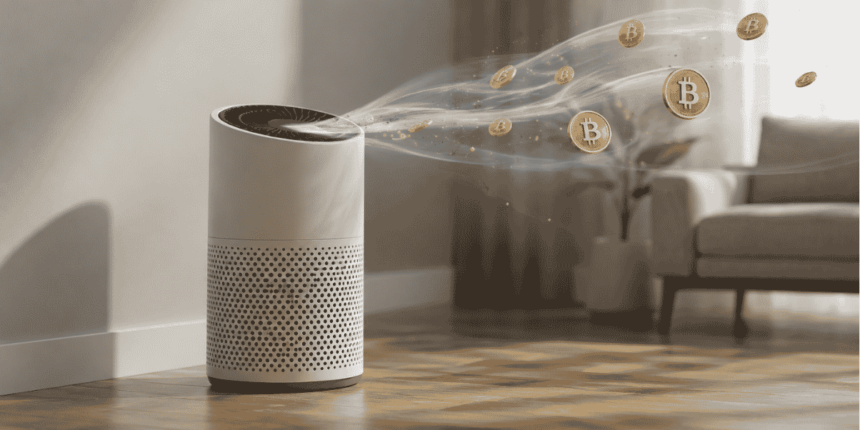
On June 11, 2026, startup Heatbit announced the pre-sale of “Bitair,” an air purifier with a built-in Bitcoin (BTC) miner. The device joins a new trend of consumer electronics integrating mining hardware, a proposal that seeks to move mining into the home environment, although the economic outcome is uncertain.
According to the company, Bitair combines a True HEPA filtration system for rooms up to 200 square feet with an ASIC chip that can deliver 1.2 terahash per second (TH/s) to the Bitcoin network. This device consumes 20 watts of power and operates at a noise level of 25 to 44 decibels.
It is worth noting that users can choose to mine solo or join a mining pool through the mobile application. In individual mode, Heatbit Probability of finding a complete block of Bitcoin Approximately 1 in 17,200 people per year. If achieved, the user will receive the full amount of the current reward, 3,125 BTC.
However, this diagram shows the limitations of the device as a mining tool. Bitair’s 1.2 TH/s is a fraction of the ASIC equipment used by professional operators, which typically exceed 200 TH/s per unit. In reality, most users who want to earn regular rewards will need to connect to a pool and receive a portion of their Bitcoins on a regular basis.
Mining moves into consumer electronics
As reported by CriptoNoticias, Bitair is not the first attempt to integrate Bitcoin mining into home devices. During the January 2026 CES fair, Superheat announced the H1, a 50-gallon water heater equipped with an ASIC that can reach approximately 120 TH/s. The device uses heat generated from mining to heat water, replacing some of the energy normally consumed by electric heaters.
A year ago, ASIC manufacturer Canaan unveiled the Avalon Mini 3, a home heater designed to generate approximately 37.5 TH/s while cooling indoor spaces.
Heatbit itself had already explored this concept with its Trio and Maxi models, which combine heating, air purification, and Bitcoin mining with significantly higher capabilities than the new Bitair.
These products share the same idea. The residual heat from mining is used to perform daily functions within the home. However, no one has been able to demonstrate that integrated mining can be a significant source of income for the average user.
Profitability is questionable
The main criticism leveled at this category of devices is related to their economic viability rather than their technical performance.
Reviews from professional media and users of previous Heatbit models indicate that the income earned is usually reduced compared to the initial cost of the equipment and associated energy costs. some analysis Describe these products as recreational or educational equipment Rather than as an investment that can be profited through mining.
In this regard, Bitair Seems to fit more into the category of technical curiosity Rather than as a tool to generate income. Its main appeal lies not in competing with large-scale mining operations, but in enabling symbolic participation in the network from common objects like air purifiers.
The emergence of devices like Bitair has no relevant impact on the current network structure, but is part of a trend of products that seek to bring Bitcoin mining closer to the home environment. in fact, Global hashrate is dominated by large industrial operationsaccess to cheap energy and optimized hardware.
In this context, these devices serve more as consumer experiments or hybrid products for home use than as actual competitive mining alternatives. Its value lies primarily in the conceptual integration of mining. Based on everyday goods rather than economic or technical viability within the Bitcoin ecosystem.


