

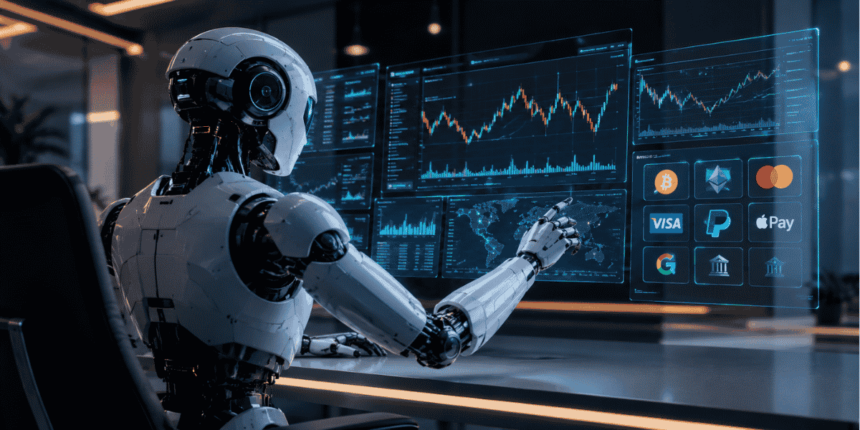
The global financial system is transitioning to an infrastructure where artificially intelligent agents autonomously execute transactions, manage capital, and make payments. In June 2026, Coinbase, Visa, and Tether simultaneously launched and announced initiatives aimed at enabling what they called the “surrogate economy.” However, these are still in their early stages and have varying degrees of technical and regulatory maturity.
This trailer comes after a series of recent releases. Enabling artificial intelligence agents to execute transactions in real-world environments for the first timeboth on exchange platforms, payment networks and physical devices.
Coinbase has introduced “Coinbase for Agents”, a CLI and MCP system. Allows you to connect artificial intelligence models to user accounts Via an API key with limited permissions. The system allows operations such as trading, remittances, and portfolio management to be performed under programmable security conditions, including segregated subaccounts, operational restrictions, and pre-validation of transactions.
Visa reports that its stablecoin payments infrastructure has already reached nearly $7 billion in annualized value and announced plans to collaborate with third parties to enable payments initiated by artificial intelligence agents.
The stated goal is to enable automated purchases within a digital environment with user-defined limits, with Visa acting as a verification and dispute resolution layer. However, this model raises questions regarding liability, transaction reversibility, and control in self-executing scenarios.
Meanwhile, Tether led an investment round of up to $1.4 billion in NEURA Robotics. Integrate self-custody wallets directly into humanoid robots. This effort includes integrating storage and payment tools into robotic systems. NEURA Robotics develops humanoids (what the company calls “physical AI”) that can interact with their environments through advanced sensors and artificial intelligence models, providing industrial and home applications.
Alongside these announcements, it is notable that broader trends consolidated within the ecosystem during 2026. The emergence of wallets designed for artificial intelligence agents. MetaMask, Coinbase, Cobo, and Trush Wallet are some of the companies that have focused their wallet design on autonomous agent operational interfaces with economic execution capabilities.
Security challenges in autonomous systems
Advances in these tools correspond to structural changes. While digital markets operate continuously, artificially intelligent agents can now perform actions without continuous human intervention. but, Autonomy brings new layers of risk. Configuration errors, excessive privileges, and system vulnerabilities can lead to loss of funds and unexpected behavior.
In this context, NVIDIA announced SkillSpector, a proactive audit system that assesses agent skills before execution. The tool analyzes 64 types of vulnerabilities across 16 categories, including data leakage and privilege escalation. Similarly, the system score We assign a score between 0 and 100, and ratings above 50 are automatically blocked.
According to the data of ecosystem analysis, it is important to mention the following: 26.1% of evaluated “skills” had vulnerabilities; Meanwhile, 5.2% exhibit high-risk or potentially malicious behavior.
For now, the development of autonomous financial agents once again reveals the following central questions: How to ensure security in systems where execution is automatic and continuous. The challenge is no longer to enable these capabilities, but to define what kinds of controls and checks are imposed when economic enforcement occurs autonomously and permanently within the global financial system.
(Tag to translate) Cryptocurrency


