

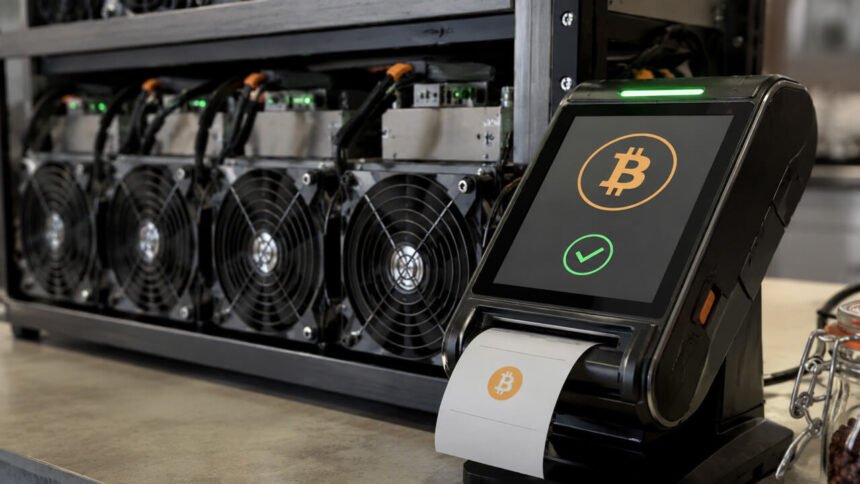
GoMining’s GoBTC Pay Bitcoin checkout system now has its biggest claim: a live integration surface for BTC payments that feels instantaneous as payments are routed through miners running on rails.
The company announced that its Gen1 SDK and API will be made public on June 19th, providing merchants and wallet providers with a path to Bitcoin checkout through miner-operated payment systems.
This design routes acceptance and settlement through GoMining’s mining infrastructure while maintaining BTC as the payment asset at the point of sale. The Lightning Network, wrapped BTC, sidechains, and forced fiat conversion are outside the path GoMining describes.
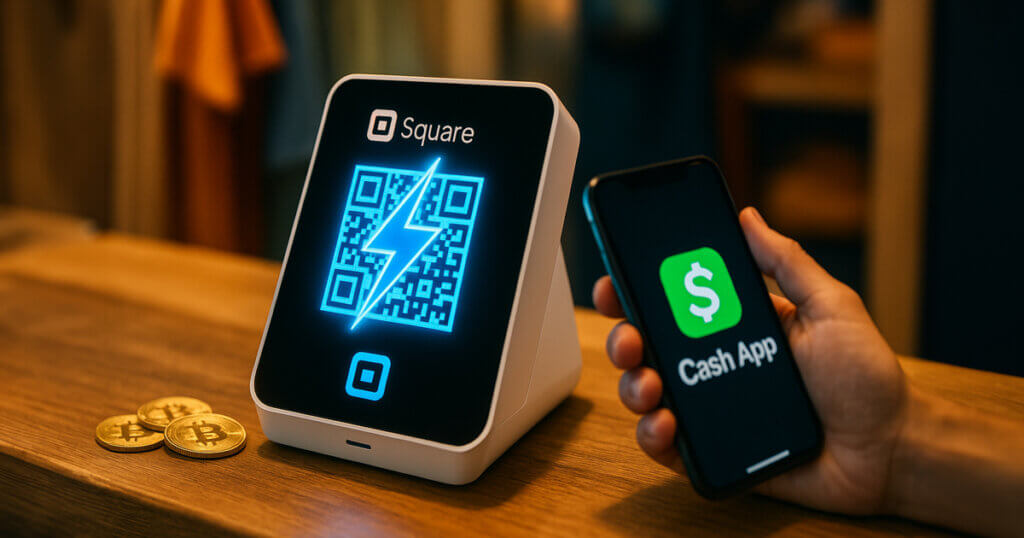
The tradeoff is focus. Merchants can get instant confirmation, users can spend their BTC without direct transaction fees, and wallet providers can connect to open APIs.
The first version asks participants to rely on payment rails, where the miners behind the product help control the route from checkout to final Bitcoin payment.
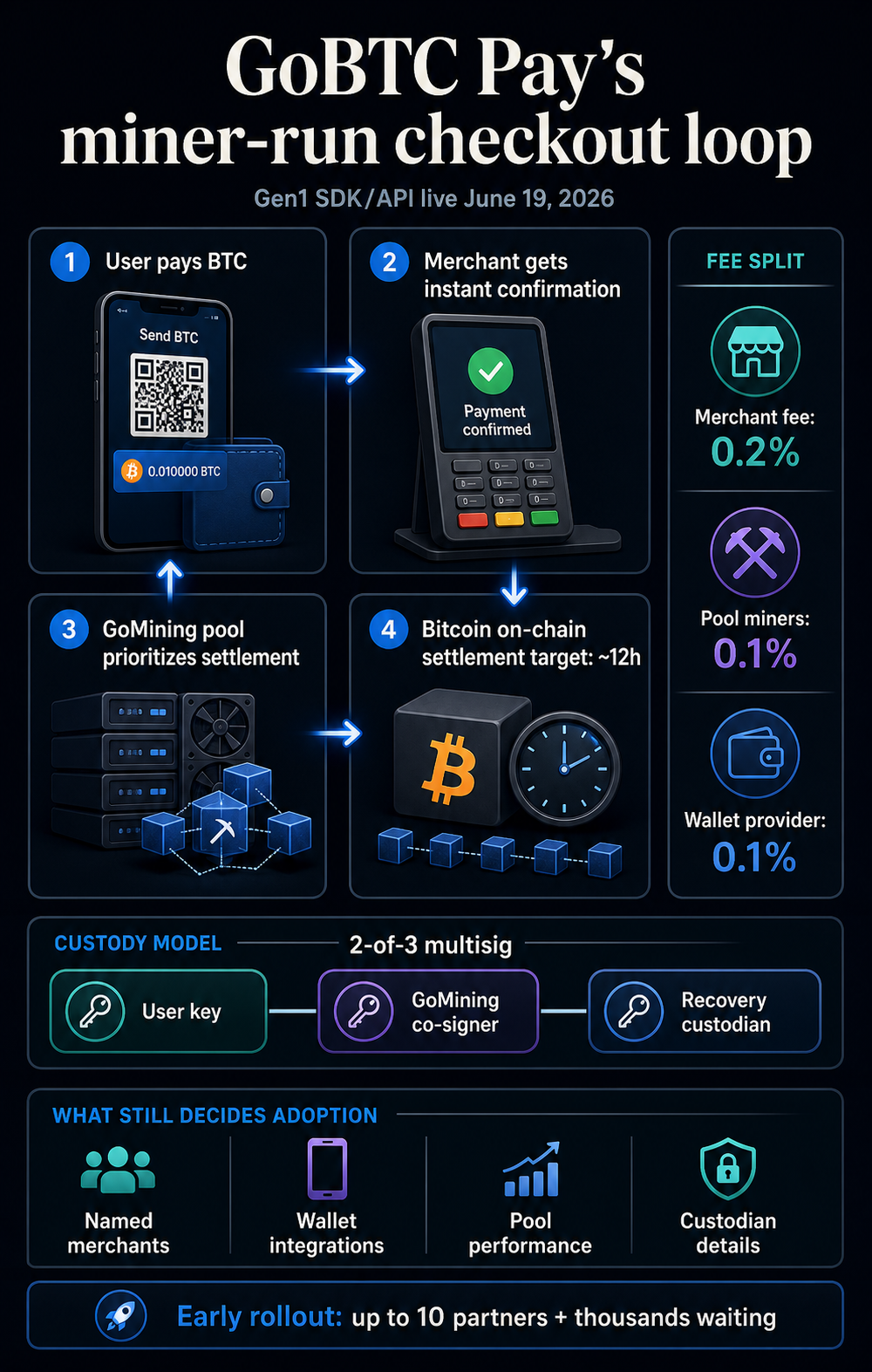
According to GoMining, the rollout will begin with up to 10 merchants and ecosystem partners, with thousands on the waiting list. As such, Gen1 will be an early controlled deployment built to measure whether miner-performed payments can attract wallets, merchants, and shoppers into the Bitcoin checkout loop.
GoBTC Pay Bitcoin checkout opens integration path
GoBTC Pay’s product page configures the system as a Bitcoin payment protocol for merchants and wallets, with opening early access, merchant onboarding forms, wallet and platform request flows, and access to API documentation.
The roadmap on the page shows a step-by-step path for spend management from merchant POS, dashboards, SDK support, merchant discovery, extensive e-commerce support, P2P payments, fiat off-ramp tools, and wallet functionality to open payments rails.
Developers, wallets, and merchants can now evaluate the GoBTC Pay SDK and API, as well as the product concept.
The product page states that payments are instantly confirmed at checkout and settled in Bitcoin, with zero direct fees to users and bypassing payment channels, wrapped tokens, sidechains, and fiat conversion at the point of sale.
The FAQ states that customer payments are broadcast to GoMining’s dedicated pool and prioritized for inclusion in blocks.
This setting creates a split experience. The seller immediately confirms the transaction and closes the sale. Final settlement will then follow Bitcoin, and GoBTC aims to have an average on-chain settlement time of approximately 12 hours through GoMining’s pool.
While final settlement remains tied to routes run by miners, merchant acceptance is felt immediately.
| GoBTC’s claim | mechanism | Disclosure still required |
|---|---|---|
| Confirm instant checkout | GoBTC routes transactions through GoMining’s payments and pool infrastructure. | How merchants assess the gap between checkout acceptance and final Bitcoin payment. |
| On-chain Bitcoin payment | Transactions are subject to settlement through GoMining’s dedicated pool. | Pool hashing power, block production variance, and actual performance depending on merchant volume. |
| Low merchant fees | GoBTC lists a 0.2% sales fee split between pool miners and starting wallet providers. | Whether wallet providers and merchants think the 0.1%/0.1% split is worth enough. |
| Non-storage design | GoBTC describes a 2-of-3 multisig model involving users, GoMining, and an independent recovery administrator. | Custodian identity, recovery process, and third-party wallet implementation details. |
The economics of Bitcoin checkout is built around miners and wallets
GoBTC’s pricing design is the clearest indication that GoMining is looking to solve payments through incentives as well as user experience. The company says users will not pay a direct transaction fee, but merchants will pay 0.2%.
For third-party transactions, GoMining states that half of the fees will be paid to the miners in the GoBTC pool, and the other half will be paid to the wallet provider that initiated the payment.
This fee split turns each transaction into a small distribution event. Miners receive a reason to support payments, and wallets receive a reason to draw users and merchants into the network.
GoMining says it doesn’t charge fees for third-party transactions and frames the model as a way to drive adoption, rather than locking all payments within its own app.
GoBTC also compares merchant claims to card payment costs and settlement terms. While this comparison should be limited to GoBTC, the broader merchant context is real. Visa’s 2024 Merchant Payments Release shows that exchange rates and POS flexibility remain major pressure points for card networks.
Recent Bitcoin payment coverage frames low-fee checkout as an adoption proposition for merchants.
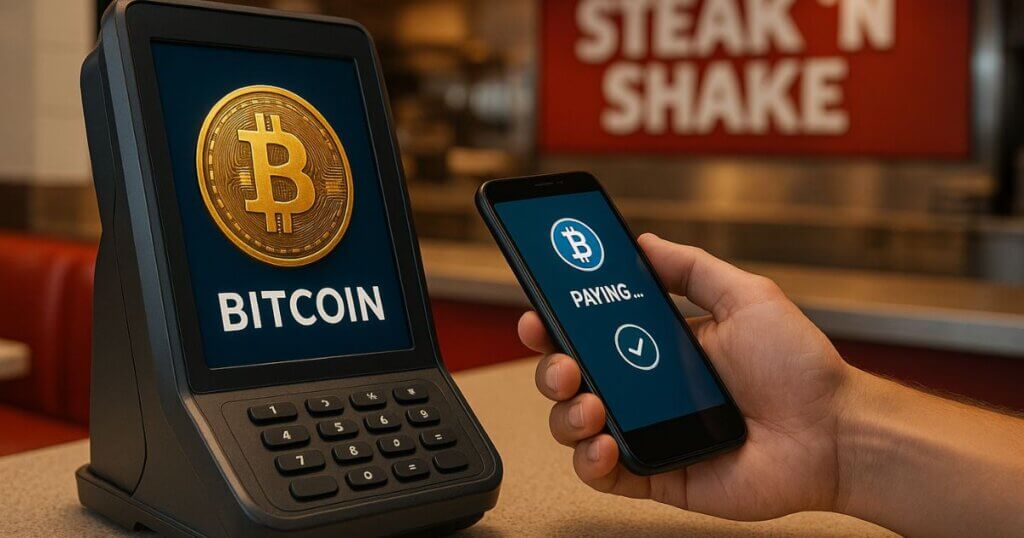
GoBTC is gaining attention for its acceptance of instant checkouts, BTC-denominated payments, and fee splits that reward the wallets and miners needed to make the system useful.
Adoption has not yet been proven. GoMining says the initial rollout will start with up to 10 merchants and ecosystem partners, but the company did not disclose the names of the initial participants.
There is a waiting list of thousands of people expressing interest. Merchant willingness to retain BTC from checkout sales, wallet provider integration priorities, and actual shopper spending will determine whether Rails progresses beyond early access.
Payment economics therefore becomes useful as a framework tool, rather than as evidence that rail already fits the product market.
While merchants may prefer 0.2% fees and fast checkout feedback, this model still requires actual checkout volume, wallet distribution, and BTC financial tolerance. These operational decisions will determine whether fee splitting makes sense.
Pool management involves settlement risk
The same design that makes GoBTC different also creates major operational risks. GoMining says that while most Bitcoin payment companies rely on external mining pools, it can prioritize GoBTC transactions because it mines its own blocks.
For sellers, that may be practical. Checkout feels fast and final payment is still done via Bitcoin.
For Bitcoin users, the architecture centralizes responsibility. Built around miner-operated pools, Payment Rail reduces certain frictions by focusing on GoMining’s pool operations, transaction prioritization, payment performance, and collection design.
Miner-operated payments are a central due diligence issue for wallets and merchants considering railroading.
The Stratum V2 mining protocol specification describes mining work that can be distributed by pools and coordinated with job declaration and template distribution mechanisms.
Bitcoin Optech’s pool mining background treats Stratum V2 as part of a broader architecture for coordinating miners. The impact of decentralization depends on the implementation, including who selects transactions, who controls block templates, and how much influence pool operators retain.
GoBTC Pay’s public page states that payments are routed through GoMining’s private or dedicated pool. This mechanism supports a simpler merchant experience while focusing due diligence on pool governance, trade selection, and settlement authority.
The custody model adds another layer. GoBTC describes a 2/3 multisig setup where one key resides with the user, one is held by GoMining as a co-signer, and one is held by an independent recovery administrator.
The company says GoMining cannot unilaterally transfer funds and that administrators will provide recovery measures if users lose access.
This model sits between the convenience of a custodial wallet and pure self-custody. The missing disclosures are practical, such as the identity of the custodian, the recovery process, implementation of third-party wallets, handling of outages, and how merchants will take into account approximately 12-hour settlement goals while accepting payments instantly.
These are integration details with operational implications. Merchants require predictable checkout confirmations, storage processes, collection procedures, and payment timing in their daily operations.
Wallets must have sufficient fee burdens and customer demand to justify routing users to payment flows tied to a single payment path operated by miners.
Wallet and merchant uptake will determine deployment
The launch of GoBTC Pay’s Gen1 gives us a path to Bitcoin payments built around direct BTC payments through GoMining’s pools. The protocol includes access to SDKs and APIs, merchant onboarding, requesting a wallet platform, and an early access funnel for an initial group of partners.
External participation is the main hurdle to implementation. Once external wallets are integrated, designated merchants are up and running, and payment performance is maintained through actual payment volumes, GoBTC Pay could be proof that mining infrastructure can play a direct role in Bitcoin commerce.
If adoption remains within GoMining’s own ecosystem, or if merchants are hesitant due to payment delays or reliance on pools, the product will look more like a miner-managed shortcut to get around Bitcoin’s old POS issues than a widely adopted payment rail.
The June 19th launch will make that tradeoff more concrete. It makes Bitcoin payments at checkout easier, but also adds new dependence on the miners who run the railways.
(Tag translation) Bitcoin


