

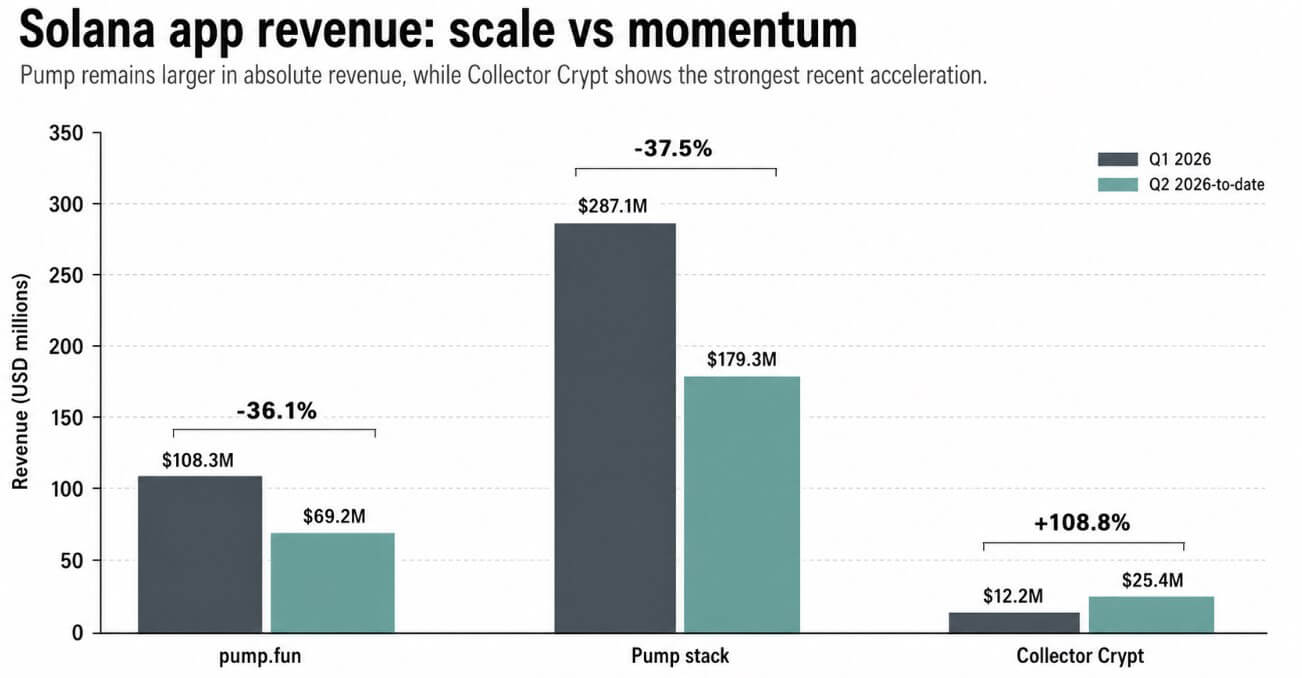
According to DefiLlama, Pump.fun generated total revenue of $108.3 million in the first quarter and $69.2 million in the second quarter to date, down 36.1% from the previous quarter’s pace.
The broader Pump stack, which includes PumpSwap, Terminal, and Pump.fun, had total protocol revenue of $179.3 million through the second quarter, 37.5% below the $287.1 million in the first quarter, while revenue fell from $120.9 million to $79.1 million over the same period.
The scale of Pump.fun ranks among the most profitable consumer applications ever built on Solana. Its cumulative revenue exceeds $1 billion, and the broader pump stack has generated $1.18 billion since launch.
Its bonding curve mechanism, which bootstraps initial liquidity for new token issuance and collects fees for trading, graduation, and Mayhem mode activities, still processes hundreds of millions of DEX volumes each month.
Quarter-on-quarter comparisons show a slowdown, with cumulative revenues and trading volumes reflecting one of crypto’s most productive consumer loops.
As Collector Crypt’s quarterly numbers move in the opposite direction, the earnings buzz around Solana has grown.
another curve
Collector Crypt is a Solana protocol built around tokenized physical trading cards. Users purchase randomized digital packs associated with authentic graded cards, trade the tokenized cards on-chain, and sell them back through the platform or redeem physical versions.
DefiLlama describes this as a protocol for selling RWA Pokemon cards on Solana, with revenue coming from gacha pack sales, marketplace fees, and royalties, minus gacha pack purchases.
Collector Crypt opened over 215,000 tokenized TCG packs in one week, with over $50 million in cumulative revenue, and over 30% of users redeemed their physical cards.
According to DefiLlama, Collector Crypt has generated $12.3 million in the first quarter and $25.8 million in the second quarter to date, an increase of 108.8%.
The 7-day revenue of $5.1 million represents about 38% of the 30-day total revenue of approximately $13.5 million, and the recent concentration is more pronounced than Pump.fun’s 22.8%.
Additionally, Collector Crypt’s cumulative DEX volume over the past 30 days accounts for 88.3% of approximately $123.5 million, while Pump.fun’s 1.4% reflects a protocol where measurable activity is recent and compressed upward rather than spanning years of cumulative issuance.
Collector Crypt’s 2026 revenue of $38.1 million represents approximately 21.5% of Pump.fun’s $177.5 million and 8.2% of the broader Pump stack’s $466.5 million.
The data shows that the protocol generates the strongest activity when large platforms slow down.
$ card as a proxy for market attention.
$ cardCollector Crypt’s tokens moved in parallel with the protocol’s revenue acceleration.
According to CoinGecko, the token is valued at approximately $0.259, up 47% in seven days, with a 24-hour trading volume of approximately $10.4 million, a market cap of approximately $66.83 million, and an all-time high of $0.38.
$ card Although it has become a liquid instrument used by traders to express their views on Collector Crypto Acceleration, token holders should not assume that they will earn revenue from its price action.
DefiLlama currently lists Collector Crypt holders’ earnings as zero and says tracking is disabled until the protocol’s buyback hub wallet receives official confirmation.
The broader tokenized trading card market provides context for why Collector Crypt’s activity curve is the way it is.
The top seven tokenized trading card platforms generated $230 million in gacha sales in May 2026, a 7x increase year over year, with Solana accounting for 64% of that sales.
This expansion demonstrates the specific aspects of Solana’s consumer app economy that can be monetized.
Pump.fun’s model relies on a speculative issuance loop. That means launching new tokens, trading on the bonding curve, graduating to the public market, and incurring fees at each stage.
Collector Crypt’s model relies on a different consumer loop than Pump.fun, based on recognizable physical collectibles, on-chain secondary transactions, and randomized pack openings tied to real-world redemptions.
Both loops generate fees, volumes, and token market activity, but have different user motivations and different definitions of what makes on-chain assets worth holding.
Where the numbers go next
If Collector Crypt maintains its current revenue pace and the broader tokenized trading card category continues to grow, the protocol will become a permanent fixture in Solana’s app revenue rankings.
$ card continues to serve as a liquid proxy for that acceleration, the demand for gacha packs continues to rise, and the 30-day revenue gap between Collector Crypt and Pump.fun further narrows.
If user demand is maintained, the 7x year-on-year growth in the broader TCG gacha category supports this trajectory.
If the demand for gacha wanes, $card As volumes decline and multiple jurisdictions apply loot box frameworks and scrutinize randomized pack mechanics, Collector Crypt’s recent barrage of activity becomes a liability rather than evidence of acceleration.
The protocol’s cumulative revenue base of $58.4 million is paltry compared to Pump.fun’s $1 billion, meaning a pullback in demand will soon appear on the weekly ratio that currently makes Collector Crypt’s trajectory easier to read.
Collector Crypt is built on the premise of users paying for, trading, and returning digital assets secured to physical objects that they recognize.
Q2 data shows that both this model and Pump.fun can generate real fees on the same chain at the same time, and that Solana’s consumer revenue base is wider than it was at the beginning of the year.


