


Bitcoin hit an intraday low of $58,189 on June 25th, but has rebounded towards $60,109 at the time of writing, even though the Federal Reserve’s recommended inflation indicators were broadly in line with expectations.
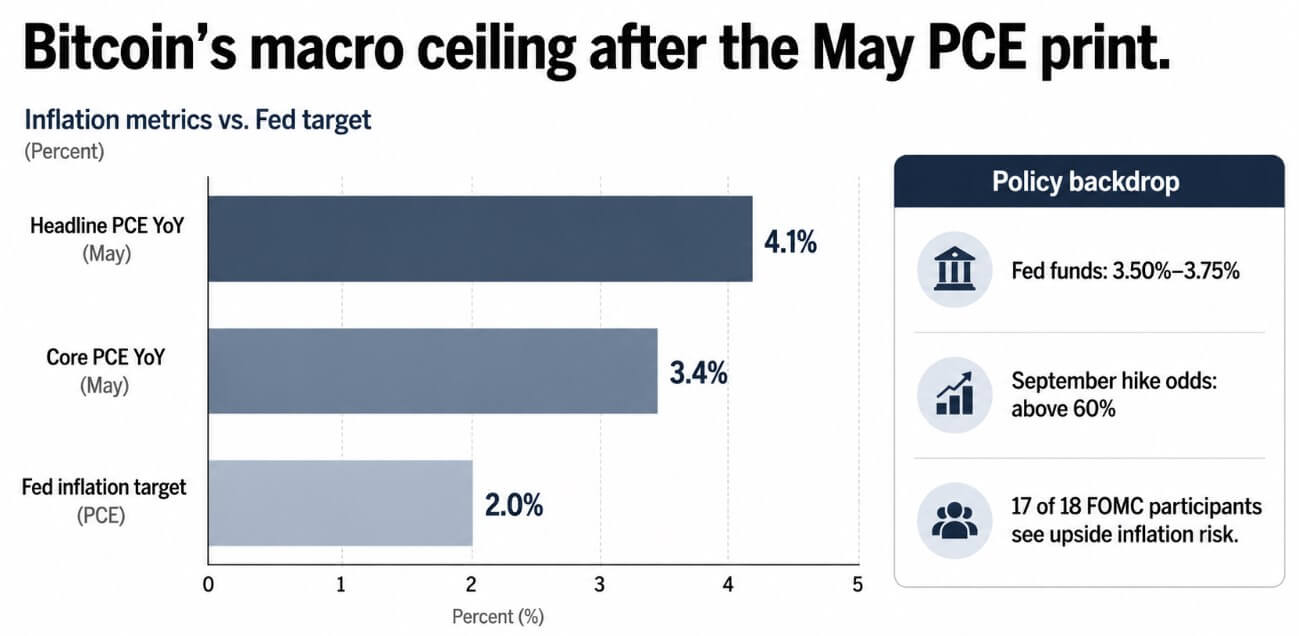
May PCE print headlines were up 4.1% year over year, core was up 3.4%, and monthly headlines were up 0.4% versus the expected 0.5%. This removed the immediate downside threat of an upward inflation shock and prevented BTC from making new bids.
Matt Mena, senior crypto research strategist at 21Shares, called the print release a “short breather.” Total PCE remains more than twice the Fed’s 2% target.
The June FOMC statement left interest rates unchanged at 3.50% to 3.75%, noting that 17 out of 18 participants judged inflation uncertainty to be higher than usual and risks to be weighted to the upside.
fed ceiling
Can Luca Koymen, investment strategist at Cygnum Bank, described the current policy environment as a “print version of the Fed,” saying core PCE drives decisions more than CPI, and Warsh has already suggested that forward guidance is no longer a policy tool.
Even after the June 25 statistics, the probability of a September interest rate hike remains above 60%, suggesting that market prices will remain hawkish toward the end of the year.
As the dollar strengthened again in recent weeks, Glassnode stated that the DXY movement was “not constructive” for BTC and the prevailing macro signals.
The gradual easing of the dollar on June 25th post-PCE was directly linked to Bitcoin’s partial recovery from $58,189 to the high $59,000s, highlighting how heavily Bitcoin currently trades as a liquidity-sensitive risk asset.
Alex Bloom, founder and CEO of Two Prime, said that while AI stocks account for most of the risk appetite, Bitcoin is “struggling both in terms of price and traction.”
U.S. semiconductor stocks rose about 170% year-over-year, while Bitcoin fell about 40% over the same period. With a hawkish Fed and the dominance of AI stocks, BTC is fighting for flows on two fronts simultaneously.
$58,000 Bitcoin Price Stress Test
Bulls were pointing to $59,000 to $62,000 as a zone anchored by the 200-week moving average and concentrated buying volume. Breaking through the lower end of that zone on June 25, Bitcoin rose to $58,189 before making a partial recovery.
A close decisively below $58,000 for multiple sessions makes PCE relief appear structurally irrelevant, and a convincing breakout of $60,000 would set $50,000 as the next psychological target.
The U.S.-traded Spot Bitcoin ETF recorded net outflows of $68.3 million on June 22, $113.8 million on June 23, and $469 million on June 24, for a total of approximately $651 million over the three sessions.
| stress point | data points | interpretation |
|---|---|---|
| Intraday BTC low price | $58,189 | Bitcoin has nearly lost its key $58,000 stress level |
| partial recovery | ~$59,542 | Relief restored, but no definitive $60,000 recovery |
| bull support zone | $59,000 – $62,000 | Previously considered a defensive area |
| Damage risk level | Closing price less than $58,000 | Would suggest PCE bailout failed to stabilize BTC |
| next bearish zone | $50,000 to $54,000 | Psychological/realized price downside area |
| ETF outflow, June 22nd | -$68.3 million | initial flow pressure |
| ETF outflow, June 23rd | -$113.8 million | accelerating outflow |
| ETF outflow, June 24th | -$469 million | surrender style flow day |
| 3 session ETF total | -$651.1 million | Confirm pressure beyond macro headlines |
| MSTR intraday low price | ~$85 | Strategic concerns still lie in the crypto-specific overhang |
| STRC preferred stock | ~$89 vs. $100 per | Funding channel pressure |
Strategy is compounding macro headwinds with crypto-specific funding issues, as MSTR fell to an intraday low near $85 on June 25 and has since traded around $87, the company’s STRC preferred stock has fallen to $89 below its $100 par value, and one of Strategy’s BTC funding channels has been shut down.
Blume said Strategy’s actions are “scaring the market,” with the price of Strategy’s preferred stock reaching nearly 80 cents on the dollar. He argued that while the concerns are emotional, STRC remains below par and MSTR remains below $90, neither of which has been resolved by PCE data.
Forced sale of exhaust itself
Glassnode’s cumulative trend score by wallet cohort reached its maximum value of 1 during the previous sell-off towards $60,000.
This means that large holders shifted from distribution to active accumulation in the last correction, with investors purchasing a net 259,298 BTC between $59,000 and $67,000 since June 5th.
As of early June, more than 10.5 million BTC had unrealized losses, exceeding the amount held as profits for the first time this quarter.
Mena points to the FTX collapses of March 2020 and 2022 as the closest historical parallels, both of which were preceded by significant recoveries that resulted in forced sales themselves.
Mr. Bloom made the same point from a different angle, arguing that the sell-off due to strategic concerns is “primarily emotional, but not a truly structural problem.”
Half of all holders have unrealized losses, giving Glassnode a score of 1, and their accumulation absorbs forced selling. Mena believes the recent sell-off in basis trades was unwound as CME premiums collapsed due to mechanical position closings among traders.
The bull market will require cooperation from oil and the Fed, as Brent crude oil prices were $73.74 and WTI crude oil prices were $70.34 on June 24, after about 20 million barrels left the Strait of Hormuz in 24 hours, lowering the energy component.
If this holds true for June and July inflation expectations, the Fed will be covered. Under Koymen’s base case, if the Hormuz River continues to improve, the Fed would hold two or three meetings over the next few months.
Fed policy maintenance, energy easing, and lower-than-expected consecutive readings of CPI and PCE will drag the dollar down, creating room for Bitcoin to regain $66,000 to $67,000. Clearing that level brings $70,000 to $75,000 into the conversation, followed by the $82,000 to $85,000 cap, which has been Bitcoin’s ceiling since February.
The bearish rationale rests on the incumbents. September rate hike odds are above 60%, ETF outflows continue, and the strategy’s STRC remains below par.
CEPR’s analysis of the Iran war shock estimates that even with a cautiously optimistic Hormuz conflict scenario, U.S. headline inflation could rise by 0.6 percentage points and core inflation by 0.2 percentage points in 2026, potentially pushing the Fed’s 2026 projections further above target.
If the outflow continues and the dollar rises again, and BTC loses $58,000 on a closing price basis, the $50,000 to $54,000 band will be the next zone to watch.
| scenario | trigger | BTC levels to watch | macro read | Article excerpt |
|---|---|---|---|---|
| bull case | Oil bailout maintained, inflation slowed in June and July, ETF outflows reversed | Get back $66,000-$67,000 | Fed gets room to hold | Forced sales may dry up |
| expansion case | BTC clears $67,000 and then $70,000-75,000 | Upper limit $82,000-$85,000 | Pressure on the dollar and interest rates eases | Rise resumes, but remains macro dependent |
| basic case | BTC holds $58,000-60,000, $67,000 uncollected | $59,000 – $62,000 | PCE Relief Stabilizes, Does Not Relieve | Sideways weak liquidity trading |
| bear case | BTC loses $58,000 based on closing price, ETF outflows continue, dollar companies | $50,000 to $54,000 | Fed cap overwhelms sense of relief | PCE was not enough |
| inflation shock event | Holmes/oil shock affects CPI/PCE | Risk less than $50,000 | The Fed becomes even more hawkish | Macro tail risks rise again |
Next Bitcoin price change
Whether the oil bailout leads to softer inflation numbers in June and July will determine how much room the Fed holds and how much room Bitcoin has to regain $66,000.
If ETF outflows reverse as macro fears fade, the bulls’ case for forced selling will become self-reinforcing. If spills continue despite benign PCE prints, the data supports structural risk aversion.
The $59,000-$62,000 zone is holding at the thinnest of margins, and a return to $60,000 on a closing price basis due to improved ETF flows would confirm that the June 25th macro reprieve has turned into a durable one.
Failure to do so will ensure that ETF outflows and the Fed cap will determine the next leg.
(Tag translation) Bitcoin


