


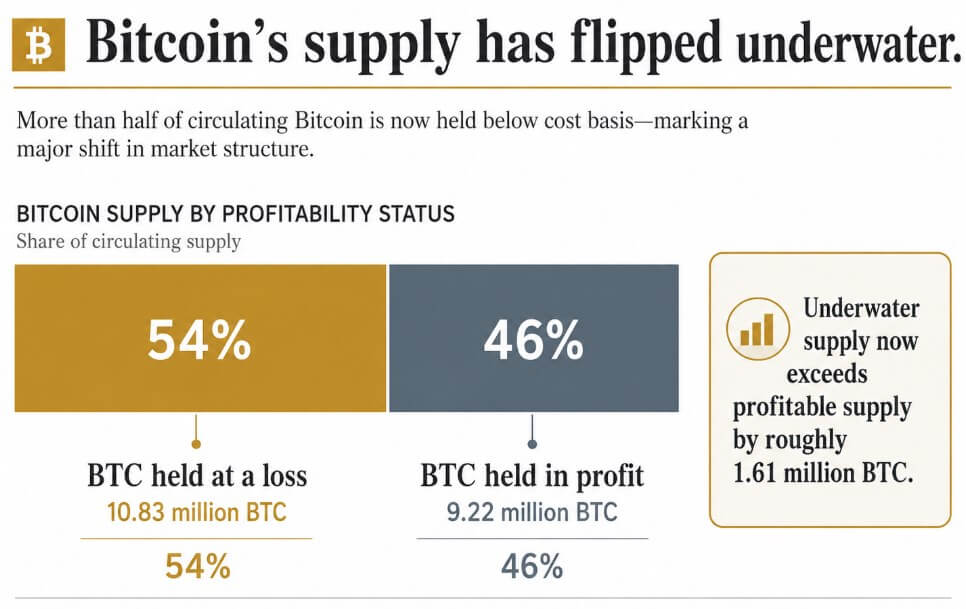
According to Glassnode’s latest Week Onchain report, about 10.83 million BTC are currently in the red, while 9.22 million BTC are still in profit.
Currently, deficit supply accounts for approximately 54% of the total measured supply, and 46% is still profitable. This means that underwater coins outperform profitable coins by approximately 1.61 million BTC.
Glassnode describes this as one of the sharpest deteriorations in investor profitability since the current bull market began, and a threshold that actually carries psychological weight.
When it was exceeded previously, there was a real capitulation among new buyers, which became the kind of stress that formed a structural drawdown.
Submerged holders are most likely to sell in a panic when prices recover or exit near break-even, thus creating a layer of resistance above the market.
However, if patient capital is willing to absorb it, those same coins can migrate to more high-conviction buyers, and Glassnode’s data shows just that kind of buyers starting to emerge.
According to Glassnode, long-term holders have started to rebuild their positions, a reversal from the long-term distribution, and net position change is back in positive territory.
The pace remains moderate and nowhere near the buying waves seen in previous accumulation cycles, but the direction is changing. The first signs of a bottom often appear here, when experienced holders decide it’s worth buying a drawdown, long before the price itself confirms anything.
Glassnode’s cumulative trend score increased across multiple cohorts this week, with the strongest readings among wallets holding less than 1 BTC and entities holding 100-1,000 BTC.
Wallets in the 1,000 to 10,000 BTC range also turned buyers. Bitcoin’s silent bid is spread across the ownership ladder, from the smallest wallets to mid-sized companies.
The US-traded Spot Bitcoin ETF remains in net outflow territory, and its selling pressure continues despite on-chain confidence increasing to the contrary. The ETF story explains why prices are depressed, and the on-chain story explains who will be on the other side.
| market layer | current signal | what it means | Meaning of the article |
|---|---|---|---|
| ETF investors | sustained net outflow | Regulated wrapper risk still reduced | Explain why prices continue to fall |
| long term holder | Net position change has returned to positive territory | Experienced holders are rebuilding exposure | Suggests supplies are shifting into patients’ hands |
| small wallet | Strong accumulation between wallets of less than 1 BTC | Retail size holders are buying drawdowns | This bid is not just institutional or whale-driven |
| medium sized company | Strong buying seen between 100 and 1,000 BTC entities | Larger on-chain holders are also absorbing supply | Accumulation is expanding across cohorts |
| big wallet | 1,000-10,000 BTC wallets become pure buyers | Major holders no longer just distribute | Verify that your seller profile has been modified |
| spot order book | Coinbase and Binance move to bidding | Buyers are below physical liquidity | A base may form even if prices look weak |
Both Coinbase and Binance are showing that buyers are adding below-spot liquidity and the books are shifting toward bidding. This bid looks patient, so even if fundamentals start to form underneath, price could still look weak.
Hyperliquid traders are using leveraged exposure to hold a long bias at the highest levels tracked by Glassnode and bet on bounces before spot conviction is fully confirmed.
The cash market is trying to find a bottom, but the derivatives market is trying to get there first.
Option traders have already paid for protection, with the 14-day put-to-call volume ratio above 1.0, the highest in a year. Implied volatility is also rising from subdued levels, but Glassnode is not calling this a panic.
The market has enough fear to start bottoming out, but the fear needed to confirm a complete capitulation may still be high.
In summary, this pattern seems unusual for a bottoming process, and Bitcoin may be finding its bottom through an unusual mechanism. While ETF investors are selling, stronger, more patient hands are absorbing exits in real time.
Glassnode frames this as an early, still-developing bottoming process and warns that a spike in volatility from an eventual capitulation remains possible.
Buying by long-term holders is also well below the scale of previous accumulation waves, leaving the accumulation recovery fragile.
Bitcoin could conceivably bottom out even without ETF inflows returning, as long as outflows slow enough to stop overwhelming on-chain accumulation and price strength gradually unwinds hyperliquid’s crowded long positions.
| scenario | what happens next | confirmation signal | what it means |
|---|---|---|---|
| Bull case: controlled transition | ETF outflows slow, while long-term holders and wallet cohorts continue to accumulate | Order books with high bids absorb underwater supplies. Hyperliquid long is resolved through bounce | Transfer phase bottoms out |
| Base case: fragile bottom | Accumulation continues, but rises are being held back by ETF outflows and underground supply | BTC chops sideways as loss supply stops expanding | Bitcoin builds foundation but recovery remains uneven |
| The Bear Incident: The Final Surrender | Crowded HyperLiquid longs are flushed as ETF outflows continue | Implied volatility spikes and hidden holders surrender to decline | Supply will still shift into stronger hands, but through a more rapid washout |
| Failure example: Accumulation fades | Long-term holder purchases slow, cohort accumulation shrinks | Order books with many bids will disappear. ETF outflows continue to dominate | The market was not at the bottom, but paused amid a broader drawdown |

how this will turn out
In the bullish case, ETF outflows continue, but at a slower pace, as long-term holders and a broader wallet cohort continue to accumulate over the summer.
The highly bid order book continues to absorb supply from new underwater holders, and aggressive hyperliquid long positioning is resolved through genuine bounces.
The Bitcoin correction will be a controlled transition from ETF sellers and short-term holders to the hands of patient on-chain capital, and the transfer phase will be the bottom.
In the bearish case, the crowded long positions in Hyperliquid are flushed out, the ETF continues to drain, and underwater holders capitulate at lower prices.
Implied volatility spikes towards true panic levels, and long-term holders’ accumulation slows as the drawdown deepens. Bitcoin will still end up in stronger hands, but it will go through a final capitulation event.
Bitcoin’s next bottom could begin in an unusual sequence: institutions retreat, weak holders capitulate, and stronger forces quietly occupy the other side. The bottom starts with the turnover of who owns the supply long before it shows up in the price.
(Tag translation) Bitcoin


